📊 Full opportunity report: Trade and supply-chain operations signal monitor: Federal judge blocks Trump effort to make voters show proof of citizenship on IdeaNavigator AI — validation score, market gap, and execution plan.

Get hardware and tech essentials delivered free with Prime
- Fast, free delivery on millions of items
- Prime Video, Amazon Music and more included
- Member-only deals all year
TL;DR
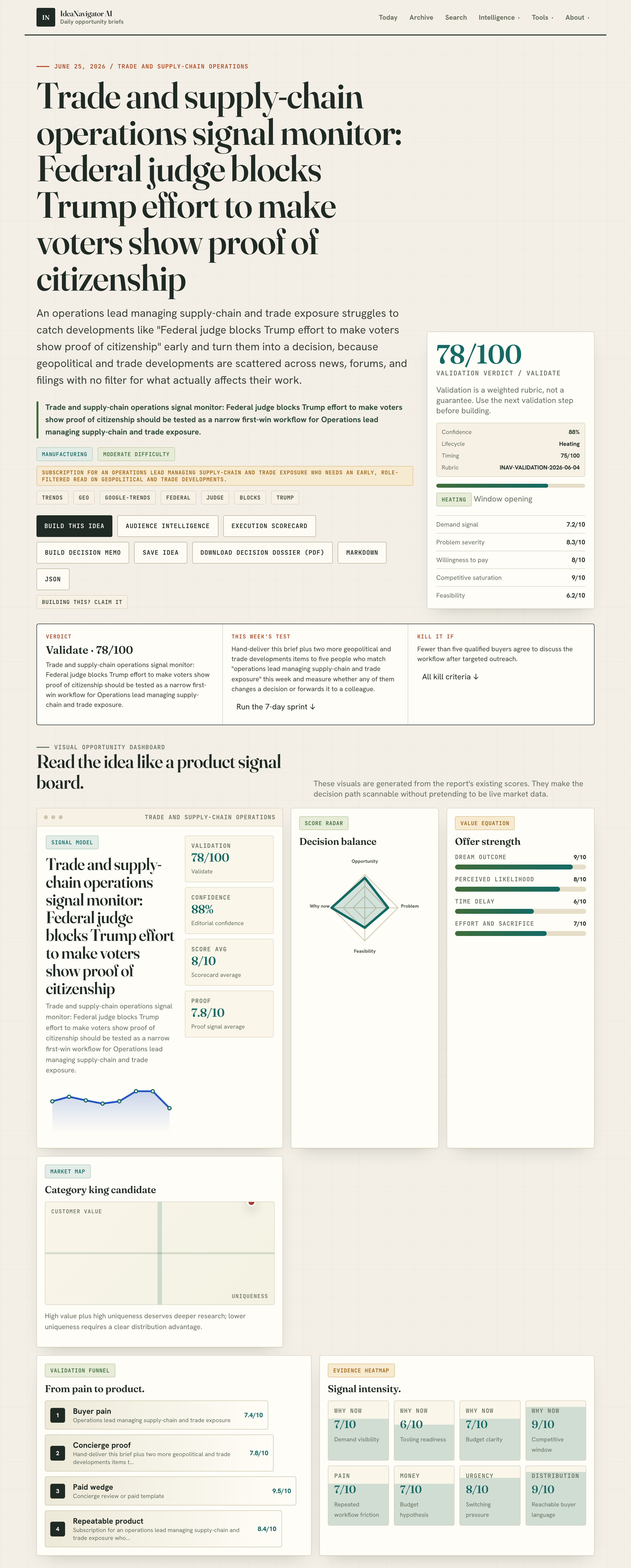
A federal court has blocked a Trump administration effort to require voters to prove citizenship. This legal development affects trade and supply-chain operations monitoring, highlighting the need for role-specific, real-time geopolitical alerts.
A federal judge has blocked former President Trump’s effort to implement a policy requiring voters to show proof of citizenship, marking a significant legal setback for the initiative. This development is relevant for operations managers overseeing trade and supply-chain activities, as it exemplifies how legal and geopolitical shifts can impact business decision-making in real time.
The court ruling, issued in March 2024, prevents the enforcement of a Trump-era plan to require proof of citizenship at polling stations. The decision was made by a federal judge who found that the policy likely violated federal voting rights laws. This legal action follows ongoing disputes over election integrity and voter identification measures.
Trade and supply-chain operations managers often struggle to stay ahead of such developments because information is scattered across various news outlets, forums, and legal filings, with no dedicated filter for their specific role. The recent court ruling underscores the need for targeted, real-time monitoring tools that can quickly translate geopolitical and legal news into actionable insights for supply-chain decision-making.
Impact of Legal Decisions on Trade and Supply Chains
This ruling exemplifies how legal and political developments can influence international trade policies and supply-chain stability. For operations leaders, understanding such legal shifts is critical, as they can affect import/export regulations, border policies, and international trade agreements, all of which directly impact supply-chain planning and risk management.
real-time geopolitical alert software
As an affiliate, we earn on qualifying purchases.
As an affiliate, we earn on qualifying purchases.
Legal Battles and Their Effect on Trade Policy
The effort to require proof of citizenship at polling stations was part of broader debates over voting rights and election security during the Trump administration. While the policy was challenged in courts, similar legal disputes over trade and border policies have historically affected supply-chain operations, especially in times of political uncertainty. The recent court decision adds to a pattern where legal rulings can swiftly alter the operational landscape for businesses managing international trade.
supply chain risk monitoring tools
As an affiliate, we earn on qualifying purchases.
As an affiliate, we earn on qualifying purchases.
Unclear Long-Term Impact on Trade Policies
It is not yet clear how this legal decision will influence future policies related to trade, border security, or international agreements. The ruling may prompt further legal challenges or policy adjustments, but the specific effects on supply-chain operations remain to be seen.
trade compliance monitoring system
As an affiliate, we earn on qualifying purchases.
As an affiliate, we earn on qualifying purchases.
Next Steps for Legal and Trade Policy Developments
Legal challenges to the court’s decision are likely, and policymakers may respond with new or revised regulations. Operations managers should monitor ongoing legal proceedings and policy changes to adapt their supply-chain strategies accordingly. Additionally, developing role-specific, real-time monitoring tools for geopolitical and legal updates could mitigate risks from such developments.
As an affiliate, we earn on qualifying purchases.
Key Questions
How does this court ruling affect international trade?
The ruling itself primarily impacts voting laws, but it exemplifies how legal decisions can influence border policies and trade regulations, which in turn affect supply-chain operations.
Why is this relevant for supply-chain managers now?
Legal and political developments can rapidly alter trade policies, import/export rules, and border security, all of which are critical factors for supply-chain planning and risk management.
Will this legal decision have long-term effects?
The long-term impact is uncertain; future legal challenges and policy responses could shape trade regulations and border policies, but specific effects on supply chains are still developing.
What should operations leaders do in response?
They should implement role-specific, real-time geopolitical and legal monitoring tools to quickly assess and respond to relevant developments, minimizing operational disruptions.
Are there similar legal threats to trade policies currently?
Yes, ongoing legal disputes and political debates continue to influence trade and border policies, which can impact supply-chain stability and international commerce.
Source: IdeaNavigator AI
Halloween Picks
halloween
As an affiliate, we earn on qualifying purchases.