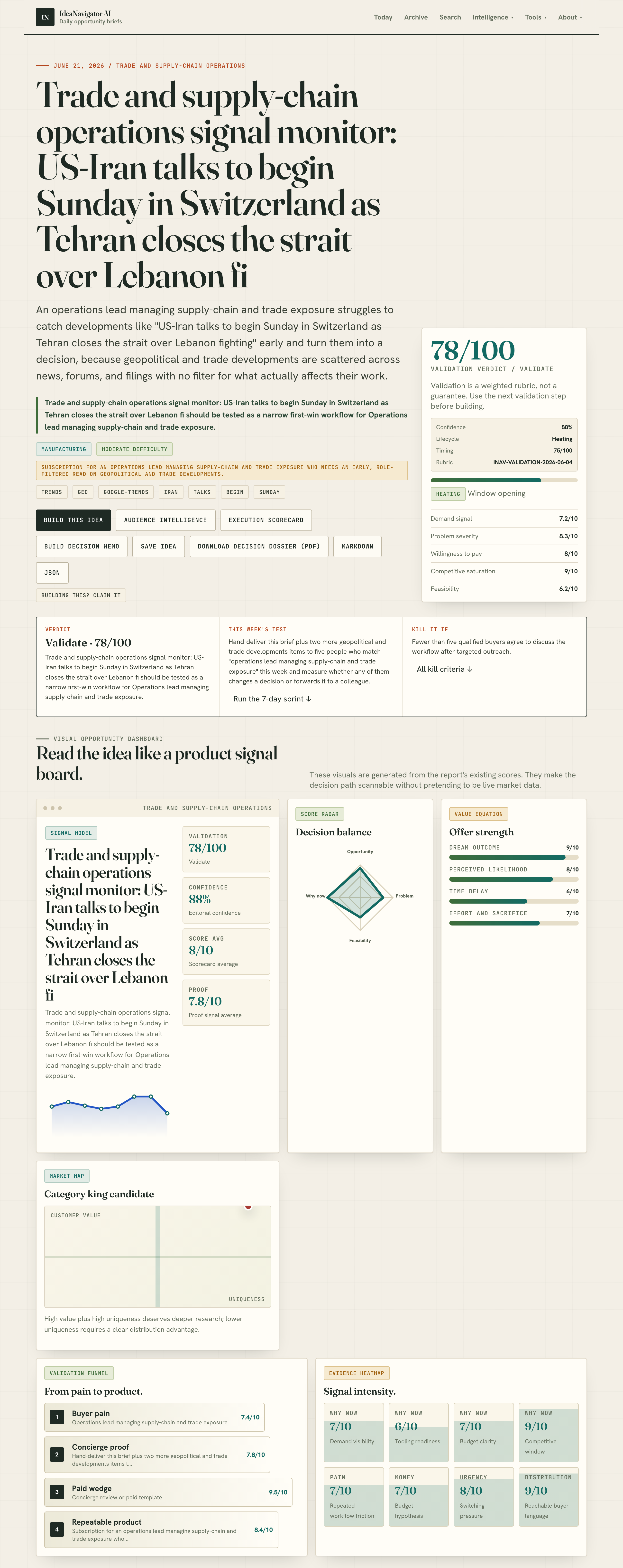
📊 Full opportunity report: Trade and supply-chain operations signal monitor: US-Iran talks to begin Sunday in Switzerland as Tehran closes the strait over Lebanon fi on IdeaNavigator AI — validation score, market gap, and execution plan.

Get hardware and tech essentials delivered free with Prime
- Fast, free delivery on millions of items
- Prime Video, Amazon Music and more included
- Member-only deals all year
TL;DR
U.S. and Iran are scheduled to hold talks in Switzerland starting Sunday. Meanwhile, Tehran has closed the Strait of Hormuz over Lebanon, raising concerns about supply-chain disruptions. This development is critical for trade operations managing geopolitical risks.
U.S. and Iranian officials are scheduled to begin talks in Switzerland on Sunday, marking a potential step toward easing long-standing tensions. Meanwhile, Iran has closed the Strait of Hormuz over Lebanon, a move that could significantly disrupt international shipping and supply chains. This convergence of diplomatic negotiations and geopolitical actions is of high importance to global trade operations managing supply-chain exposure.
According to sources familiar with the situation, the U.S. and Iran will hold diplomatic discussions in Switzerland starting this Sunday. The talks are part of ongoing efforts to address nuclear concerns and regional conflicts. Concurrently, Iran has announced the closure of the Strait of Hormuz, citing tensions over Lebanon as a reason. The Strait is a critical chokepoint for global oil and shipping routes, and its closure could threaten supply chains worldwide.
Trade and supply-chain operations are closely monitoring these developments, as disruptions at the Strait of Hormuz could lead to delays, increased costs, and logistical challenges. Industry sources indicate that the timing of the talks and the closure’s duration remain uncertain, but the potential impact underscores the need for role-specific intelligence to inform decision-making.
Implications for Global Supply Chains During Diplomatic Tensions
This situation underscores the vulnerability of global trade routes to geopolitical conflicts. The upcoming talks could influence Iran’s decision to reopen the Strait of Hormuz, but the current closure already raises risks of supply disruptions, especially for energy markets. For operations managers, understanding these developments is vital to mitigate potential delays and costs, and to adjust logistics strategies accordingly.
supply chain disruption monitoring tools
As an affiliate, we earn on qualifying purchases.
As an affiliate, we earn on qualifying purchases.
Recent Escalations in US-Iran Relations and Strategic Straits Closures
Relations between the U.S. and Iran have been tense over recent years, with periodic negotiations over nuclear programs and regional influence. The Strait of Hormuz, a vital passage for about 20% of the world’s oil trade, has seen closures and threats in the past, often tied to regional conflicts. The current closure over Lebanon is an escalation, raising concerns about broader instability and supply-chain risks. Diplomatic efforts have historically fluctuated, with recent talks in Switzerland representing a potential shift toward dialogue.
“The upcoming talks in Switzerland are a critical step toward de-escalation, but the situation at the Strait of Hormuz remains fluid.”
— an anonymous government official
geopolitical risk management software
As an affiliate, we earn on qualifying purchases.
As an affiliate, we earn on qualifying purchases.
Unclear Duration and Impact of Strait Closure
It remains unclear how long Iran will keep the Strait of Hormuz closed and whether the talks will lead to a resolution that reopens the passage. The potential for escalation or de-escalation is still developing, and the actual impact on global trade depends on diplomatic outcomes and Iran’s subsequent actions.
As an affiliate, we earn on qualifying purchases.
Next Steps in Diplomatic and Supply-Chain Responses
The talks in Switzerland are scheduled to begin this Sunday, with ongoing negotiations expected to continue over the coming days. Supply-chain managers are advised to monitor updates closely, prepare contingency plans, and assess exposure to energy and maritime risks. Industry sources will be watching for signs of a resolution or further escalation that could influence shipping routes and costs.
As an affiliate, we earn on qualifying purchases.
Key Questions
What is the significance of the US-Iran talks starting in Switzerland?
The talks could lead to a de-escalation of tensions, potentially reopening critical shipping routes like the Strait of Hormuz. Their outcome will influence regional stability and global trade flows, especially energy supplies.
How does the closure of the Strait of Hormuz affect global supply chains?
The Strait is a key chokepoint for oil and shipping; its closure can cause delays, increased transportation costs, and supply disruptions across multiple sectors, particularly energy and logistics.
What are the risks if the Strait remains closed?
Prolonged closure could lead to significant supply chain disruptions, higher fuel prices, and increased logistical complexity for international trade, especially for companies relying on maritime routes.
When might the Strait of Hormuz reopen?
This depends on the outcome of diplomatic negotiations and Iran’s subsequent decisions. It is currently uncertain and subject to ongoing developments.
What should supply-chain operations do now?
Operators should monitor geopolitical updates closely, consider contingency plans for energy and shipping disruptions, and stay informed about diplomatic progress and potential escalations.
Source: IdeaNavigator AI
Fall Picks
fall essentials
As an affiliate, we earn on qualifying purchases.