
📊 Full opportunity report: Ensure Optimal Data Center Operations With Rack Deployment Monitoring on IdeaNavigator AI — validation score, market gap, and execution plan.

Get hardware and tech essentials delivered free with Prime
- Fast, free delivery on millions of items
- Prime Video, Amazon Music and more included
- Member-only deals all year
TL;DR
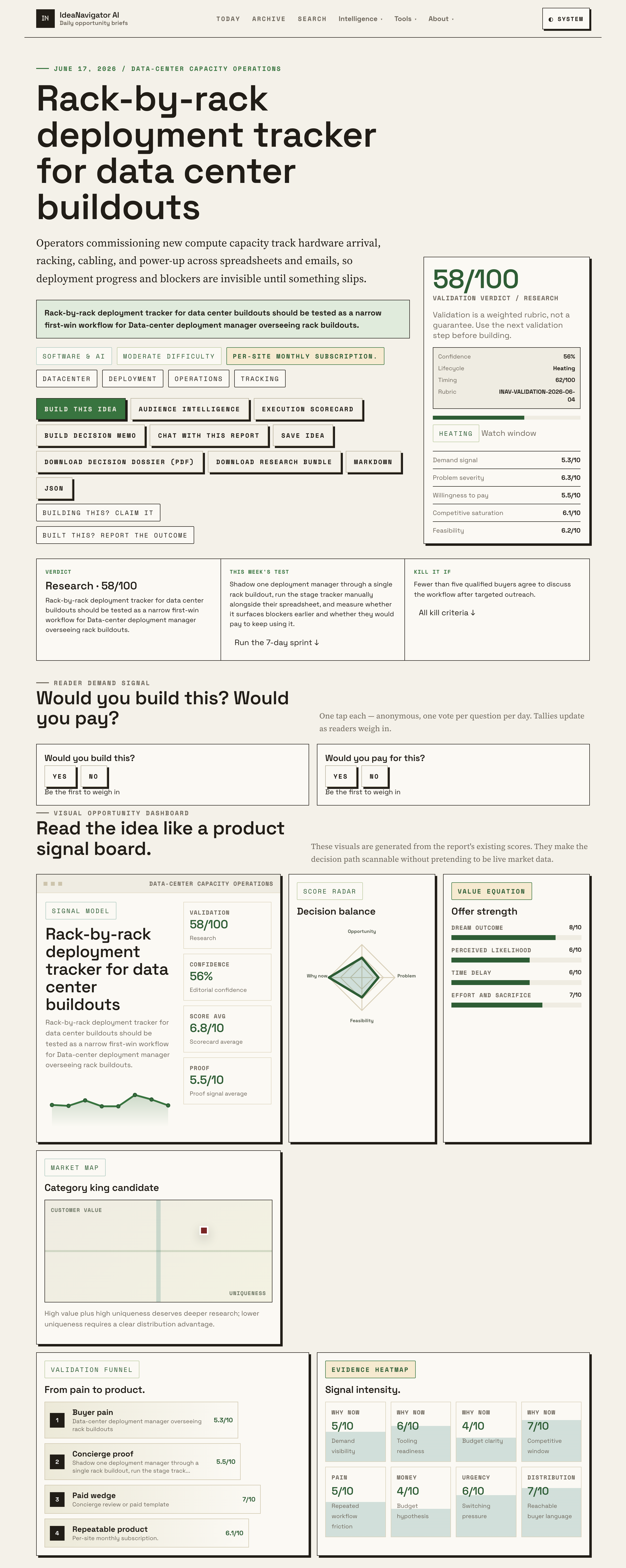
A proposed rack deployment monitoring tool for data centers is entering pilot testing. It aims to improve visibility into buildout progress and detect issues earlier, addressing a critical need amid record expansion driven by AI demand.
A new rack-by-rack deployment tracker for data center buildouts is being tested as a streamlined workflow tool for deployment managers. This development addresses the challenge of tracking hardware arrival, racking, cabling, and powering across complex projects, which often rely on spreadsheets and emails. The tracker aims to provide real-time visibility into buildout progress and identify blockers early, a critical need as record data center expansions accelerate due to rising AI demand.
The proposed Minimum Viable Product (MVP) is a simple deployment board where a manager logs each rack through fixed stages: delivered, racked, cabled, powered, and validated. This allows for a live percent-complete view and highlights stalled racks, facilitating proactive management. The initiative is currently in a testing phase, where a deployment manager will shadow the process, running the tracker manually alongside existing spreadsheets to assess whether it surfaces issues sooner and if operators are willing to subscribe on a per-site basis.
According to sources familiar with the project, the tracker is designed to be easy to implement, requiring minimal setup, and aims to address a significant pain point in data center capacity operations. The goal is to validate whether this tool can improve deployment efficiency and reduce delays, especially as data centers are deploying thousands of GPUs per site on compressed timelines.
Potential Impact on Data Center Deployment Efficiency
If successful, this rack deployment tracker could significantly enhance operational visibility for data center managers, reducing delays and preventing blockers from going unnoticed until they cause issues. As AI-driven demand pushes for faster buildouts, such a tool could become essential for maintaining schedules and controlling costs. The subscription-based model offers a scalable solution for operators seeking to optimize capacity expansion without extensive new infrastructure investments.
data center rack deployment monitoring tool
As an affiliate, we earn on qualifying purchases.
As an affiliate, we earn on qualifying purchases.
Growing Data Center Expansion Driven by AI Demand
Data center operators are experiencing record buildout activity, driven by the surge in AI and high-performance computing applications. This rapid expansion requires managing thousands of racks across multiple sites, often under tight timelines. Currently, most operators rely on manual methods such as spreadsheets and emails, which can obscure progress and delay issue detection. The development of purpose-built deployment tracking tools aims to address these inefficiencies, aligning with industry trends toward automation and real-time monitoring.
“A simple, live deployment tracker could help operators spot stalled racks earlier and keep buildouts on schedule.”
— an anonymous researcher
As an affiliate, we earn on qualifying purchases.
Unclear Aspects of Adoption and Effectiveness
It is not yet confirmed how quickly deployment managers will adopt the new tracker or whether it will demonstrably reduce delays in practice. The effectiveness of the manual shadowing process as a validation step remains to be seen, and there is uncertainty about the willingness of operators to pay for a per-site subscription model. Further testing results are needed to confirm whether this approach can scale across diverse data center environments.
data center hardware deployment tracker
As an affiliate, we earn on qualifying purchases.
As an affiliate, we earn on qualifying purchases.
Next Steps in Validation and Rollout
The next phase involves shadowing a single deployment manager through a full rack buildout, comparing manual tracking with the new tool to measure early issue detection. If results are positive, developers plan to refine the tracker based on user feedback and prepare for broader testing. Successful validation could lead to a wider rollout and potential market adoption, especially as data center capacity expansion continues to accelerate.
As an affiliate, we earn on qualifying purchases.
Key Questions
How does the rack deployment tracker work?
The tracker logs each rack through predefined stages—delivered, racked, cabled, powered, validated—and provides a live percentage of completion, highlighting stalled racks to facilitate proactive management.
Who would use this deployment tracker?
Data center deployment managers overseeing rack buildouts are the primary users. The tool is designed to complement existing manual tracking methods and improve visibility.
What are the benefits of using this tracker?
It aims to surface blockers earlier, reduce delays, and improve overall buildout efficiency during rapid expansion phases driven by AI demand.
Is this solution ready for widespread deployment?
It is currently in a testing phase with initial validation underway. Broader deployment will depend on the outcomes of pilot testing and user feedback.
How much will this tracking service cost?
The proposed business model is a per-site monthly subscription, but pricing details are still under development.
Source: IdeaNavigator AI
Halloween Picks
halloween
As an affiliate, we earn on qualifying purchases.