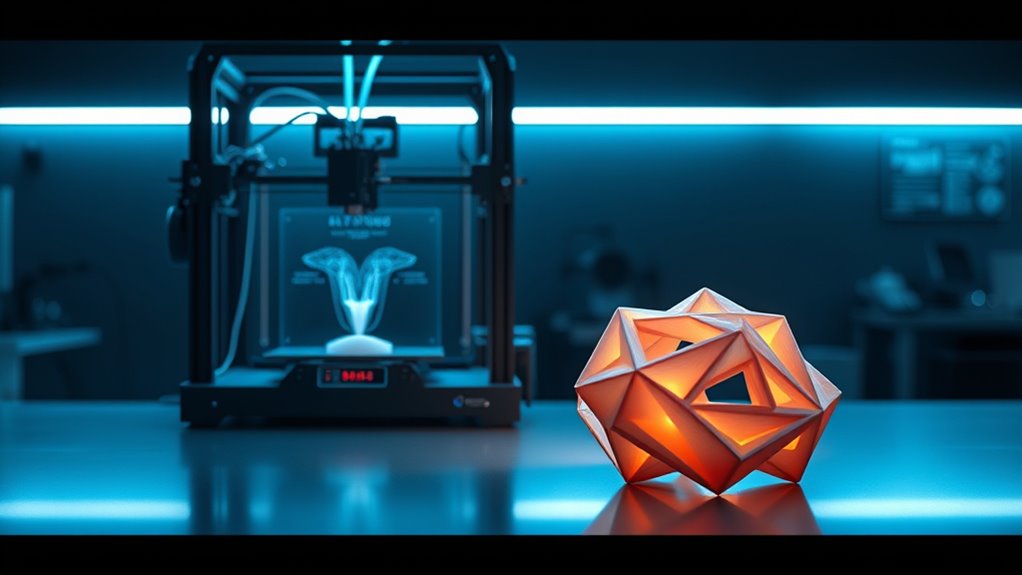

AI is revolutionizing 3D printing by making designs smarter, faster, and more precise. It automates complex workflows like model creation, slicing, and quality checks, helping you save time and reduce errors. Real-time monitoring detects issues instantly, ensuring high-quality results. Robotics and hybrid manufacturing streamline production, while AI-driven customization opens new creative possibilities. As these technologies evolve, you’ll discover even more ways AI guides the future of advanced, efficient 3D printing.

Get hardware and tech essentials delivered free with Prime
- Fast, free delivery on millions of items
- Prime Video, Amazon Music and more included
- Member-only deals all year
Key Takeaways
- AI automates complex design generation, enhancing creativity and reducing time-to-production in 3D printing.
- Real-time AI monitoring optimizes printing processes, ensuring higher precision and fewer errors.
- Workflow automation democratizes 3D printing, making advanced manufacturing accessible to more industries.
- Integration of robotics with AI enables seamless hybrid manufacturing and improves efficiency.
- AI-driven applications in healthcare and aerospace demonstrate transformative impacts on precision and innovation.
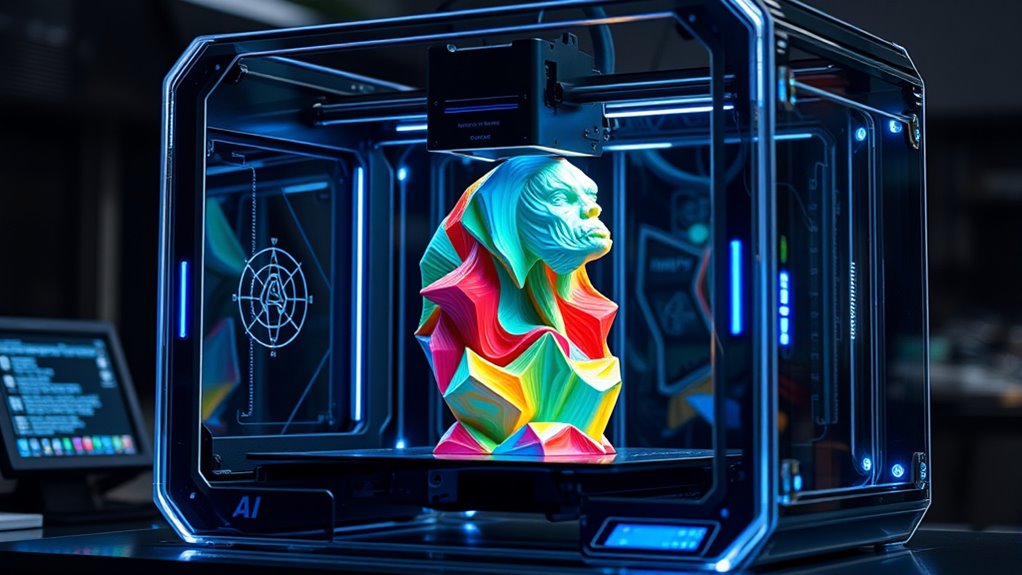
The evolution of 3D printing is accelerating thanks to advancements in AI technology. You now have access to smarter, faster, and more dependable manufacturing processes that push the boundaries of what’s possible. Generative AI, for example, automates the creation and enhancement of 3D models from basic parameters. Instead of spending hours on manual design work, you can input simple guidelines, and AI will generate complex, refined models ready for printing. This not only saves time but also enhances precision, enabling you to produce intricate parts with less effort. Meanwhile, AI-powered slicing software dynamically adjusts layer thickness and printing parameters during the process. It guarantees ideal material use and structural strength by responding in real-time to the model’s needs, reducing waste and improving overall quality. AI-driven process monitoring analyzes sensor data during printing to detect anomalies instantly. Predictive algorithms analyze your 3D models before printing even begins, highlighting potential errors and suggesting adjustments to avoid failures. This streamlines your workflow, minimizes trial-and-error, and results in higher success rates. As AI models become more specialized and enterprise-grade, their integration into automated design processes becomes smoother, making advanced features accessible even for smaller teams. The rise of ChatGPT and similar AI solutions reflects a growing demand for user-friendly interfaces that make complex design automation straightforward, allowing you to focus more on creative and strategic tasks rather than technical minutiae. During the printing process, AI systems continuously analyze sensor data to detect deviations or defects as they happen. This real-time monitoring lets you correct issues immediately, preventing wasted material and reducing post-production inspection. Technologies like Nikon’s 3D metrology leverage advanced imaging methods—such as fringe scanning, interferometry, and X-ray—to inspect each layer during printing, ensuring the highest standards of accuracy. Anomaly detection systems serve as your digital quality control, instantly flagging issues and prompting corrective actions, especially critical in sensitive fields like aerospace and healthcare, where precision is non-negotiable. Utilizing vertical storage solutions in your design workspace can help maintain a clutter-free environment, allowing for better focus and creativity in your projects. AI also democratizes 3D printing by automating complex tasks like design adjustments, slicing, and post-processing. This lowers the barrier to entry, enabling more industries—dental, aerospace, jewelry—to adopt additive manufacturing. Automation of CAM steps and intuitive knowledge management tools empower you to troubleshoot and learn on the fly with natural language prompts, accelerating onboarding and scaling operations. Robotics further enhance this ecosystem by handling part removal, post-processing, and material delivery, reducing human error and labor costs. Hybrid manufacturing lines marry additive and subtractive processes, with robots switching seamlessly between tasks, boosting efficiency. In healthcare, AI-driven 3D printing of vascular tissues and dental restorations continues to grow, resulting in better patient outcomes and more personalized solutions. This synergy between AI and 3D printing is transforming manufacturing into a highly precise, efficient, and accessible industry. You’re now equipped with tools that make complex production faster, more reliable, and more innovative than ever before.
As an affiliate, we earn on qualifying purchases.
Frequently Asked Questions
How Does AI Improve the Speed of 3D Printing?
AI improves your 3D printing speed by optimizing design, reducing setup time, and predicting maintenance needs. It automatically analyzes and refines designs, streamlines slicing, and adjusts print parameters on the fly, preventing errors and reprints. Real-time monitoring detects issues immediately, allowing quick corrections. Predictive maintenance minimizes downtime, so your printers stay operational longer. Overall, AI streamlines every step, helping you complete prints faster without sacrificing quality or accuracy.
What Are the Current Limitations of AI in 3D Printing?
Did you know that AI-driven 3D printing can take up to 30% longer due to complex processing? Currently, you face hardware limitations like slow processing on older systems and high costs for advanced equipment. Software integration remains tricky, and reliable datasets are hard to gather. Material constraints and unpredictable process factors further restrict AI’s effectiveness, making it challenging to fully realize faster, more efficient, and innovative 3D printing workflows.
Can AI Predict Material Failures During Printing?
Yes, AI can predict material failures during printing by analyzing real-time data such as flow rate, temperature, and vibration patterns. It uses advanced neural networks and machine learning algorithms to forecast issues like under-extrusion or layer misalignment before they happen. This proactive approach helps you make immediate adjustments, reducing waste and downtime while ensuring your print quality stays high throughout the process.
How Accessible Is AI Integration for Small-Scale 3D Printers?
You might be surprised to learn that open-source AI tools are making integration more affordable for small-scale 3D printers. While costs and technical skills can be barriers, platforms like Synera and online communities help you navigate these challenges. With educational resources and collaborations, you can now access AI-powered features, improve print quality, and customize products, making AI integration increasingly accessible even with limited resources.
What Future Innovations Might AI Bring to 3D Printing Technology?
You can expect AI to revolutionize 3D printing with smarter, more efficient processes. It’ll enable real-time quality control, predictive maintenance, and personalized design capabilities. AI will also facilitate seamless hybrid manufacturing, combining additive and subtractive methods automatically. Additionally, innovations like AI-optimized bioprinting and in-situ electronics integration will open new possibilities in healthcare and electronics, making complex, customized products faster, more reliable, and accessible to a broader range of users.
3D printer with real-time monitoring
As an affiliate, we earn on qualifying purchases.
As an affiliate, we earn on qualifying purchases.
Conclusion
As you stand at the crossroads of innovation, AI fuels 3D printing’s journey like a master sculptor shaping raw clay into art. It’s a symphony of precision and creativity, transforming ideas into tangible realities with laser focus. With AI as your guiding compass, the future of 3D printing isn’t just unfolding—it’s bursting into a vibrant tapestry of endless possibilities. Embrace this evolution, and watch as your visions take flight like a phoenix rising from the ashes of the old.
generative AI 3D modeling software
As an affiliate, we earn on qualifying purchases.
As an affiliate, we earn on qualifying purchases.
automated 3D printing quality inspection
As an affiliate, we earn on qualifying purchases.
As an affiliate, we earn on qualifying purchases.
Halloween Picks
halloween
As an affiliate, we earn on qualifying purchases.