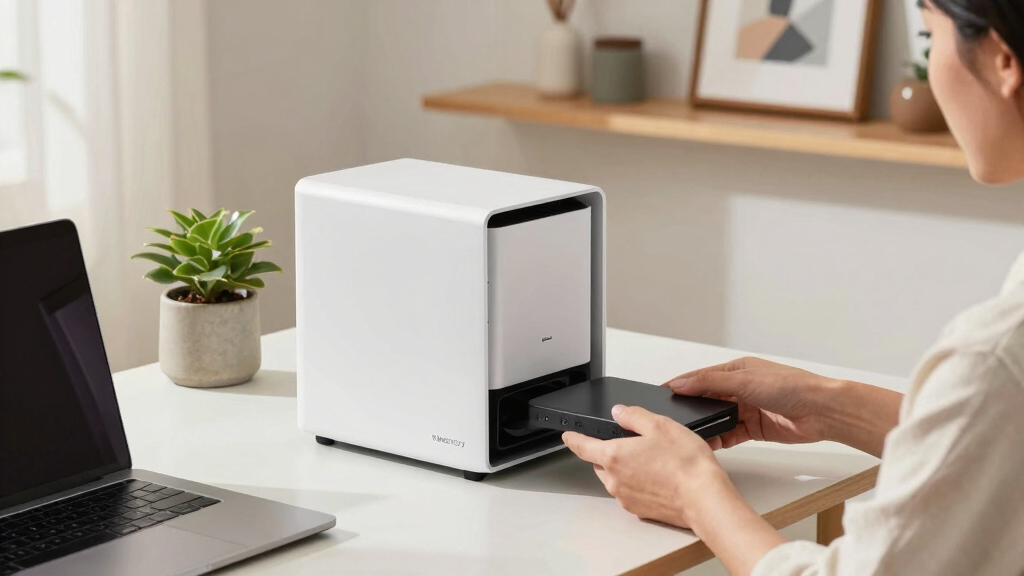

Choosing the best NAS device for a home office involves balancing performance, ease of use, and cost. The Synology DiskStation DS223j stands out as the overall best for its user-friendly interface and reliable storage. For those prioritizing performance, the UGREEN NAS DXP4800 Plus offers robust hardware and expandability, but at a higher price. Budget-conscious buyers might lean toward the BUFFALO LinkStation SoHo 220, which provides solid features with included drives. The key tradeoffs often boil down to capacity versus simplicity, and power versus affordability. Keep reading for a detailed breakdown of these top picks and what suits your specific needs best.
Open a free Amazon Business account
Business pricing, bulk buying and tax-exempt orders.
Create a free accountAs an affiliate, we earn on qualifying purchases.
Key Takeaways
- The top-ranked NAS devices combine high performance with user-friendly interfaces, making them accessible for non-technical users.
- Expandability and hardware specs vary greatly; higher-end models offer more slots and faster connections, but come with increased costs.
- Pre-installed drives simplify setup but limit customization, while diskless models require additional investment in drives and setup time.
- Network connectivity options, like 2.5GbE or multi-Gig ports, significantly influence data transfer speeds for demanding workflows.
- Price often correlates with capacity and advanced features; balancing your current needs with future expansion is key.




More Details on Our Top Picks
BUFFALO LinkStation SoHo 220 2-Bay Personal Cloud Office NAS 8TB (2x4TB) with Hard Drives Included
This model stands out for offering a balanced mix of security, ease of setup, and integrated hard drives, making it a strong choice for home office users who prioritize data safety without complicated configurations. Compared to the Synology DS223j, the BUFFALO LinkStation SoHo 220 includes pre-installed drives, simplifying initial setup, but it offers fewer advanced features like multi-version backups or app integrations. The RAID 1 configuration ensures data redundancy, yet limits effective capacity to 4TB, which could be a concern for users with growing storage needs. The 2.5 GbE connectivity provides faster transfers than standard Ethernet, beneficial for larger backups or media streaming. US-based support and a three-year warranty add reliability, though the closed system design reduces flexibility for expanding or customizing storage. Overall, this NAS makes the most sense for users seeking straightforward, subscription-free storage with built-in drives and strong security.
Pros:- Pre-installed hard drives simplify setup
- RAID 1 offers data redundancy for safety
- Fast 2.5 GbE connectivity speeds up file transfers
- 24/7 US-based support enhances reliability
Cons:- Limited capacity (usable 4TB in RAID 1) may be insufficient long-term
- Closed system reduces flexibility for upgrades or third-party app integrations
Best for: Home office users who want a plug-and-play, secure, and reliable storage solution with included drives.
Not ideal for: Tech-savvy users needing extensive customization, advanced app support, or higher capacities beyond 8TB.
- Digital Storage Capacity:8 TB
- Hard Disk Interface:Serial ATA
- Connectivity Technology:Ethernet
- Hard Disk Form Factor:3.5 Inches
- Hard Drive Rotational Speed:5400 RPM
- Data Transfer Rate:2500 Mbps
Bottom line: Best suited for home offices seeking straightforward, secure storage with minimal fuss and included drives.
Asustor Drivestor 2 Gen 2 AS1202T, 2 Bay NAS, Quad-Core 1.7GHz CPU, 2.5GbE Port, 1GB DDR4, 3 USB 3.0, Network Attached Storage for Personal and Home Cloud Backup (Diskless)
This pick makes the most sense for newcomers to NAS setups who want a user-friendly experience combined with good multimedia capabilities. Unlike the Synology DS223j, the AS1202T offers a more comprehensive software ecosystem with its App Central, making it easier to add features like media servers, VPN, or backup tools. The 1GB DDR4 RAM and quad-core processor enable smooth transcoding of 4K videos, ideal for home entertainment. Its simple, tool-less drive installation and straightforward setup guide reduce the learning curve for less tech-savvy users. While it lacks the extensive app support or higher RAM of the DS423, it provides a balanced entry point for basic backup and streaming. However, its 2-bay capacity and modest hardware may limit advanced use cases or future expansion. Overall, this NAS is great for beginners looking for easy multimedia and backup functions without complexity.
Pros:- User-friendly, tool-less drive installation
- Excellent multimedia transcoding with 4K support
- Rich app ecosystem for media, backup, and VPN functions
- 3-year warranty and reliable support
Cons:- Limited to 2 drive bays, restricting expansion
- Relatively modest hardware specs for heavy use
Best for: Home users new to NAS devices who want easy setup and media streaming functionality.
Not ideal for: Power users needing high performance, extensive customization, or large storage capacities.
- Digital Storage Capacity:Diskless
- Processor:Quad-Core 1.7GHz
- RAM:1GB DDR4
- Network Connectivity:2.5GbE
- USB Ports:3
- Drive Bays:2
Bottom line: Ideal for beginners seeking an easy-to-use NAS with strong multimedia and backup features.
UGREEN NAS DXP4800 Plus 4-Bay Desktop NAS, Intel Pentium Gold 8505 5-Core CPU, 8GB DDR5 RAM, Built-in 128G SSD, 1 * 10GbE, 1 * 2.5GbE, 2 * M.2 NVMe Slots, 4K HDMI, Network Attached Storage (Diskless)
This model is best suited for technically experienced users who need high performance and advanced features. Compared with Synology DS423, the UGREEN DXP4800 Plus boasts a powerful Intel Pentium Gold processor, 8GB DDR5 RAM, and dual high-speed network ports, making it ideal for demanding tasks like virtual machines, Docker containers, or large-scale backups. The inclusion of a built-in 128GB SSD accelerates cache and system operations, while the 4-bay capacity allows for extensive storage expansion. The HDMI port adds versatility, supporting direct media output or surveillance displays. Nevertheless, its complexity and higher price point make it less suitable for casual or novice users. The extensive feature set provides maximum flexibility but requires familiarity with network and storage configurations. This NAS makes the most sense for power users or small offices needing high throughput and advanced data management.
Pros:- High-speed 10GbE and 2.5GbE ports for fast data transfer
- Powerful Intel Pentium Gold processor with 8GB DDR5 RAM
- Supports virtual machines and Docker containers
- Built-in 128GB SSD for caching and system speed
Cons:- More complex setup and configuration process
- Higher cost may be prohibitive for casual users
Best for: Tech-savvy home users or small offices requiring high performance, virtualization, and extensive storage.
Not ideal for: Home users with limited technical experience or those seeking simple backup solutions.
- Processor:Intel Pentium Gold 8505
- RAM:8GB DDR5
- Storage Capacity:Supports 4 drives
- Network Ports:10GbE and 2.5GbE
- Built-in SSD:128GB
- M.2 NVMe Slots:2
Bottom line: Best for advanced users needing high throughput, virtualization, and extensive customization options.
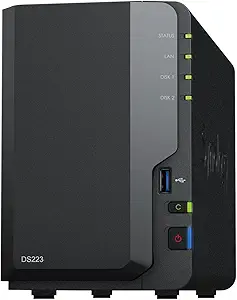
Synology 2-Bay DiskStation DS223j (Diskless)
This pick makes the most sense for users seeking a trusted brand with straightforward setup and strong data sharing features. While it lacks the advanced hardware of the DS423 or the high performance of the UGREEN NAS, the DS223j offers a reliable, energy-efficient platform with Synology’s DSM OS, known for user-friendly interface and broad app support. Its two bays support RAID configurations for data protection, and the built-in software makes sharing, backing up, and remote access simple for non-technical users. Compared to the BUFFALO LinkStation SoHo, it offers more polished software and a more active community for support. Its modest hardware means limited expansion or high-end multimedia functions, but it covers essential home office needs effectively. Overall, this NAS is a dependable, easy-to-manage choice for small-scale data management and sharing.
Pros:- Trusted brand with robust software ecosystem
- Easy setup and intuitive interface
- Supports RAID for data protection
- Excellent for basic sharing and backups
Cons:- Limited hardware scalability and expansion options
- Only 2 bays, restricting capacity growth
Best for: Home users prioritizing reliable, simple NAS for data sharing and backup with minimal setup fuss.
Not ideal for: Power users needing advanced features, large storage, or multimedia transcoding.
- Model Number:DS223j
- Number of Bays:2
- Warranty:2 years
- Supported OS:Windows, macOS, Linux
- Data Protection:RAID supported
- Processor:Unknown (basic ARM-based)
Bottom line: Ideal for users seeking a reliable, easy-to-use NAS for sharing and backing up data without complex setup.
Synology 1-Bay DiskStation DS124 (Diskless)
This model makes the most sense for individuals or small home offices wanting an affordable, space-saving private cloud. Unlike the larger DS423 or the multi-bay options, the DS124 offers a compact solution with a single drive bay, ideal for basic data storage, sharing, and remote access. Its Synology DSM OS provides a familiar, easy-to-navigate interface with extensive app support, including backup, surveillance, and media sharing. The built-in features enable complete data ownership, with options to expand storage via external drives or network backups. Its simplicity makes it perfect for those who don’t need high capacity or RAID redundancy but still want reliable access to their data from multiple devices. The downside is limited scalability—if your storage needs grow, this model may soon be insufficient. Overall, best for single users or minimal home office data management.
Pros:- Very compact and space-efficient design
- Familiar Synology DSM for easy operation
- Supports multi-platform data access
- Affordable entry-level price
Cons:- Limited to one drive bay, restricting capacity
- No RAID redundancy support
Best for: Individuals needing a compact, easy-to-manage NAS for personal cloud storage and basic sharing.
Not ideal for: Users with large or growing data requirements, or those seeking RAID redundancy and advanced features.
- Model Number:DS124
- Drive Bays:1
- Warranty:2 years
- Supported OS:Windows, macOS, Linux
- Data Ownership:Full control, private cloud
- Size:Small footprint
Bottom line: Perfect for individuals needing a simple, space-saving private cloud with reliable access.
Synology BeeStation 4TB Personal Cloud Storage Device (BST150-4T)
This Synology BeeStation stands out for its effortless setup, making it ideal for users who want a plug-and-play solution without technical complexity. Unlike more advanced NAS options like the QNAP TS-264-8G-US, it lacks expandability and raw performance, but for personal use, its preconfigured system simplifies data sharing and backup. The device integrates seamlessly with cloud services, allowing automatic sync from Google Drive and Dropbox, which is perfect for those seeking centralized storage without ongoing subscription costs. However, it sacrifices advanced features like RAID configuration or high-speed data transfer, making it less suitable for power users or small businesses needing high performance. Its main drawback is the limited hardware flexibility, which can hinder future upgrades.
bestFor: Individuals or families seeking straightforward, hassle-free personal cloud storage.
notIdealFor: Power users or small businesses requiring scalable, high-performance NAS solutions.
- Quick, out-of-the-box setup with minimal technical knowledge
- Centralizes data from multiple cloud and device sources
- No subscription fees for cloud sync
- Preconfigured hard drive included
- Limited hardware upgrade options
- Basic performance suitable mainly for personal use
- No RAID or high-speed data transfer capabilities
verdict: This device is perfect for home users needing simple, ready-to-use cloud storage without technical fuss.
- Built-in hard drive: 4TB
- Preconfigured for easy setup
- Access via web, desktop, and mobile apps
- Syncs with Google Drive, OneDrive, Dropbox
- File editing from desktop with sync
- Warranty: 3 years
Pros:- Easy setup with included hardware
- No subscription costs for cloud sync
- Centralizes data from cloud services and devices
- Supports file editing directly from desktop
Cons:- Limited upgradeability and hardware flexibility
- Basic performance suitable mainly for personal use
- Lacks advanced NAS features like RAID
- Storage Capacity:4TB
- Connectivity:Wi-Fi and Ethernet (built-in Wi-Fi not specified)
- Compatible Devices:Phones, tablets, desktops
- File Sharing:Web, mobile, desktop
- Backup Support:Google Drive, OneDrive, Dropbox
- Size:Approx. 4.53 x 10.16 x 9.92 inches
Bottom line: Ideal for users who want a simple, ready-to-use personal cloud without fuss or technical complexity.
BUFFALO LinkStation 720 4TB 2-Bay Home Office Private Cloud Data Storage with Hard Drives Included
The BUFFALO LinkStation 720 offers a highly competitive price point, making it suitable for small households or home offices that need reliable storage without additional expenses. Compared to the QNAP TS-264-8G-US, it comes with pre-installed drives, simplifying initial setup, but falls behind in performance and scalability, with only 4TB capacity and basic network speeds. Its rugged, metal-enclosed design ensures durability, and the included drives eliminate the need for separate purchases. The interface is straightforward, geared toward users who prioritize value over advanced features like multi-user management or high-speed data transfers. The main drawback is the limited capacity and slower speeds, which may not keep up with larger or more demanding data needs.
bestFor: Small families or home users seeking affordable, reliable local storage with minimal hassle.
notIdealFor: Small businesses or power users who need higher capacity or faster network speeds.
- Pre-installed 4TB drives simplify setup
- Durable metal enclosure
- Supports network sharing and backups
- Affordable price for basic storage needs
- Limited to 4TB capacity
- Lower data transfer speeds (max 300MB/s)
- No scalability beyond 4TB
verdict: This NAS is a great budget option for small households that need simple, reliable storage without complex features.
- Hard Drive Size: 4TB (2x2TB drives included)
- Network speed: Up to 300MB/s
- Connectivity: Ethernet 1GbE
- Build Material: Metal
- Dimensions: 8.1 x 3.6 x 5 inches
- Warranty: 2 years
Pros:- Includes drives, no additional purchase needed
- Durable metal enclosure
- Affordable and straightforward
- Supports multiple user backups
Cons:- Limited capacity and scalability
- Relatively slow data transfer speeds
- No advanced NAS features like RAID
- Hard Drive Size:4TB (2x2TB)
- Network Speed:300MB/s
- Connectivity:Ethernet 1GbE
- Build Material:Metal
- Dimensions:8.1 x 3.6 x 5 inches
- Warranty:2 years
Bottom line: A budget-friendly choice for small households needing simple, reliable storage with minimal setup.
QNAP TS-264-8G-US 2 Bay High-Performance Desktop NAS with Intel Celeron Quad-core Processor, M.2 PCIe Slots and Dual 2.5GbE
This QNAP TS-264-8G-US makes a compelling case for tech-savvy users or small teams that need high performance and expandability. Its powerful quad-core Intel processor and up to 16GB DDR4 RAM enable smooth multitasking, media streaming, and large file transfers, outperforming the UGREEN NAS DH4300 Plus in raw speed and features. Dual 2.5GbE ports support faster network throughput, and M.2 PCIe slots allow for SSD caching or additional storage, appealing to users wanting to optimize performance. The inclusion of multiple USB ports and support for RAID configurations makes it suitable for future scaling or more demanding workloads. The main tradeoff is complexity and cost, which may be overkill for simple home backups or casual users.
bestFor: Tech enthusiasts, small teams, or users needing high performance and expandability in a compact NAS.
notIdealFor: Less technical users or those with limited budgets seeking basic storage solutions.
- Quad-core Intel Celeron processor with 8GB RAM
- Dual 2.5GbE ports for faster network access
- Support for SSD caching via M.2 PCIe slots
- Supports RAID and scalable storage options
- More expensive and complex than entry-level NAS
- Requires technical knowledge for optimal setup
- Powerful hardware may be overkill for casual users
verdict: This NAS is suited for users who want high speed, expandability, and advanced features for small-scale professional or multimedia tasks.
- Processor: Intel Celeron N5105/N5095
- RAM: 8GB DDR4 (expandable to 16GB)
- Network: Dual 2.5GbE ports
- Storage: 2 bays, supports RAID
- Connectivity: Multiple USB 3.2 ports
- Size: Compact desktop form factor
Pros:- Powerful quad-core processor with ample RAM
- Fast dual 2.5GbE network ports
- Supports SSD caching for performance boost
- Supports RAID and future expansion
Cons:- Higher price point compared to basic NAS models
- Requires more technical setup and management
- May be unnecessary for casual home users
Bottom line: A high-performance NAS ideal for enthusiasts and small teams demanding speed and expandability.
UGREEN NAS DH4300 Plus 4-Bay Desktop NASync, Support Capacity 128TB (Diskless), Remote Access, AI Photo Album, Beginner Friendly
The UGREEN NAS DH4300 Plus offers a feature-rich, user-friendly experience with support for extensive storage up to 128TB when combined with drives, making it suitable for users with large media libraries or backup needs. Its high-performance processor, 8GB RAM, and 4K HDMI output enable smooth multimedia handling and quick file transfers, outperforming more basic models like the SSK 4TB NAS in raw power. Its support for AI photo albums and semantic search adds convenience for users managing large photo collections. However, as a diskless unit, it requires separate drive purchases, and wired Ethernet-only connectivity limits remote flexibility. Its advanced features come with increased complexity, which might be challenging for absolute beginners.
bestFor: Home users with large media collections or small businesses seeking high capacity and multimedia features.
notIdealFor: Users needing Wi-Fi connectivity or simple plug-and-play solutions.
- Supports up to 128TB with HDDs
- High-performance processor and 8GB RAM
- Supports AI photo album management
- 4K HDMI output for media viewing
- Wired Ethernet only, no Wi-Fi
- Requires separate HDD purchases
- More complex setup for beginners
verdict: This NAS is perfect for users who want large storage, multimedia output, and smart photo management, despite higher complexity.
- Processor: Intel Pentium Gold 8505
- RAM: 8GB LPDDR4X
- Support Capacity: 128TB (diskless)
- Connectivity: 1x 10GbE, 2x M.2 slots, HDMI output
- Form Factor: Desktop
- Supports: Remote access, AI photo album
Pros:- Supports very large storage capacity (128TB)
- Powerful CPU with ample RAM
- Supports AI photo album and semantic search
- 4K HDMI output for media use
Cons:- Wired Ethernet only, no Wi-Fi support
- Requires separate HDDs for capacity
- More complex setup for beginners
Bottom line: A high-capacity, multimedia-focused NAS best suited for users comfortable with setup and seeking advanced features.
Synology 2-Bay NAS DS223 (Diskless)
This entry-level Synology DS223 stands out for its robust software ecosystem and flexible data management, especially compared to simpler options like the BUFFALO LinkStation 720. Its ability to create a private cloud, share files across platforms, and run various applications makes it ideal for users comfortable with network configurations. However, setting up and mastering DSM requires a learning curve, making it less suitable for those seeking plug-and-play simplicity. The device supports two drives, offers multi-platform access, and includes intelligent surveillance tools, but it does involve some initial setup effort and is pricier than basic models. Compared to the BUFFALO LinkStation, the DS223 provides much more control and expandability, but with greater complexity. This pick makes the most sense for tech-savvy users wanting a versatile, powerful NAS that can grow with their needs. Best For: Home users with networking experience or willingness to learn NAS management. NotIdealFor: Complete beginners or those looking for a simple, set-it-and-forget-it device.
- Robust Synology DSM environment with extensive app support
- Supports drives of different sizes via SHR
- Multi-platform file sharing and remote access
- Includes surveillance monitoring tools
- Requires some technical knowledge to set up and manage
- Higher initial cost compared to basic NAS solutions
- Limited to two drive bays, restricting maximum storage expansion
Verdict: This NAS is best for users who value flexibility and features over simplicity.
Pros:- Rich software ecosystem with DSM
- Supports hybrid RAID (SHR) for drive flexibility
- Multi-platform sharing and remote access
- Includes surveillance tools
Cons:- Steep learning curve for beginners
- Higher price point than basic models
- Limited to two drive bays, less scalable
- Drive Bays:2
- Network Ports:1 Gigabit Ethernet
- Supported Drives:HDD/SSD (up to 2 drives)
- Software:Synology DSM
- Additional Features:Surveillance Station
- Warranty:2 years
BUFFALO LinkStation 720 8TB 2-Bay Home Office Private Cloud Data Storage with Hard Drives Included
This BUFFALO LinkStation 720 offers a straightforward, cost-effective solution for home storage needs, especially compared to more complex NAS systems like the Synology DS223. Its inclusion of two hard drives and RAID 1 configuration simplifies setup for users wanting a reliable backup without fuss. The device is easy to install, supports Windows and Mac, and offers cloud-like access without monthly fees. Still, it lacks advanced features and customization options, making it less suitable for users needing more control or expansion. The device provides 8TB of usable storage, quick setup, and basic sharing capabilities but falls short on security options and app support, which are limited compared to Synology. Compared to the Synology DS223, it is simpler and more affordable but less versatile and expandable. This makes it ideal for home users seeking easy, reliable storage with minimal setup. Best For: Home users prioritizing affordability and simplicity. NotIdealFor: Power users or those needing advanced management or scalability.
- Pre-installed with two hard drives, RAID 1 configured
- Supports Windows and MacOS
- Easy to install and use
- No monthly fees for storage access
- Limited security and access controls
- Fewer advanced features and apps
- Less scalable than higher-end systems
Verdict: This NAS is perfect for users who want simple, reliable storage without complexity.
Pros:- Includes two pre-installed drives
- Supports Windows and MacOS
- Easy setup and use
- No subscription fees
Cons:- Limited security features
- Fewer customization options
- Less scalable for growing needs
- Drive Bays:2
- Total Capacity:8TB
- Network Ports:1 Gigabit Ethernet
- Supported Drives:HDDs (included)
- Warranty:3 years
- Additional Features:RAID 1
LincStation N2 6-Bay NAS Storage – Intel N100 4-Core Processor, 10GbE, 16GB LPDDR5 RAM, 128G eMMC, 2×2.5 SATA HDD + 4xM.2 NVMe Slots, 2-Year Warranty, 4K HDMI | Network Attached Storage (Diskless)
The LincStation N2 offers enterprise-level hardware with a 10GbE port and 16GB RAM, making it a top choice for demanding applications compared to more basic NAS like the BUFFALO LinkStation. Its flexible storage options—supporting both SATA HDDs and NVMe SSDs—plus pre-installed Unraid OS provide unmatched customization, virtualization, and performance. It excels for users needing high-speed data handling, multimedia playback via HDMI, or running multiple services simultaneously. The main tradeoff is the initial complexity in setup and the higher price, which may deter casual users. Its hardware robustness and OS flexibility make it suitable for tech enthusiasts or small offices managing large data loads, but not for those seeking simple plug-and-play devices. Compared to basic NAS, it offers extensive expandability and performance, but requires technical familiarity. This is ideal for advanced users or small teams needing a versatile, high-performance storage solution. Best For: Small offices, tech enthusiasts, or power users. NotIdealFor: Home users with minimal storage needs or limited technical skills.
- 10GbE high-speed network port
- Supports SATA HDDs and NVMe SSDs
- Pre-installed Unraid OS for customization
- 16GB LPDDR5 RAM for multitasking
- Requires technical knowledge for setup and management
- Higher initial investment
- More complex than typical consumer NAS
Verdict: This NAS suits users who need raw performance and extensive expandability at the expense of simplicity.
Pros:- High-speed 10GbE port
- Supports multiple drive types (HDD/NVMe)
- Pre-installed Unraid OS for flexibility
- Large 16GB RAM for multitasking
Cons:- Requires technical expertise to set up
- Higher cost than basic NAS
- Initial configuration can be complex
- Drive Bays:6
- Processor:Intel N100 4-core
- Memory:16GB LPDDR5
- Network Ports:10GbE
- Supported Drives:SATA HDD + NVMe SSD
- Special Features:HDMI 4K output, Unraid OS
BUFFALO LinkStation 720 16TB 2-Bay Home Office Private Cloud Data Storage with Hard Drives Included
This BUFFALO LinkStation 720 offers a straightforward, high-capacity storage solution for home use, especially when compared to more complex systems like the Synology DS223. Its two pre-installed drives in RAID 1 provide 16TB of protected storage with minimal setup. Ideal for users who need a reliable, easy-to-use backup and file sharing device, it supports Windows and Mac, and offers quick network access. However, it lacks advanced features, app support, and granular security controls, making it less suitable for power users or those wanting custom configurations. The device emphasizes ease of use and large capacity, but sacrifices flexibility and security features found in higher-end NAS units. Compared with Synology DS223, it is simpler but less versatile for expanding or customizing. This is perfect for users who want large storage in a no-fuss package. Best For: Home users needing large, reliable storage with minimal fuss. NotIdealFor: Users who require advanced management, security, or app support.
- Includes two drives, RAID 1 with 16TB total
- Supports Windows and MacOS
- Simple setup with minimal configuration
- Large capacity suitable for backups and media storage
- Limited security and management features
- No app ecosystem or advanced controls
- Less flexible in drive configuration
Verdict: This NAS is ideal for users seeking large, protected storage with ease of use.
Pros:- High capacity (16TB with drives included)
- Supports Windows and Mac
- Simple plug-and-play setup
- Reliable RAID 1 protection
Cons:- Limited security and management features
- No app ecosystem or expandability
- Less flexible drive configuration
- Drive Bays:2
- Total Capacity:16TB
- Network Ports:1 Gigabit Ethernet
- Supported Drives:Included HDDs
- Warranty:3 years
- Additional Features:RAID 1 protection
BUFFALO LinkStation SoHo 220 2-Bay Personal Cloud Office NAS 12TB (2x6TB) with Hard Drives Included
The BUFFALO LinkStation SoHo 220 provides a dependable, entry-level storage option for home offices, especially compared to more feature-rich models like the BUFFALO LinkStation 720. It comes with two drives pre-installed, supports RAID 1, and offers simple network sharing, making it suitable for users who want easy backup and media storage. Its straightforward setup and familiar interface make it accessible for non-technical users. However, it lacks advanced security, app support, and flexibility, which limits its suitability for users with more complex needs. The device is ideal for those prioritizing basic storage and simplicity over features, but it isn’t designed for scaling or security-focused environments. Compared with the BUFFALO LinkStation 720, it is more basic but easier for novices to operate. This NAS makes sense for users who want simple, protected storage without extra bells and whistles. Best For: Home users seeking reliable, easy-to-use storage with minimal setup. NotIdealFor: Power users or those needing advanced security and customization.
- Supports RAID 1 with 12TB total
- Pre-installed with two drives
- Supports Windows and Mac
- Simple setup for basic storage needs
- Limited security and app ecosystem
- Less flexible in configuration and scaling
- No HDMI or multimedia features
Verdict: This NAS is best for users who want straightforward, protected storage without complexity.
Pros:- Includes two drives, RAID 1
- Supports Windows and Mac
- Easy to set up and operate
- Reliable for basic backups
Cons:- Limited security and management features
- No app ecosystem or advanced controls
- Less flexible for future expansion
- Drive Bays:2
- Total Capacity:12TB
- Network Ports:1 Gigabit Ethernet
- Supported Drives:2x6TB HDDs
- Warranty:3 years
- Additional Features:RAID 1
How We Picked
To determine the best NAS devices for home offices, I evaluated each model based on performance, ease of setup, build quality, expandability, and value. Devices were rated on how seamlessly they integrate into a typical home environment, with particular attention to user interfaces, noise levels, and remote access capabilities. I also considered the variety of configurations available, such as diskless versus pre-populated drives, and the overall cost of ownership, including potential upgrade paths. The rankings highlight options that deliver the best balance of features and affordability for different types of home office users.Factors to Consider When Choosing Best NAS Devices For Home Offices
Choosing the right NAS device for your home office involves more than just specs. You should consider your current storage needs, future expansion plans, network infrastructure, and technical comfort level. A well-chosen NAS can streamline backups, facilitate remote access, and serve as a media hub, but picking the wrong one can lead to frustration or unnecessary expenses. Here are key factors to weigh before making your decision.Performance and Processing Power
Performance impacts how smoothly your NAS handles multiple users, large files, and media streaming. Look for models with quad-core processors and ample RAM, especially if you plan to run multiple services or virtual machines. Cheaper models often compromise on processing power, which can cause slow backups or lag during media playback. Investing in higher-performance units makes sense if your workload involves frequent data transfers or heavy multitasking.
Storage Capacity and Expandability
Assess your current storage needs and consider future growth. Many home users start with 2-bay models, which are simple and cost-effective, but may limit storage expansion. Multi-bay units, like 4 or 6 bays, offer more flexibility, especially with hot-swappable drives. Diskless models provide customization but require additional purchase and setup time, whereas pre-filled drives are ready to use but less flexible. Think about how much data you anticipate storing over the next few years.
Ease of Use and User Interface
A straightforward setup process and an intuitive interface are vital for home users who may not be tech-savvy. Brands like Synology are renowned for their user-friendly OS, which simplifies configuration and ongoing management. Complex interfaces or frequent firmware issues can turn a home NAS into a source of frustration. If you prefer plug-and-play solutions, choose models with guided setup and strong customer support.
Network Connectivity and Speed
Fast data transfer relies on network ports and Wi-Fi support. 2.5GbE or multi-Gig Ethernet ports become increasingly important as file sizes grow. Some models also support Wi-Fi or have USB ports for direct connections, but wired connections typically offer more stability. Consider your existing network infrastructure; upgrading to a multi-Gig switch might be necessary to fully leverage faster NAS speeds. The right connectivity ensures smooth backups and media streaming without bottlenecks.
Price and Total Cost of Ownership
Balance your budget with your needs. Entry-level models are affordable but may lack expandability or advanced features. Higher-end units offer faster performance, more bays, and better software, but at a premium. Remember to factor in the cost of drives, accessories, and maintenance over time. Sometimes, paying more upfront for a reliable, scalable model reduces the need for future replacements or upgrades, saving money in the long run.
Frequently Asked Questions
Should I buy a diskless NAS or one with pre-installed drives?
Choosing between diskless and pre-installed drives depends on your needs for customization and convenience. Diskless NAS units allow you to select drives that match your capacity, speed, and brand preferences, which can be more cost-effective and flexible. However, they require more setup time and technical knowledge. Pre-installed drives offer a ready-to-use solution, ideal for those who want quick deployment, but they limit options for future upgrades and may be more expensive upfront. Consider your comfort with hardware setup and future expansion plans when making this choice.
How important is network speed for a home office NAS?
Network speed is a critical factor, especially if you frequently transfer large files, stream media, or back up multiple devices simultaneously. Standard Gigabit Ethernet might suffice for basic use, but 2.5GbE or multi-Gig ports significantly reduce transfer times and improve overall responsiveness. Upgrading your home network to support these speeds can maximize your NAS’s capabilities. If your current setup is limited to 1GbE, investing in a faster port on the NAS and compatible network hardware can be a worthwhile upgrade.
Is a higher capacity NAS always better for a home office?
More capacity provides room for growth, but it isn’t always necessary initially. Overestimating your storage needs may lead to overspending, while underestimating can result in frequent upgrades. Focus on your current data volume and consider the potential for future expansion. Multi-bay models with easy drive replacement offer flexibility, but they also tend to cost more. Balance current requirements with realistic growth expectations to choose the most suitable capacity.
Do I need advanced features like virtualization or media streaming support?
Features like virtualization or 4K media streaming are valuable if you have specific, demanding workloads. For typical home office backups and file sharing, such features may be unnecessary and add to the cost. If you plan to run virtual machines or serve as a media server, look for models with more RAM, high-performance CPUs, and multimedia support. Otherwise, a basic but reliable NAS will handle most everyday tasks efficiently.
What should I consider about future-proofing my NAS investment?
Future-proofing involves selecting a NAS with expandability, faster network ports, and sufficient processing power. Investing in a model with multiple drive bays and upgrade options ensures your device can grow with your needs, avoiding early replacements. Compatibility with upcoming network standards, such as Wi-Fi 6 or 10GbE, can also protect your investment. Remember that software updates and hardware compatibility are equally important for long-term usability.
Conclusion
For most home office users, the Synology DiskStation DS223j offers a perfect blend of ease, reliability, and affordability, making it ideal for those new to NAS devices. Budget-conscious buyers will find the BUFFALO LinkStation SoHo 220 a solid choice, especially with included drives. Power users or small teams requiring high performance and expandability should consider the UGREEN NAS DXP4800 Plus or the LincStation N2. If you prioritize simplicity and quick setup, a pre-configured model like the Synology BeeStation can be a smart pick. Ultimately, your choice should align with your current needs, future plans, and comfort with hardware setup, ensuring a smooth and scalable home office storage solution.
Flea & tick season Picks
flea and tick prevention
As an affiliate, we earn on qualifying purchases.