
TL;DR
Anthropic’s $65 billion Series H isn’t just about valuation. It’s a massive investment in AI compute infrastructure, aiming to meet exploding demand for Claude and AI services. Revenue growth and chip demand are fueling a new frontier in AI scaling.
When a startup hits a $965 billion valuation, most eyes zero in on the number. But behind the headlines lies a different story: this isn’t just a valuation race. It’s a battle over compute. Anthropic’s latest funding round is a massive capacity push, aimed at securing the infrastructure needed to meet exponential demand for its AI model, Claude. This shift from valuation to capacity signals something bigger about the future of AI: supply of compute is the new gold rush.
In the next few thousand words, we’ll unpack what this means for AI’s economic engine, the role of chipmakers, and how Anthropic’s strategy could reshape the industry. If you’ve ever wondered why AI companies are pouring billions into hardware and infrastructure, this is the story that reveals the real game — and it’s about much more than just money.
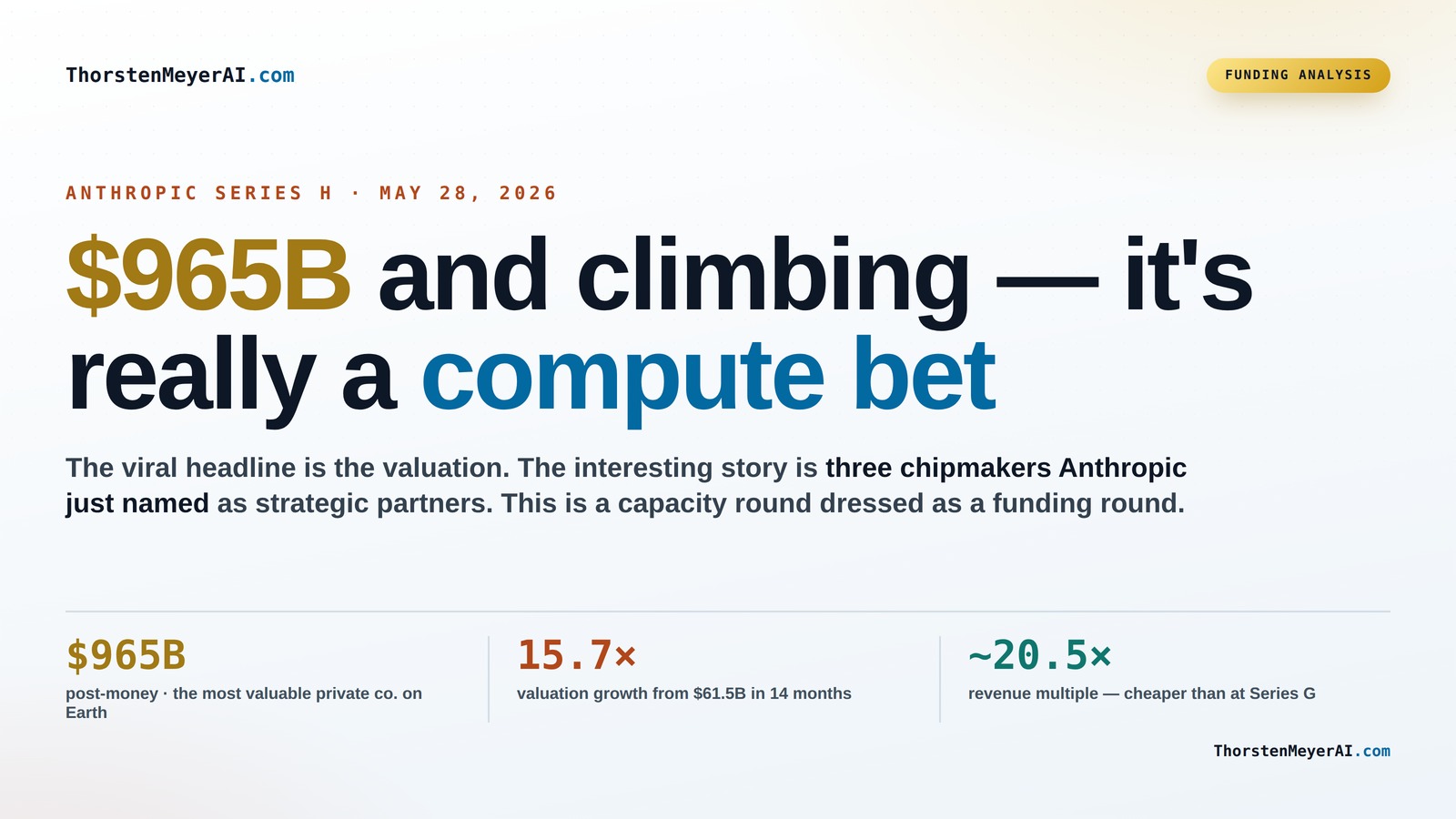
$965B and climbing — it’s really a compute bet
The viral headline is the valuation. The interesting story is in the press release’s middle paragraphs — and in three chipmakers Anthropic just named as strategic partners. This is a capacity round dressed as a funding round.
The numbers nobody can quite parse in sequence
Read together they describe a trajectory with no precedent in enterprise software. Read individually, each looks like a typo.
From $61.5B to $965B in fourteen months
Salesforce took roughly two decades to reach revenue numbers Anthropic just blew past. The sequence below is the part most coverage skips — it’s not the size, it’s the shape.
Anthropic’s valuation ladder · Mar 2025 → May 2026
Five rounds, fourteen months. Bar height is the valuation; the climb itself is the story. Tap any milestone for context.
The multiple actually got cheaper
Bubbles look like multiples expanding while revenue lags. Anthropic’s pattern is the inverse — the valuation tripled, but revenue grew faster, and the multiple compressed.
Revenue-to-valuation multiple · Series G → Series H
Same company, three months apart. The denominator (revenue) is outrunning the numerator (valuation) — exactly the opposite of what a bubble narrative predicts.
10+ gigawatts and three chipmakers
When you name Micron, Samsung & SK hynix alongside your equity backers, you’re saying the binding constraint isn’t demand or model quality — it’s the physical supply of memory chips. The Series H is a capacity round.
Compute commitments backing Anthropic’s capacity bet
$200B+ in announced compute spend across multi-year contracts. The $65B Series H raise has to be read against that bill, not against operating losses.
A genuinely durable bet — or a structural exposure?
Both readings can be true at once. The answer arrives over the next 18–24 months as the gigawatts come online and either fill with paying demand or don’t.
Revenue growth has no precedent in B2B software ($1B → $47B in 17 months). The multiple is compressing, not expanding. Claude is the only frontier model on all 3 major clouds. Enterprise AI spend share went from ~10% to >65% in a year. Compute commitments are tied to specific contracts with capacity dates.
20× revenue is not cheap by any historical software-investing standard. Revenue is reported gross of cloud-reseller pass-throughs, which inflates the top line. Profitability is 2 years out. Amodei’s own warning: a 12-month delay in AI progress “would make him bankrupt” — the compute commitments are a structural exposure to demand persistence.
The valuation race — and the IPO context
Anthropic shipped Opus 4.8 the same morning as Series H — not a coincidence. One week after OpenAI filed confidentially for IPO. The late-2026 frame is set: two frontier AI companies racing to public markets, each pitching durability.
Key Takeaways
- Anthropic’s $65 billion raise is primarily a capacity expansion, not just a valuation boost, signaling a focus on securing compute infrastructure.
- Revenue is exploding — over $30 billion run-rate — driven by surging demand for Claude, fueling the capacity push.
- Despite the valuation soaring, the revenue multiple has decreased, showing capacity growth outpacing valuation inflation.
- Major chipmakers and cloud providers are now key players in this capacity race, making hardware access the new strategic battlefield.
- Safety and interpretability are central to Anthropic’s plans, aiming to differentiate with trustworthy AI while scaling infrastructure.

AI & Emerging Technology Infrastructure 2026-2030: A complete master guide to AI and Emerging Technology Infrastructure, Hyperscale Data Centers, Compute, Cloud, Data, Deployment, Edge, Security…..
As an affiliate, we earn on qualifying purchases.
As an affiliate, we earn on qualifying purchases.
Why a $65 Billion Raise Is Really a ‘Compute’ Power Grab
The $65 billion raised by Anthropic isn’t just a big number for the sake of headlines. It’s a clear signal that the company is prioritizing infrastructure. They’ve explicitly linked this capital to expanding compute capacity, referencing commitments from chipmakers like Micron, Samsung, and SK hynix. Think of it like building a pipeline for a flood of customer demand for Claude — more servers, more GPUs, more data centers.
Picture a busy highway clogged with traffic. No matter how good your cars (AI models) are, if the road (compute infrastructure) isn’t wide enough, you hit a wall. Anthropic is now investing heavily to widen that highway, ensuring it can handle the surge of users and data.
Why does this matter? Because in AI, the ability to process vast amounts of data quickly and efficiently is the key to improving model performance and deployment speed. By investing in infrastructure, Anthropic aims to outpace competitors who might be limited by hardware bottlenecks, giving it a strategic advantage in scaling Claude and other future models. The tradeoff, however, is that this focus on capacity may divert resources from shorter-term product innovations or safety features, highlighting a strategic gamble on infrastructure as the future backbone of AI growth.


ZIG NETWORK PROGRAMMING: A Complete Professional Guide to Building High-Performance Network Applications from First Principles (Zig Programming)
As an affiliate, we earn on qualifying purchases.
As an affiliate, we earn on qualifying purchases.
The Real Numbers: Revenue and Valuation in a Rapid Race
| Time Point | Valuation | Run-Rate Revenue | Revenue Multiple |
|---|---|---|---|
| March 2025 | $61.5B | $1B | ~61× |
| End 2025 | $183B | $9B | ~20× |
| February 2026 | $380B | $14B | ~27× |
| May 2026 | $965B | $47B | ~20.5× |
Notice how the valuation shot up, but the multiple actually shrank. That’s because revenue growth (from $14B to $47B in just three months) outpaced the valuation increase, pushing the multiple down. This pattern indicates that Anthropic is prioritizing scaling its capacity to meet demand over simply inflating its valuation. It’s a shift from a market driven by hype to one where operational metrics and real-world utility are becoming more critical. This focus on capacity signals that the company aims to sustain rapid growth by ensuring it has the hardware backbone to support future AI deployments, even if the valuation multiples temporarily fluctuate. The implication is that investors and industry watchers should look beyond the headline valuation and pay attention to revenue growth and infrastructure investments as more meaningful indicators of long-term potential.

SLURM FOR AI AND DEEP LEARNING: GPU CLUSTER MANAGEMENT AND DISTRIBUTED TRAINING: SCHEDULE PYTORCH, TENSORFLOW, AND MULTI-NODE LLM WORKLOADS WITH JOB QUEUING AND RESOURCE OPTIMIZATION
As an affiliate, we earn on qualifying purchases.
As an affiliate, we earn on qualifying purchases.
How Fast Is Revenue Growing? It’s Not Just a Fluke
Anthropic’s revenue is exploding. In just 14 weeks, revenue jumped from around $9 billion to over $30 billion. That’s a 3.3× increase. By the end of June, analysts expect it to hit $50 billion — a staggering growth rate for a company just three years old.
This rapid expansion isn’t merely a sign of market enthusiasm; it underlines a fundamental shift in how AI services are adopted and scaled. The surge in revenue reflects an unprecedented demand for Claude, driven by enterprise needs, new applications, and AI democratization. This demand has created a feedback loop: more users require more compute, which in turn fuels further revenue growth. The key implication is that AI companies like Anthropic are no longer just experimenting with models—they’re rapidly deploying them at scale, which forces a re-evaluation of infrastructure priorities and investment strategies. The ability to sustain this growth hinges on robust compute capacity, making infrastructure investments not just strategic but essential for future competitiveness.


The Data Center Engineering Handbook: A Practical Guide to Infrastructure Design, Power Systems, Cooling, Security, Compliance, and Operational Excellence
As an affiliate, we earn on qualifying purchases.
As an affiliate, we earn on qualifying purchases.
Claude’s Demand: Why Everyone Wants This AI Now
Claude isn’t just another chatbot. It’s becoming the backbone for enterprise AI, used in customer service, content creation, and data analysis. Its demand skyrocketed in early 2026, pushing Anthropic to accelerate infrastructure investments.
This demand surge isn’t accidental; it reflects a broader industry shift where AI models like Claude are integral to digital transformation across sectors. As companies realize the competitive advantage of AI-powered tools, the pressure to deploy and scale these models intensifies. This creates a cycle: increased demand leads to more investment in compute infrastructure, which in turn lowers the marginal cost of deploying Claude at scale, encouraging even wider adoption. The explicit link between funding and Claude’s rising demand underscores how critical this model has become to Anthropic’s growth strategy. It’s not just about having a good AI; it’s about ensuring the capacity exists to deliver it reliably to millions of users worldwide, which is a complex balancing act involving hardware, software, and operational scaling.

Safety, Interpretability, and Why They Matter More Than Ever
Anthropic isn’t just about making bigger models; it’s investing heavily in safety and interpretability. This isn’t a throwaway line. It’s a strategic move to differentiate in a crowded market.
Think of safety research as installing better brakes on a speeding car. It’s critical for avoiding accidents — or in AI’s case, preventing harmful outputs or misuse. The new funds will bolster those efforts, ensuring Claude is not just powerful but trustworthy. As models grow larger and more capable, the potential risks also escalate. Without proper safety and interpretability measures, the deployment of such models could lead to unintended consequences, public backlash, or regulatory hurdles. Therefore, this focus isn’t just about corporate responsibility; it’s a strategic necessity. Investing in safety and interpretability enhances trust, which is essential for enterprise adoption and long-term success. It also creates a competitive advantage, as clients increasingly demand transparent and safe AI systems, especially when scaling to millions of users. The tradeoff is that safety investments might slow down immediate deployment but ultimately foster sustainable growth by reducing risks and building credibility.

What Does All This Mean for the AI Industry at Large?
Anthropic’s massive raise signals a shift in the AI landscape. The real battle isn’t just about creating smarter models — it’s about access to enough compute to run those models at scale.
This infrastructure race isn’t limited to Anthropic alone. Major chipmakers like Nvidia, Samsung, and Micron are investing heavily to meet the surging demand for hardware. Simultaneously, cloud giants such as AWS, Microsoft, and Google are expanding their data center capacities to support AI workloads. The implications are profound: as hardware becomes scarcer and more expensive, the companies that secure the best access will hold a strategic advantage, potentially shaping who leads in AI innovation and deployment in the coming decade. This shift also raises questions about the future of AI democratization—will access to compute become a barrier for smaller players? The industry’s focus on infrastructure underscores that AI’s future isn’t just about algorithms but about who controls the underlying hardware ecosystem.

What You Should Take Away — The Big Picture
This isn’t just about a huge valuation. It’s about a strategic shift toward infrastructure dominance. Anthropic’s ability to rapidly grow revenue and commit billions to hardware shows that in AI, the real currency is compute power.
If you’re tracking AI’s future, pay attention to who controls the hardware. The companies investing now are setting the stage for the next decade of AI growth, as the ability to deploy and scale models depends on access to the necessary infrastructure. This fundamental shift indicates that AI’s future will be shaped by hardware ecosystems and capacity, not just algorithmic breakthroughs. The winners will be those who secure and optimize compute resources, potentially creating new power centers within the industry. This also raises questions about the sustainability and environmental impact of expanding hardware infrastructure—an important tradeoff that industry stakeholders will need to address as the race accelerates.
Frequently Asked Questions
Why does Anthropic need so much money right now?
They’re investing heavily in building the infrastructure needed to support rapid demand growth for Claude. It’s about securing the compute capacity to run larger, more powerful models at scale.Is this funding mainly for compute or product development?
While some funds go toward safety and research, the bulk is earmarked for expanding compute infrastructure — more GPUs, data centers, and chip partnerships.What does ‘compute’ really mean here?
Compute refers to the hardware — GPUs, TPUs, data centers — powering AI training and inference. It’s the raw material needed to run and improve large models like Claude.How does Anthropic’s valuation compare with OpenAI?
Despite being larger in valuation, Anthropic’s revenue multiple (around 20.5×) is lower than OpenAI’s (~65×), indicating a focus on scaling capacity rather than just valuation inflation.Will this funding help with safety or just infrastructure?
Both. Part of the funds will go to safety and interpretability research, but the main thrust is expanding hardware capacity to meet soaring demand.Conclusion
This isn’t just about huge numbers; it’s about who controls the raw power behind AI’s future. As Anthropic pours billions into hardware, the real story is clear: in AI, capacity is king.
Keep your eyes on the infrastructure race. It’s shaping who will lead the next wave of intelligent machines — and who will be left behind in the dust.