
TL;DR

Get hardware and tech essentials delivered free with Prime
- Fast, free delivery on millions of items
- Prime Video, Amazon Music and more included
- Member-only deals all year
IdeaClyst acts as a digital war room, offering founders a collaborative space to pressure-test ideas, discover new opportunities, and develop clear plans—all while keeping everything on their own machine. It reduces risk and saves time in the startup journey.
Ever had that sinking feeling of watching a promising idea spiral into a costly dead end? You’re not alone. The real challenge isn’t just building faster—it’s about knowing which idea to chase. That’s where a dedicated war room becomes your secret weapon.
Imagine a space—physical or digital—that keeps your ideas, notes, and tests front and center. A place where your team sees progress, shares insights, and challenges assumptions in real-time. That’s exactly what IdeaClyst offers—a modern, local-first war room built for the fast-paced world of startups and innovation. Learn more about war rooms here.
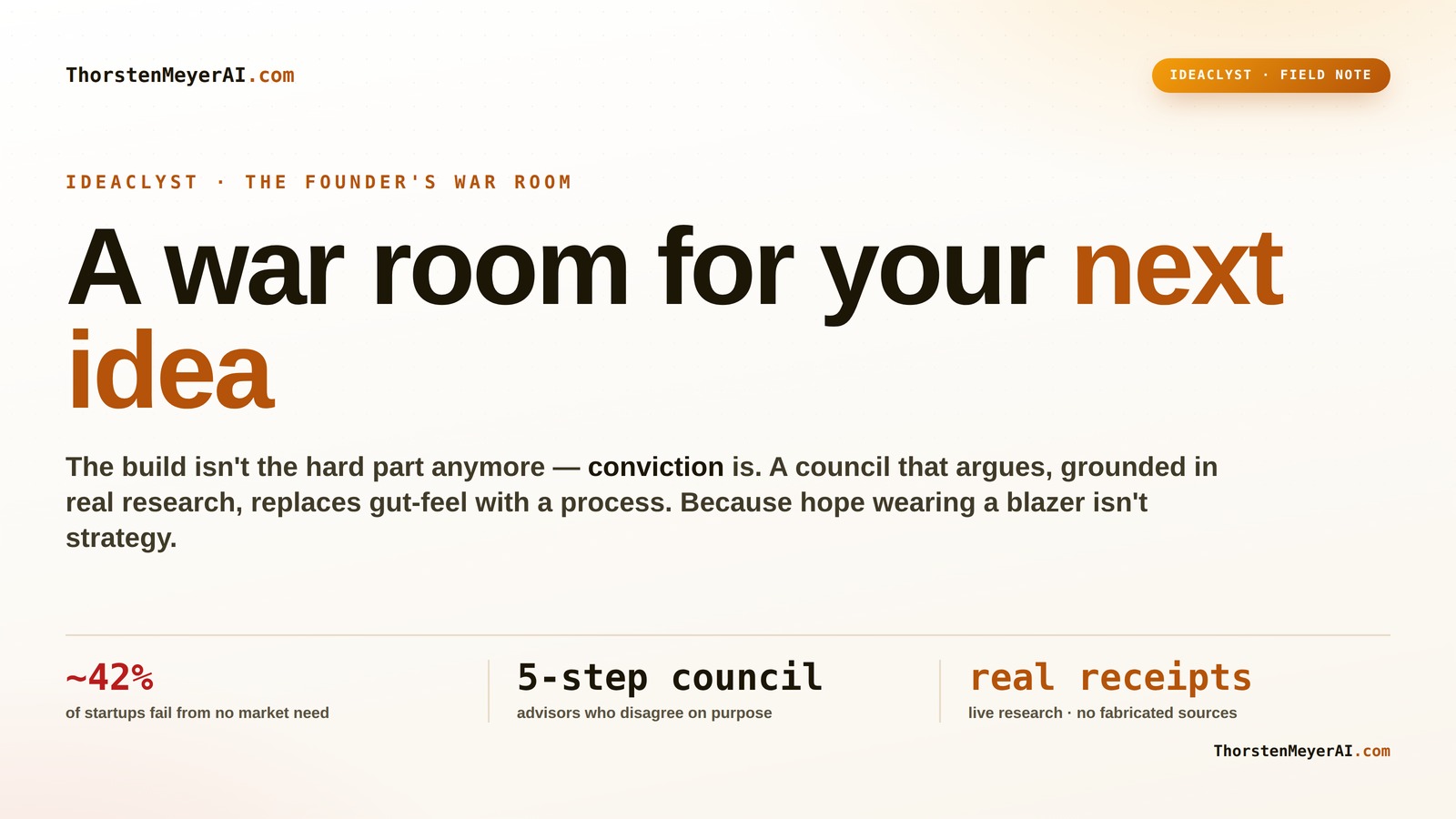
A war room for your next idea
The build isn’t the hard part anymore — conviction is. Knowing which idea deserves the next six months, and being able to defend it. Most founders answer with gut feel and optimistic math. That’s hope wearing a blazer. IdeaClyst replaces it with a process.
The most expensive decision is what to build
The single most valuable thing a tool can do is talk you out of the wrong six months. The numbers make the case better than any pitch.
Three tools in one — on your own machine
Strip away the framing and IdeaClyst is three things at once, all running locally with nothing leaving your laptop.
An AI council
Pressure-tests an idea you bring it — advisors who argue on purpose.
A discovery engine
Finds ideas you didn’t know to look for by hunting real demand signals.
A founder’s workspace
Carries winners from “interesting” all the way to “ready to build.”
Advisors who disagree on purpose
Not one confident, agreeable answer — a structured five-step deliberation where models play different roles and turn on their own work. The disagreement is the feature.
The five-step deliberation
A council that leads with the bad news surfaces the objections you’d otherwise find the expensive way, on month five.
Product strategy
Who’s it for, what’s the wedge, why now, what’s the business model.
Technical architecture
What would it actually take to build — and where’s the risk.
Critique pass
The council turns on its own work. Where’s the hand-waving? What kills this?
Second, independent critique
A different voice, a different angle — so blind spots don’t survive.
Final synthesis
Everything into one coherent founder packet: strategy, architecture, validation, plan.
When IdeaClyst cites a source, it actually fetched it
The hard departure from “ask an AI what it thinks of my startup.” It runs in a strict, real-data-only mode — if it can’t gather genuine evidence, it says so plainly rather than inventing a plausible paragraph.
Confidence with receipts
No fabricated statistics, no imaginary competitors, no made-up citations. The packet survives a skeptical co-founder or a sharp investor because the reasoning has receipts.
Market research first
Scouts the landscape before the council reasons about anything.
Competitor read
Real positioning, pricing signals, feature claims — differentiation vs. reality.
Validation with links
Not “talk to customers” — concrete signals & sources you can click.
From the blank page to build-ready
Evaluation is half the problem; the blank page is the other half. And a plan is worthless if it dies in a tab you never reopen.
Bring a space, not an idea
“AI for accountants,” “tools for indie game studios” — plus your goal and real capacity. It hunts demand signals across HN, Reddit, Product Hunt, GitHub, pricing pages.
- An honest market read — leads with the bad news when a space is hard
- An opportunity map — high pain, thin competition
- Ranked candidates — wedge, who pays, effort, risk, confidence
- each with KILL CRITERIA — when to walk away
A home and a forward path
Every promising idea gets carried forward, with every artifact in plain files on your disk.
- Validation tooling — sprint board, interview list, evidence browser
- Founder profile — a personal-fit lens; same discovery, different advice
- Build workspaces — funnel, personas, landing draft, version history
- “Build this idea” → a PRD + task queue, ready for a coding agent
Key Takeaways
- IdeaClyst transforms idea validation into a structured, collaborative process, reducing costly missteps.
- A digital war room keeps your ideas, critiques, and plans visible and version-controlled—boosting team alignment and speed.
- Grounding AI critiques in live web research ensures your decisions are based on real, current data—not just model guesses.
- Setting up a digital war room is simple but requires organization: dedicate folders, structure phases, and keep it active.
- Whether physical or digital, a war room helps teams see progress, share notes, and stay aligned through every stage of development.
As an affiliate, we earn on qualifying purchases.
Why a War Room Is the Secret Sauce for Your Startup’s Success
A war room isn’t just a fancy term. It’s a dedicated space—physical or digital—where your team converges to focus on one goal: turning ideas into reality efficiently. Discover how war rooms boost startup success. Think of it like the nerve center during a critical project, where every note, sketch, and decision is visible at a glance.
For example, during a product sprint, a physical war room might have sticky notes, wireframes, and timelines plastered on the walls. For remote teams, a digital war room—like IdeaClyst—hosts the same kind of clarity on a shared screen. This visibility keeps everyone aligned and speeds up decision-making, reducing the risk of costly missteps.
Research shows that teams with clear, shared workspaces make decisions 40% faster and with more confidence. See more on effective collaboration spaces. It’s about creating a visible, living map of your progress, so everyone stays on the same page.
Deeply, this approach matters because it minimizes the often-overlooked cognitive load of tracking multiple ideas across different platforms. When everything is centralized, teams can quickly identify bottlenecks, redundancies, and overlooked opportunities. The tradeoff, however, is that maintaining such a shared space requires discipline and regular upkeep—without it, the war room can become cluttered or outdated, reducing its effectiveness.
As an affiliate, we earn on qualifying purchases.
How IdeaClyst Turns Your Brainstorm Into a Real Strategy
IdeaClyst isn’t just a note-taking app—it’s a digital war room designed to pressure-test ideas with a structured council of AI advisors. Explore AI-driven idea validation. You start by feeding your raw idea—say, a new SaaS feature or a marketing angle—and it kicks off a multi-step debate among different AI models.
Each model plays a role: one challenges your target market assumptions, another assesses technical feasibility, and a third looks for hidden risks. They argue, critique, and synthesize, giving you a balanced, well-rounded view of your idea’s potential.
For instance, if you propose a new app feature, IdeaClyst’s council might identify overlooked user needs or technical roadblocks. The result? A comprehensive founder packet—strategy, architecture, validation plans—that’s ready to share or build upon.
This process is impactful because it transforms individual insights into a collective, critical-thinking environment. It’s akin to having a panel of experts scrutinize your idea from multiple angles, which reduces bias and blind spots. The tradeoff is that relying on AI models requires understanding their limitations—while they can simulate diverse perspectives, they still depend on the data they’re trained on, meaning human oversight remains essential.
collaborative startup war room software
As an affiliate, we earn on qualifying purchases.
As an affiliate, we earn on qualifying purchases.
The Power of Grounding Ideas in Real Data, Not Just Model Vibes
Many AI tools give you vague, confidence-laden guesses about markets or tech. But IdeaClyst stands apart by anchoring every recommendation in live web research. Learn about data-driven crypto insights. It pulls in current market data, competitor info, and trend reports to back up its critiques.
For example, instead of telling you that ‘market demand is growing,’ it shows recent sales figures, user reviews, or industry reports—like a mini research team in your pocket.
This approach is crucial because data-driven validation helps prevent costly missteps. Relying solely on AI-generated insights without real-world context can lead to overconfidence in flawed assumptions. The implication is that your decisions become more resilient and adaptable when they’re based on live, relevant data. The tradeoff, however, is that live research can sometimes introduce noise or outdated information if not curated carefully, so it’s vital to interpret the data critically and supplement it with human judgment.
Research indicates that startups leveraging real-time data are better positioned to pivot successfully and avoid wasting resources on irrelevant solutions. Therefore, integrating live research into your validation process enhances accuracy and minimizes confirmation bias, ultimately leading to smarter, more reliable decision-making.
idea testing and development software
As an affiliate, we earn on qualifying purchases.
As an affiliate, we earn on qualifying purchases.
Building Your Own Digital War Room: Setup Tips & Best Practices
Setting up a digital war room with IdeaClyst is straightforward but needs some thoughtful planning. Here are some tips: Find more online income strategies.
- Dedicate a folder: Keep all reports, notes, and plans in one place on your disk.
- Organize by phases: Break your idea development into stages like ‘brainstorm,’ ‘critique,’ ‘validation,’ and ‘final plan.’
- Use visual artifacts: Embed sketches, charts, or screenshots within your Markdown files for quick reference.
- Keep it active: Schedule regular reviews, updates, and critiques to keep the space alive.
This structure matters because it ensures that your digital war room remains a dynamic, evolving tool rather than a static archive. When each phase is well-organized, team members can easily track progress, revisit earlier ideas, and avoid redundant work. The tradeoff is that initial setup takes time and discipline, but the payoff is a more coherent and efficient validation process that scales with your project.
Frequently Asked Questions
What exactly is a digital war room?
A digital war room is a centralized online space, like IdeaClyst, designed for teams to collaborate, track, and critique ideas in real-time. It combines visual artifacts, live data, and structured debates to keep everyone aligned and moving forward.How is a war room different from a regular project workspace?
While a regular workspace might store files and notes, a war room emphasizes visibility, continuous critique, and strategic focus. It’s a dedicated zone for active decision-making, not just storage.Can small startups really benefit from a war room approach?
Absolutely. Small teams thrive with clarity and focus. Digital war rooms like IdeaClyst help keep everyone aligned, reduce wasted effort, and accelerate validation—perfect for lean startups aiming to move fast.What tools are ideal for creating a digital war room?
Tools like IdeaClyst, with its integrated AI council and live web research, are ideal. They combine structured critique, version control, and easy sharing—making your war room smarter and more efficient.How do I keep my digital war room organized over time?
Create clear folders for each phase, document every critique and test, and schedule regular reviews. Consistent updates turn a cluttered space into a strategic asset that grows with your project.Conclusion
Think of your next big idea as a battle plan. A war room—physical or digital—gives you the strategic vantage point to see the battlefield clearly. With IdeaClyst, that battlefield is your own laptop, packed with honest critiques, real data, and a clear plan to move forward.
Don’t just build faster—build smarter. Make your war room the heartbeat of your innovation process, and watch your ideas turn into real, tested success stories.
Halloween Picks
halloween
As an affiliate, we earn on qualifying purchases.