
For makers seeking the best 3D scanners, the options range from versatile handheld devices to high-precision industrial tools. The Creality CR-Scan Ferret Pro stands out as the overall top pick thanks to its wireless convenience and solid accuracy. The Revopoint POP 4 offers advanced AI segmentation, making detailed scans easier for hobbyists and semi-professionals. Meanwhile, the Creality Raptor Pro delivers ultra-high precision at a faster frame rate, suited for those needing meticulous detail. Each option balances factors like usability, accuracy, and portability, with tradeoffs around cost and complexity. Continue reading for a detailed breakdown to help you choose the best fit for your making projects.

Get hardware and tech essentials delivered free with Prime
- Fast, free delivery on millions of items
- Prime Video, Amazon Music and more included
- Member-only deals all year
Key Takeaways
- High accuracy models like the Creality Raptor Pro are best for detailed, precision-dependent projects but come at a higher price.
- Portability and ease of use are key strengths for scanners like the Creality Pika series, ideal for on-the-go makers.
- AI segmentation features, present in Revopoint models, significantly simplify complex scans, making them more accessible to hobbyists.
- Frame rate and speed matter for scanning larger objects or when rapid results are needed, as seen in the MetroY Ultra and MetroX Pro.
- Connectivity options like WiFi 6 expand usability, especially for wireless workflows and integration with various devices.




| 3D scanners for maker | Accuracy | Frame Rate | Connectivity |
|---|---|---|---|
| Creality CR-Scan Ferret Pro 3D | 0.1mm | 30FPS | — |
| Revopoint POP 4 3D Scanner | 0.03mm | up to 105 fps | WiFi 6.0 |
| Creality Raptor Pro 3D Scanner | 0.02mm | 60FPS | — |
| Revopoint MetroY Ultra 3D Scan | 0.015 + 0.04mm | — | — |
| Creality Pika Portable 3D Scan | 0.03mm | 110 FPS | Wi-Fi 6 |
| Creality Pika 3D Scanner | — | — | WiFi 6 |
| Revopoint MetroX Pro 3D Scanne | up to 0.02 mm | — | — |
| Creality 3D Scanner Wireless P | 0.03mm | — | Wi-Fi 6, USB 3.0 |
More Details on Our Top Picks
Creality CR-Scan Ferret Pro 3D Scanner for 3D Printing, Wireless Handheld with WiFi 6, 0.1mm Accuracy
The Creality CR-Scan Ferret Pro stands out for its combination of high accuracy (0.1mm) and fast 30FPS scanning, making it suitable for both detailed prototyping and quick outdoor captures. Compared to the Revopoint POP 4, it offers more seamless wireless connectivity via WiFi 6, reducing data bottlenecks during scanning sessions. Its anti-shake feature ensures stable results even when handheld, but it struggles with reflective or transparent surfaces, which can hamper accuracy. This model suits users who need a reliable, portable device without sacrificing precision, although system requirements and device compatibility may limit some casual users. Its support for multiple formats like OBJ, STL, and PLY enhances workflow flexibility.
Pros:- High precision with 0.1mm accuracy and fast 30FPS speed
- Wireless data transfer with WiFi 6 for efficient workflows
- Effective outdoor scanning with anti-shake tracking
- Supports multiple file formats for integration
Cons:- Struggles with reflective or transparent surfaces
- Requires compatible devices with robust system specs
- Some features depend on specific hardware/software updates
Best for: Maker professionals and advanced hobbyists needing versatile, wireless handheld scanning with outdoor capability
Not ideal for: Beginners or users primarily working with reflective or transparent objects due to scanning limitations
- Accuracy:0.1mm
- Resolution:0.16mm
- Frame Rate:30FPS
- Wireless Technology:WiFi 6
- Supported File Formats:OBJ, STL, PLY
- Compatibility:Windows, Mac, Android, iOS
Our verdict“This scanner is best for makers who value portability and versatility in outdoor or complex environments without sacrificing core accuracy.”
Revopoint POP 4 3D Scanner, AI Segmentation, for 3D Printing, Premium
The Revopoint POP 4 offers exceptional accuracy down to 0.03mm, making it ideal for reverse engineering and detailed models. Its speed is impressive, with up to 105 fps and 5 million points per second, surpassing many competitors like the Creality CR-Scan Ferret Pro in raw detail. It also features AI-powered segmentation, but this requires Windows and may involve additional licensing costs, limiting its ease of use for some. Designed for professional-grade work, it performs well outdoors thanks to its all-weather capability, though the high-end software requirements and price tag may deter casual makers. Its accuracy and speed make it a top choice for high-precision needs.
Pros:- Exceptional 0.03mm accuracy for detailed modeling
- High-speed scanning with 105 fps and 5 million points/sec
- All-weather outdoor performance
- Wireless connectivity with real-time preview
Cons:- Requires Windows with paid licenses for full features
- High cost may be prohibitive for casual users
- AI segmentation limited to Windows
Best for: Professional makers and engineers needing ultra-precise, fast scans for reverse engineering and detailed prototypes
Not ideal for: Casual hobbyists or users with limited hardware resources, due to its high cost and system demands
- Accuracy:0.03mm
- Full-Field Accuracy:0.08mm
- Frame Rate:up to 105 fps
- Points per Second:5,000,000
- Scan Volume:10x10x10 mm to 2x2x2 m
- Connectivity:WiFi 6.0
Our verdict“This scanner is best suited for professionals seeking the highest accuracy and speed for detailed industrial or reverse-engineering tasks.”
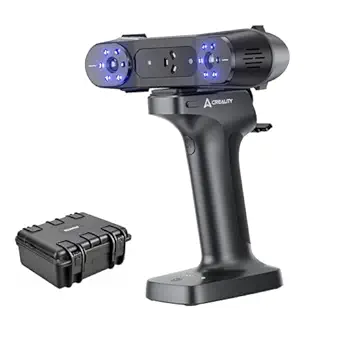
Creality Raptor Pro 3D Scanner with Scan Bridge Wireless, High Precision 0.02mm, 60FPS, Blue Laser Lines
The Creality Raptor Pro excels in capturing highly detailed, full-color 3D models thanks to its 0.02mm accuracy and 60FPS speed. Its support for laser lines and a wide object range from 5mm to 2000mm makes it more suitable for capturing objects with realistic textures, especially compared to the handheld Ferret Pro. However, calibration may be needed to optimize results, and its software compatibility details are limited, which could pose a challenge for some users. It’s an excellent fit for makers focused on color-rich visualizations or detailed surface textures, but its price point may be steep for casual or beginner users.
Pros:- High-precision 0.02mm accuracy
- Fast 60FPS scanning for efficient workflows
- Supports full-color 3D texture mapping
- Wireless connectivity for convenience
Cons:- May require calibration for best results
- Limited software compatibility info available
- Potentially costly for casual use
Best for: Artists and makers who require vibrant, textured 3D scans with high detail and color accuracy
Not ideal for: Beginners or those with limited calibration experience, due to potential setup complexity
- Accuracy:0.02mm
- Frame Rate:60FPS
- Laser Lines:22+7 Blue Laser Lines
- Object Size Range:5mm to 2000mm
- Supports Full-Color:Yes
- Wireless:Yes
Our verdict“This scanner is ideal for users prioritizing detailed, color-rich 3D captures, especially for artistic projects or textured prototypes.”
Revopoint MetroY Ultra 3D Scanner, Up to 90 FPS, for 3D Printing, Standard
The Revopoint MetroY Ultra offers a resolution of 0.05mm and a remarkable 90FPS, making it suitable for industrial applications requiring detailed measurements, such as reverse engineering. Its ability to scan dark or shiny surfaces without spray and perform outdoor scanning surpasses many handheld scanners like the Creality CR-Scan Ferret. While it is heavier at 450g and demands high-performance hardware, its multiple modes and support for diverse formats make it versatile. The setup is more complex, making it less ideal for casual or beginner makers. Its precision and surface adaptability make it a go-to for advanced industrial projects.
Pros:- High resolution of 0.05mm
- Supports dark and shiny surfaces without spray
- Fast 90 FPS capture rate
- Multiple scanning modes for versatility
Cons:- Heavy and less portable at 450g
- Requires powerful hardware and complex setup
- Higher price point for casual users
Best for: Industrial makers and engineers focused on detailed measurement, reverse engineering, and challenging surfaces
Not ideal for: Casual hobbyists or those seeking lightweight, portable scanners for simple hobby projects
- Resolution:0.05mm
- Scanning Speed:90 FPS
- Accuracy:0.015 + 0.04mm
- Surface Compatibility:Dark, shiny surfaces
- Supported Formats:PLY, OBJ, STL, etc.
- Weight:450g
Our verdict“This scanner is best for industrial or professional makers needing ultra-precise, robust surface scanning in challenging conditions.”
Creality Pika Portable 3D Scanner, 0.03mm High Accuracy, Dual-Mode Blue Laser & NIR Structured Light, AI-Powered Body Completion & Retexturing, Wi-Fi 6, 3″ Touchscreen
The Creality Pika combines portability with advanced AI features, offering 0.03mm accuracy and dual-mode scanning with blue laser and NIR structured light. Its small form factor (just 260g) and 3-inch touchscreen make it highly portable, especially when compared to bulkier models like the Raptor Pro. It excels in outdoor environments and for body retexturing, thanks to AI-powered completion. However, its limited screen size and high hardware dependency could make setup and operation less user-friendly for newcomers. This device is tailored for those needing high-precision, portable scanning with AI enhancements, particularly in outdoor or body-centric applications.
Pros:- High accuracy at 0.03mm
- Lightweight and portable (260g)
- AI-powered body completion and retexturing
- Supports dark and metallic surfaces without spray
Cons:- Small 3-inch touchscreen may limit usability
- Dependent on compatible devices and software
- Battery life details are not specified
Best for: Makers and artists who need portable, high-precision body or object scans, especially in outdoor or on-the-go scenarios
Not ideal for: Beginners or users seeking a larger display or simple, plug-and-play scanning for basic projects
- Accuracy:0.03mm
- Frame Rate:110 FPS
- Weight:260g
- Display:3-inch HD touchscreen
- Connectivity:Wi-Fi 6
- Supported Platforms:Windows, macOS, iOS, Android
Our verdict“This scanner is perfect for portable, high-precision body and object scanning in outdoor settings, with AI features enhancing detailed retexturing.”
Creality Pika 3D Scanner, Portable AI Blue Laser & NIR, for 3D Printing, WiFi 6, 3″ Touch Screen, Outdoor & Body Scanning, Compatible with Win/Mac/Android/iOS
The Creality Pika stands out for its portability combined with advanced AI features, making it ideal for outdoor and body scanning. Compared to the Creality 3D Scanner Wireless Pika, it offers a more compact design and improved AI texture and hole filling, enhancing ease of use for detailed small object capture. Its high-precision 0.03mm laser and sunlight resistance make it suitable for on-the-go scanning without sacrificing detail. However, the setup can be complex for less tech-savvy users, and the price is higher due to its advanced tech. It’s best suited for makers who need reliable outdoor or body scans and are comfortable with some technical configuration.
Pros:- Very high detail resolution at 0.03mm for precise models
- Sunlight-resistant, ideal for outdoor scanning
- AI features automate texture mapping and hole filling
- Supports multiple platforms and easy export formats
Cons:- Complex initial setup may challenge beginners
- Higher price point reflects its advanced features
- Limited to small and medium-sized objects
Best for: Makers who need a portable, high-precision scanner for outdoor use or body modeling with AI enhancements
Not ideal for: Beginners or hobbyists seeking a simple, plug-and-play device, as setup is more involved and requires technical knowledge
- Scanning Speed:Up to 110 FPS
- Laser Type:Blue laser
- Laser Wavelength:0.03mm precision
- Display:3-inch touch screen
- Connectivity:WiFi 6
- Compatibility:Windows, macOS, Android, iOS
- Supported Formats:STL, OBJ, PLY, ASC
- Object Size Range:5mm – 2m
- Power:USB 3.0
Our verdict“This scanner is perfect for makers who prioritize portability and AI-driven detail enhancement in outdoor or body scanning tasks.”
Revopoint MetroX Pro 3D Scanner, Blue Laser Scan for 3D Printing and Industrial Measurement
The Revopoint MetroX Pro is designed for professional and industrial applications, with a focus on high accuracy and versatile scanning modes. Unlike the Creality Pika, which excels in portability and AI features, the MetroX Pro offers up to 0.01mm precision and multiple laser modes that handle complex, shiny, or dark surfaces effectively. It supports real-time data streaming and automation with an auto turntable, making it suitable for detailed product modeling or inspection. The main tradeoff is its requirement for a Windows PC and a higher cost for professional-grade features. It’s best for users who need extreme detail and industrial robustness, rather than casual or outdoor use.
Pros:- Exceptional accuracy up to 0.01mm for detailed models
- Multiple scanning modes for various surface types
- Real-time streaming and automated workflows
- Color capture with HD RGB camera
Cons:- Requires Windows PC, limiting portability
- Higher price for professional features
- Complex setup for non-experts
Best for: Industrial designers, precision modelers, or inspection professionals needing ultra-accurate scans
Not ideal for: Hobbyists or casual makers seeking a budget-friendly, portable device, as it demands a more powerful PC and higher investment
- Scanning Modes:30 Cross-line Lasers, 15 Parallel Lines, 62-line Full-field Blue Structured Light
- Precision:up to 0.01 mm
- Accuracy:up to 0.02 mm
- Points per Second:up to 7 million
- Color Capture:HD RGB camera
- Automation:Auto turntable with dual-axis
Our verdict“This scanner is ideal for professionals demanding high precision and versatile scanning capabilities, especially in industrial or detailed modeling contexts.”
Creality 3D Scanner Wireless Pika with 7-Line Blue Laser and NIR Light
The Creality Wireless Pika offers a compelling combination of wireless operation and dual-light sources, making it suitable for capturing larger scenes or objects with ease. Compared to the Creality Pika with AI features, this version emphasizes wireless convenience and infrared structured light for outdoor or reflective surfaces. Its 0.03mm accuracy and high-speed Wi-Fi 6 enable rapid, high-detail scans, but performance depends heavily on external hardware, and it’s not fully standalone—requiring a compatible device for operation. For makers who want mobility and fast data transfer, this is a solid choice, but less ideal for those seeking a completely independent device or who have less powerful hardware.
Pros:- Wireless operation for greater mobility
- High-precision 0.03mm scanning accuracy
- AI-enhanced textures and gap filling
- Supports high-speed Wi-Fi 6 for fast data transfer
Cons:- Requires a compatible computer or smartphone for operation
- Not a fully standalone device, adding complexity
- Performance relies on high-end hardware
Best for: Makers needing a flexible, wireless scanner for large or outdoor projects with high detail requirements
Not ideal for: Beginners or those with limited hardware, as it depends on a capable PC or smartphone and cannot operate fully independently
- Light Sources:7-line blue laser and infrared structured light
- Display:3-inch high-brightness touchscreen
- Connectivity:Wi-Fi 6, USB 3.0
- FPS:Up to 110fps on PC
- Accuracy:0.03mm
- Supported Formats:STL, OBJ, PLY, ASC
Our verdict“This scanner suits makers who prioritize wireless flexibility and high-accuracy scans in dynamic environments, provided they have suitable hardware.”
How We Picked
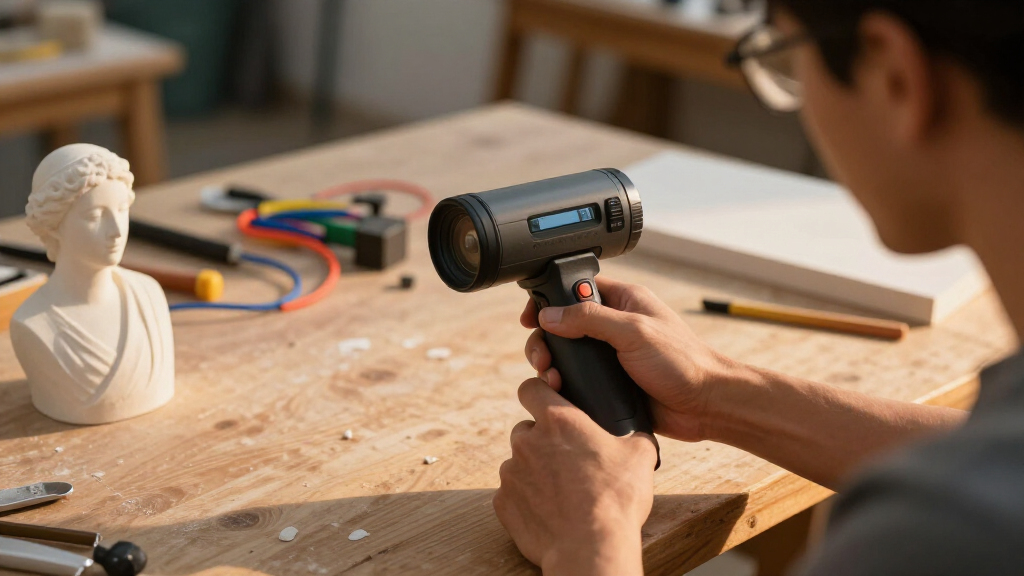
These scanners were evaluated based on a combination of performance metrics, usability, build quality, and value. Accuracy, scan speed, and compatibility with different operating systems directly impact a maker’s workflow, while ease of use influences how quickly a project can move forward. We prioritized versatile options that balance affordability with advanced features, ensuring that both hobbyists and more serious makers find suitable choices. Devices were ranked by their ability to deliver reliable, precise scans in real-world maker scenarios, with consideration for maintenance, portability, and future-proof connectivity features.| 3D scanners for maker | Connectivity |
|---|---|
| Creality CR-Scan Ferret Pro 3D | — |
| Revopoint POP 4 3D Scanner | WiFi 6.0 |
| Creality Raptor Pro 3D Scanner | — |
| Revopoint MetroY Ultra 3D Scan | — |
| Creality Pika Portable 3D Scan | Wi-Fi 6 |
| Creality Pika 3D Scanner | WiFi 6 |
| Revopoint MetroX Pro 3D Scanne | — |
| Creality 3D Scanner Wireless P | Wi-Fi 6, USB 3.0 |
Factors to Consider When Choosing Best 3D Scanners For Makers
Choosing the right 3D scanner for making hinges on understanding your specific needs and project scope. Key factors include accuracy, portability, ease of use, and compatibility. Making the wrong choice can lead to frustration or subpar results, so weighing these considerations carefully helps ensure your investment pays off. Below, I explore the main factors that influence making the most of your scanner.Accuracy and Resolution
For detailed parts or intricate models, high accuracy and resolution are essential. Scanners like the Creality Raptor Pro excel here with 0.02mm precision, suitable for fine craftsmanship or industrial prototyping. On the other hand, less precise models may still serve well for rough prototypes or larger objects where minute detail isn’t critical. Understanding your project requirements helps decide whether to prioritize precision or speed and ease of use.
Portability and Size
If you need to scan on-site or outside a dedicated workspace, a compact, lightweight scanner like the Creality Pika or Revopoint POP 4 offers significant advantages. Larger, stationary models tend to deliver higher accuracy but are less convenient for quick, on-the-move projects. Consider how often you’ll need to transport or set up your scanner, and choose accordingly to avoid frustration.
Ease of Use and Workflow
Ease of use depends on interface design, scan process complexity, and software integration. Scanners with AI segmentation, such as the Revopoint POP 4, simplify complex scans and reduce post-processing time. However, more advanced devices often require a learning curve or specialized software. Balancing feature set against your comfort level and technical skills helps prevent wasted time and frustration.
Connectivity and Compatibility
Wireless connections like WiFi 6 can streamline workflows, especially when scanning multiple objects or integrating with tablets and smartphones. Compatibility with your operating system (Windows, Mac, Android, iOS) also matters; some devices support multiple platforms, making them more versatile. Consider your existing setup and future needs when evaluating connectivity options.
Price and Long-term Value
High-precision scanners tend to cost more but offer finer detail, which can be crucial for certain projects. Cheaper models might lack some features but still provide good value for hobbyists or those just starting. Think about how often you’ll use the scanner and whether investing in a premium model aligns with your long-term making goals.
Frequently Asked Questions
Can I use a handheld 3D scanner for detailed jewelry or miniature modeling?
Yes, handheld scanners like the Creality Raptor Pro are capable of capturing detailed surfaces required for jewelry or miniature work, especially when paired with high-precision settings. However, achieving perfect detail may require steady handling and proper calibration. For extremely fine detail, consider scanners with sub-0.02mm accuracy, but remember that handheld devices may introduce slight variability depending on operator stability.
Are portable 3D scanners suitable for outdoor or environmental scanning?
Portable scanners like the Creality Pika series and Revopoint POP 4 are designed for mobility and can handle outdoor conditions better than larger, stationary units. However, environmental factors like lighting, wind, and surface reflectivity can affect scan quality. For outdoor use, models with NIR structured light or laser-based scanning tend to perform more reliably, but always test in your specific environment to ensure results meet your expectations.
How important is scan speed for my making projects?
Scan speed becomes significant when working with larger objects or when multiple scans are needed within a limited timeframe. Faster frame rates, like 90 FPS in the MetroY Ultra, help capture more data quickly, reducing the chance of errors due to movement or environmental changes. However, higher speed sometimes means sacrificing some accuracy, so balance your need for rapid results with the detail required for your project.
Should I prioritize WiFi connectivity in my 3D scanner?
WiFi connectivity enhances flexibility by enabling wireless data transfer and easier workflow integration. Devices supporting WiFi 6, such as the Creality Pika and Creality Pika Portable, allow scanning without cables, saving time and reducing clutter. If you frequently switch locations or work with multiple devices, prioritizing wireless features can significantly improve your experience. However, ensure your environment supports stable wireless connections for best results.
Is it worth investing in a high-end 3D scanner for hobbyist projects?
Investing in a high-end scanner can provide detailed, precise results that elevate your projects, especially if you plan to use scans for professional prototypes or detailed artworks. However, premium models often come with steeper learning curves and higher costs, which might be overkill for simple or occasional use. For casual or beginner makers, more affordable, user-friendly options often deliver excellent value, making them suitable starting points.
Conclusion
For makers just starting out or focusing on quick prototyping, the Revopoint POP 4 offers a balanced mix of ease, features, and affordability. The Creality CR-Scan Ferret Pro stands out as the best overall choice thanks to its wireless convenience and reliable accuracy. Serious hobbyists or those needing meticulous detail should consider the Creality Raptor Pro for its ultra-high precision. For portable, outdoor, or on-the-go scanning needs, the Creality Pika series provides excellent mobility and ease of use. Ultimately, your choice depends on your project scope, budget, and technical comfort — match the scanner to your specific making goals for the best results.
Halloween Picks
halloween
As an affiliate, we earn on qualifying purchases.