
Artificial intelligence is transforming how we understand Antarctica’s hidden ecosystems by revealing the diverse life beneath ice, on land, and in surrounding waters. It helps identify microbes in subglacial lakes, maps vibrant marine habitats, and monitors the spread of ice-free areas where hardy plants and animals thrive. AI’s predictive power and non-invasive methods are essential for conservation efforts and future research. Keep exploring to discover more about these extraordinary, fragile communities hidden beneath the ice.
Key Takeaways
- AI models analyze satellite and drone data to map and monitor Antarctica’s expanding ice-free habitats and emerging ecosystems.
- Machine learning techniques classify and predict distribution patterns of unique terrestrial and marine species.
- AI-driven sampling methods enable contamination-free microbial and environmental data collection from subglacial lakes and deep-sea habitats.
- Predictive algorithms assess ecosystem responses to climate change, aiding conservation and protection strategies.
- AI enhances understanding of complex, hidden ecosystems, supporting global efforts to preserve Antarctica’s biodiversity.
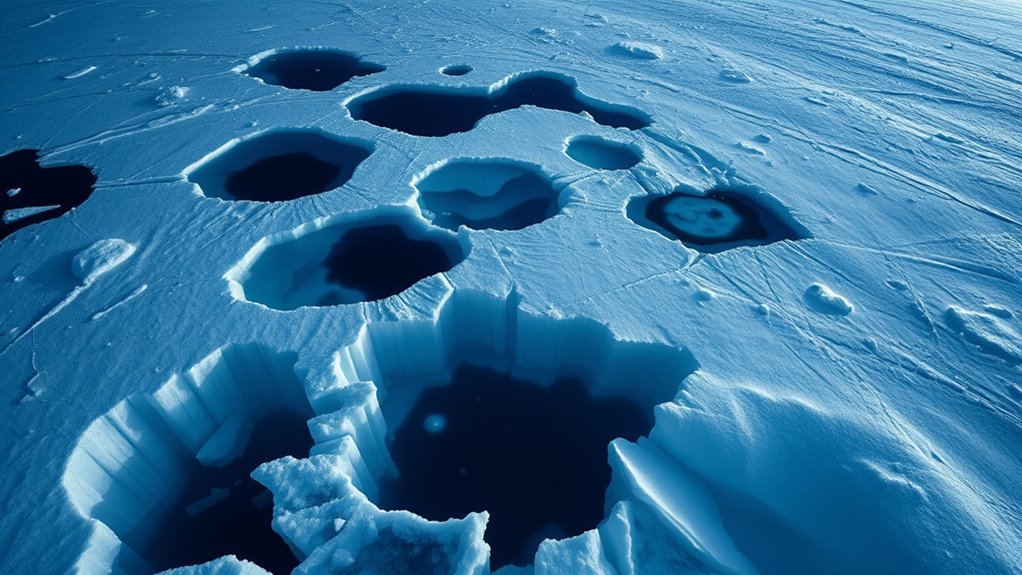
Ever wonder what secrets lie beneath Antarctica’s icy surface? Thanks to advances in artificial intelligence, scientists are now uncovering the mysteries of this frozen continent’s hidden ecosystems with unprecedented detail. These AI-powered insights are transforming our understanding of Antarctica’s diverse environments, from its ice-free lands to its submerged and subglacial worlds.
Antarctica’s ice-free areas host one-of-a-kind terrestrial ecosystems. Here, you’d find hardy plants like lichens, mosses, Antarctic hairgrass, and pearlwort, which survive despite extreme conditions. Tiny creatures—mites, springtails, tardigrades, nematodes, algae, and microbes—form complex communities essential to ecosystem stability. Land-breeding seabirds, such as penguins, petrels, gulls, skuas, and albatrosses, nest and raise their young in these zones, creating bustling colonies. As climate change causes ice-free patches to expand, connectivity among these habitats increases. This shift allows species from lower latitudes to migrate and establish new populations, potentially reshaping the entire ecosystem. AI models help scientists monitor these changes, develop classification systems, and predict future distribution patterns, aiding conservation efforts under the Antarctic Treaty System. Additionally, color accuracy in environmental data collection is crucial for effectively understanding these ecosystems.
Antarctica’s ice-free zones host unique ecosystems, expanding with climate change and aided by AI-driven monitoring and conservation efforts.
Beneath the ice sheets, hundreds of subglacial lakes remain isolated from surface ecosystems for millennia. Mercer Subglacial Lake, buried under a kilometer of ice, hosts microbial communities with unique genetic profiles. Researchers analyze thousands of single-cell genomes to understand how these microbes survive in complete darkness, with limited nutrients, and in extreme pressure. These microbes demonstrate metabolic flexibility, switching between heterotrophic and chemoautotrophic lifestyles depending on oxygen availability. The SALSA project employs AI-driven, contamination-free sampling techniques to study these microbes, revealing insights into life’s resilience in isolated environments. These findings not only expand our understanding of microbial adaptation but also inform astrobiology, offering clues about potential life on other icy worlds.
Underneath the ice shelves, vibrant marine ecosystems thrive, despite the darkness and scarcity of nutrients. Autonomous underwater vehicles and ROVs map these habitats, revealing communities of icefish, octopuses, corals, sponges, and giant sea spiders. These ecosystems persist for decades or even centuries, with some species fixed to the seabed, making them vulnerable to rapid environmental changes like iceberg calving events that expose new seabed areas. AI tools analyze these data to understand how such ecosystems respond to shifting ice dynamics and to forecast future impacts of climate change on these fragile habitats.
The Southern Ocean surrounding Antarctica harbors critical biodiversity hotspots, including habitats vital for species like Adélie penguins, Weddell seals, and humpback whales. AI-driven assessments identify thirty new protected areas, ensuring these resilient ecosystems receive conservation priority. As human impacts grow, AI helps optimize the placement of marine protected zones, balancing ecological needs with ongoing research and activity restrictions. These technological advancements are key to safeguarding Antarctica’s unique, interconnected ecosystems, which play a vital role in Earth’s climate and biodiversity.
Frequently Asked Questions
How Does AI Differentiate Between Various Antarctic Microorganisms?
You can see how AI differentiates Antarctic microorganisms by analyzing genetic data like 16S and 18S rRNA sequences, using machine learning models such as deep learning and support vector machines. It also examines metagenomic data to identify unculturable microbes, and classifies morphotypes with DNA sequencing. Additionally, AI automates phylogenetic analysis, recognizing unique sequence patterns, and integrates environmental data to understand microbial diversity and ecological roles in extreme cold environments.
What Challenges Are Faced When Deploying AI in Extreme Cold Environments?
You face significant challenges deploying AI in extreme cold environments. For instance, sensors can malfunction in sub-zero temperatures, with data gaps increasing by up to 30%. Ice buildup and snowfall cause measurement errors, while prolonged darkness limits solar power. Additionally, limited infrastructure and energy constrain computing power, making it tough to process data reliably. These factors hinder AI’s ability to operate continuously, reducing data accuracy and complicating ecosystem monitoring efforts.
Can AI Predict Future Changes in Antarctica’s Ecosystem?
Yes, AI can predict future changes in Antarctica’s ecosystem by analyzing environmental data like temperature, ice cover, and ocean currents. You can rely on AI models to forecast shifts in species distribution, productivity, and habitat conditions over time. These predictions help you understand potential impacts of climate change, guiding conservation efforts and adaptive strategies to protect fragile ecosystems from ongoing and future environmental changes.
How Accurate Are AI Models in Identifying Unknown Species?
AI models are surprisingly modest in identifying unknown species, with accuracy often feeling like catching shadows in fog. They can classify unknown inputs at broader taxonomic levels like genus with around 81% accuracy, but struggle with species-level identification, especially with limited data—sometimes only 2-3%. Morphological similarities and scarce training observations hinder precise recognition. To improve, continuous updates and more training data are essential, gradually turning AI into a sharper tool for discovering new life forms.
What Role Does AI Play in Protecting Antarctic Biodiversity?
AI plays a vital role in protecting Antarctic biodiversity by enabling rapid species detection, monitoring habitat changes, and predicting environmental threats. You benefit from its ability to process large data sets in real-time, helping conservationists identify vulnerable species and sensitive habitats quickly. AI’s predictive models inform decision-making, support early warnings for climate impacts, and guide adaptive management strategies, ultimately enhancing efforts to preserve the unique and fragile ecosystems of Antarctica.
Conclusion
As you uncover Antarctica’s hidden ecosystems through AI, remember that “the more you learn, the more you realize how much you don’t know.” These advancements remind us that even the coldest, most remote places hold secrets worth exploring. By embracing technology and curiosity, you help protect these fragile environments. Keep pushing boundaries, because in the end, understanding is the first step toward preserving our planet’s most precious and mysterious corners.