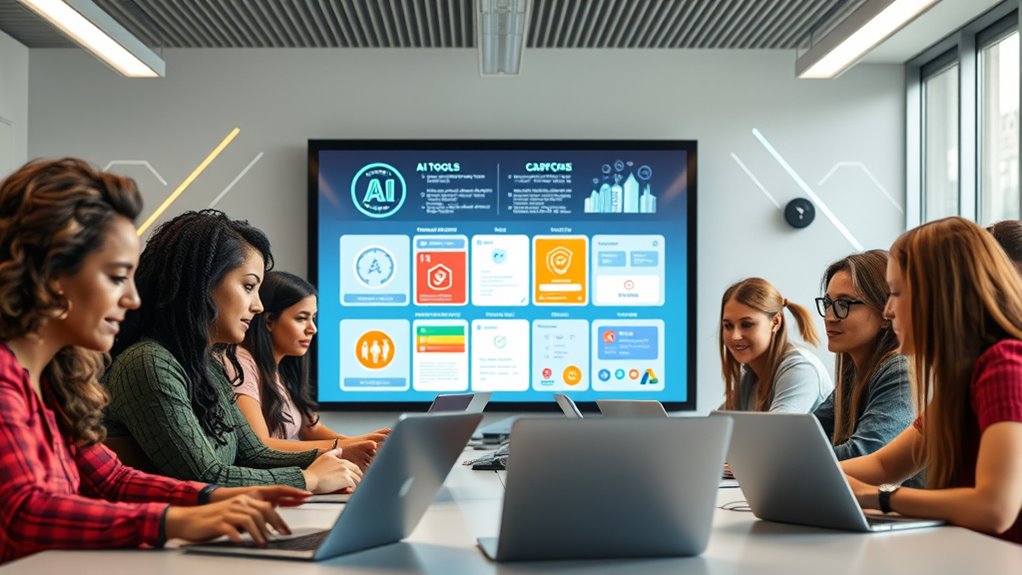

Big Tech companies are launching initiatives to transform teachers into AI-savvy educators by providing extensive training, tools, and resources. They’re partnering with industry leaders and teacher unions to guarantee ethical and responsible AI integration. These efforts aim to equip you with skills to use AI responsibly, enhance classroom experiences, and address concerns about job security. If you want to understand how these initiatives impact your teaching journey, keep exploring what’s next in this movement.

Get hardware and tech essentials delivered free with Prime
- Fast, free delivery on millions of items
- Prime Video, Amazon Music and more included
- Member-only deals all year
Key Takeaways
- Major tech companies like Microsoft, Google, and OpenAI are partnering with educators to develop AI training programs for teachers.
- Initiatives include free AI tools, resources, and comprehensive training to help teachers incorporate AI responsibly in classrooms.
- The American Federation of Teachers collaborates with industry leaders to create an AI training hub for educators nationwide.
- Programs focus on ethical AI use, enhancing lesson planning, grading, communication, and personalized learning.
- Federal and corporate efforts aim to equip teachers with AI literacy, making them proficient in guiding digital and AI-driven education.

Have you ever wondered how big technology companies are shaping the future of education? They’re launching initiatives that aim to transform teachers into AI-savvy educators, ensuring they’re prepared for an increasingly digital classroom. The White House’s nationwide AI education initiative is a prime example, with commitments from Amazon, Google, Anthropic, Brainly, and others to boost AI literacy across U.S. schools. This effort isn’t just about new tools; it’s an all-encompassing push to equip teachers and students with skills needed for an AI-driven world. The “Pledge to America’s Youth: Investing in AI Education” emphasizes expanding resources, training, and tools in classrooms nationwide. President Trump signed an executive order to support these efforts, underscoring federal backing for AI learning. Meanwhile, the Presidential AI Challenge engages K-12 students to develop AI solutions addressing local community problems, fostering practical skills and innovation early on. Government and industry leaders meet regularly to coordinate policies, aligning public goals with private sector capabilities to maximize impact.
Big Tech companies are making substantial commitments to support teachers directly. Amazon plans to train four million learners by 2028 and support 10,000 educators with AI curricula, backed by $30 million in AWS cloud credits. Microsoft has pledged to give every U.S. K-12 student free access to AI CoPilot for an entire year, along with over a million dollars in prizes for the Presidential AI Challenge, plus extensive LinkedIn Learning courses aimed at building AI skills. OpenAI, Microsoft, and Anthropic are working together to create a $23 million AI training hub for educators via the American Federation of Teachers, focusing on practical classroom applications. Meta and Pearson have committed over $20 million specifically for AI tools tailored to school districts serving military communities. Other companies like HP, Zoom, NVIDIA, and Mastercard are also investing heavily in teacher training, grants, and AI literacy programs, fueling a robust ecosystem of support.
Partnerships between teacher unions and tech giants are central to this movement. The American Federation of Teachers, which represents 1.8 million educators, teamed up with Microsoft, OpenAI, and Anthropic to develop a national AI training hub. Microsoft’s $12.5 million investment over five years aims to equip teachers with practical skills in AI for lesson planning, grading, communication, and personalized instruction. These training programs focus on helping teachers incorporate AI ethically and responsibly into their classrooms, addressing concerns about job security and learning quality. Despite occasional tensions, educators and tech companies share a common goal: preparing students for a future where AI is integral. This collaboration aims to make AI literacy accessible, ethical, and relevant, empowering teachers to lead the way as they adapt to technological change. Through these efforts, teachers are no longer just facilitators—they’re becoming AI-ready professionals capable of guiding students in an increasingly complex digital landscape. Additionally, the federal government’s commitment to training teachers underscores the importance of AI education in today’s classrooms. Furthermore, the emphasis on Cultural Intelligence ensures that educators can effectively navigate diverse classrooms while integrating AI into their teaching practices.
As an affiliate, we earn on qualifying purchases.
Frequently Asked Questions
How Will Teacher Privacy Be Protected During AI Training?
You can protect your privacy during AI training by ensuring platforms encrypt chat data and anonymize information before it’s used. Make sure you’re informed about data privacy laws like FERPA and give consent when necessary. Always choose secure, compliant platforms and stay updated on regulatory policies. By actively engaging in ethical AI practices and understanding data protections, you help keep your personal and student data safe throughout the training process.
What Is the Timeline for Nationwide Implementation?
By 2027, most U.S. classrooms will have integrated AI tools like Microsoft CoPilot and Reading Coach. You can expect widespread adoption, with over 60% of educators using AI daily. The rollout starts in late 2024 with training hubs and microcredentials, expanding through 2025 and 2026. Full implementation aims to empower teachers nationwide, transforming education into a more personalized, tech-savvy experience over the next few years.
Are There Plans for Ongoing Teacher Support Post-Training?
Yes, there are plans for ongoing support after your training. You’ll receive continuous technical assistance and access to resources to help you implement AI tools effectively. The program emphasizes real classroom feedback to improve training and offers regular updates on AI advancements. Additionally, the initiative includes dedicated hubs and online platforms where you can collaborate with peers, ensuring you stay current and confident in integrating AI into your teaching practices.
How Will AI Tools Be Integrated Into Existing Curricula?
You’ll see AI tools woven seamlessly into your curriculum, transforming lessons and engaging students in new ways. Adaptive learning resources tailor content to individual needs, while generative AI helps you design assessments and enhance lesson plans effortlessly. As integration deepens, expect ongoing professional development to keep you ahead. Clear policies will guide your use of AI, ensuring privacy and integrity. This evolving partnership promises a smarter, more dynamic educational experience—if you embrace it.
What Are the Costs Associated With This Project?
You’ll find that costs include funding for training programs, building and operating AI hubs, and developing tailored curricula and certification materials. Expect expenses for upgrading school tech infrastructure, supporting teacher time, and administrative coordination. Additional costs cover reaching underserved communities, creating inclusive content, and scaling training efforts. Ongoing expenses involve monitoring program effectiveness and updating resources, ensuring equitable access and effective AI integration across diverse educational settings.
As an affiliate, we earn on qualifying purchases.
Conclusion
So, stay sharp and seize this shift, as tech transforms teaching into a trailblazing territory. Embrace the evolving ecosystem, empower educators with essential expertise, and ignite innovation in your classroom. By bridging the binary with the human, you’ll build a bold, brighter future where teachers thrive as tech-savvy trailblazers. Don’t delay—dive into this dynamic development and drive your digital destiny today!
AI-powered classroom management software
As an affiliate, we earn on qualifying purchases.
As an affiliate, we earn on qualifying purchases.
As an affiliate, we earn on qualifying purchases.
Halloween Picks
halloween
As an affiliate, we earn on qualifying purchases.