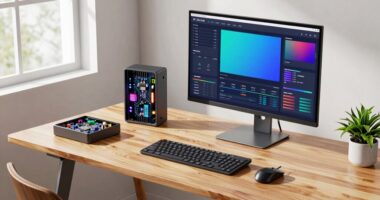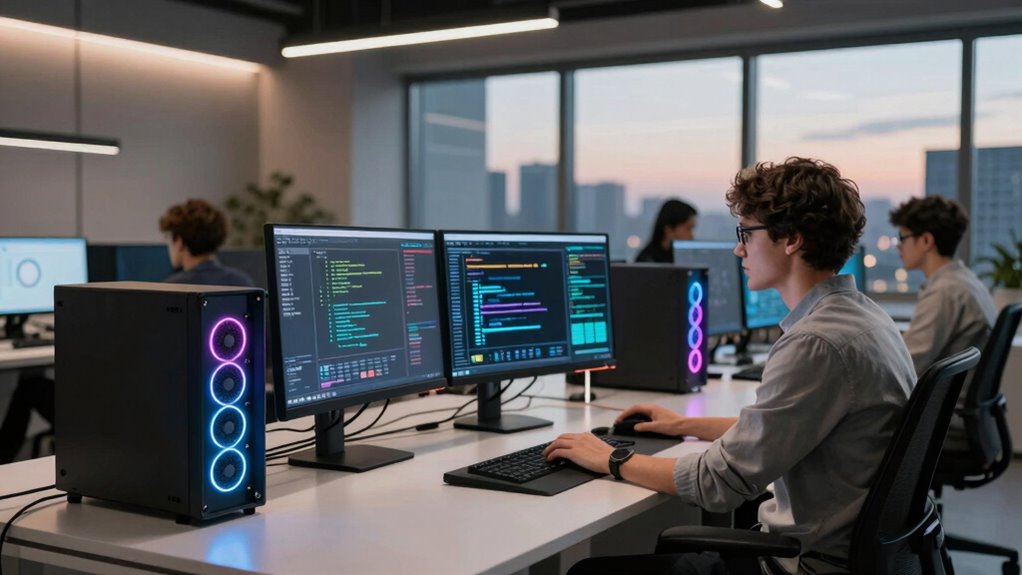

AI workstations are becoming more relevant for small teams because advances in hardware now offer powerful, affordable tools you can set up locally. With these systems, you can handle data training, model testing, and collaboration without relying on costly cloud services. They improve efficiency, security, and scalability, giving you better control over your projects. If you want to discover how these innovations can boost your team’s AI capabilities, keep exploring what’s possible.

Get hardware and tech essentials delivered free with Prime
- Fast, free delivery on millions of items
- Prime Video, Amazon Music and more included
- Member-only deals all year
Key Takeaways
- Advances in affordable, energy-efficient AI hardware make powerful workstations accessible for small teams.
- In-house training and testing reduce latency and streamline AI project workflows.
- Shared workstations enhance collaboration, enabling multiple experiments and seamless data sharing.
- Owning hardware lowers long-term costs and allows easy upgrades tailored to project needs.
- Increased data security and control give small teams a competitive edge in innovation.
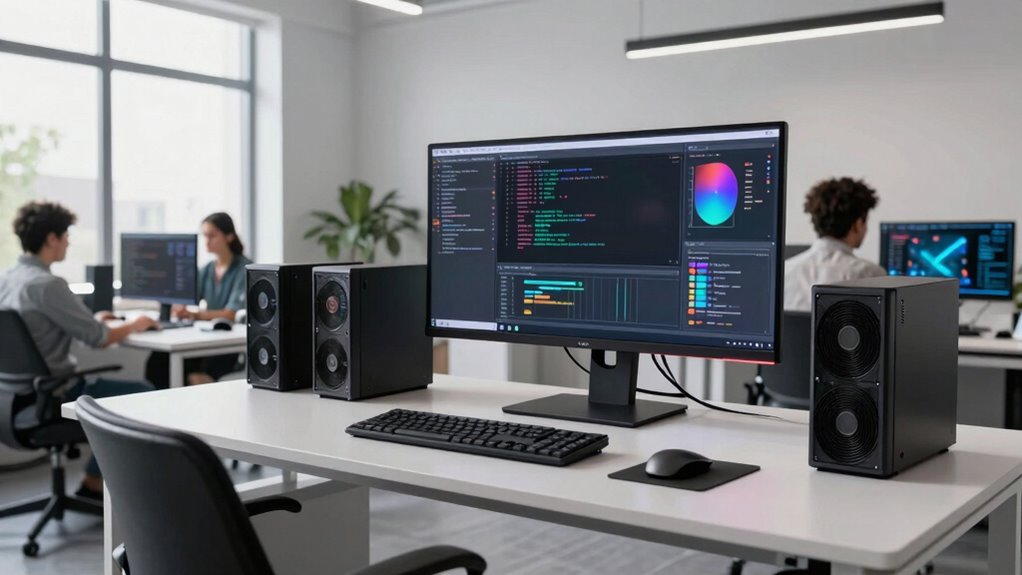
Small teams looking to harness the power of AI no longer need massive budgets or extensive resources. Advances in AI hardware have made sophisticated tools more accessible, allowing smaller groups to compete with larger organizations. Instead of relying on cloud-based solutions or outsourcing, you can now invest in dedicated AI workstations that fit within your budget. These workstations come equipped with powerful GPUs, ample memory, and fast processors, giving you the computing muscle necessary for complex AI tasks. With the right AI hardware, your team can perform data training, model development, and testing directly in-house, reducing latency and increasing efficiency.
The shift toward dedicated AI workstations also emphasizes team collaboration. When everyone works on the same hardware setup, it becomes easier to share data, models, and insights. You can foster a more integrated environment where different team members—whether data scientists, developers, or domain experts—collaborate seamlessly. This shared hardware setup minimizes compatibility issues and streamlines communication, so you spend less time troubleshooting and more time innovating. Plus, with AI hardware designed for multitasking, your team can run multiple experiments simultaneously, speeding up project timelines and boosting productivity. Additionally, the availability of cost-effective AI hardware options has made it easier for small teams to scale their operations without significant financial strain. As AI hardware continues to improve, it also offers more energy-efficient solutions, which can help reduce operational costs and environmental impact. Embracing accessible AI hardware is essential for small teams aiming to stay competitive in a rapidly evolving tech landscape.
Another reason AI workstations are gaining relevance is their cost-effectiveness. Cloud solutions often come with ongoing expenses that add up over time, especially when you need to run intensive computations regularly. Investing in a dedicated AI workstation might seem costly upfront, but it pays off in the long run by reducing operational costs and giving you full control over your hardware. You can customize your setup to meet your specific needs and upgrade components as your projects grow, ensuring your team stays ahead without constantly relying on external providers. As AI hardware continues to advance, these workstations are becoming even more powerful and versatile.
Furthermore, owning your AI hardware enhances data security. Small teams often handle sensitive data, and relying solely on cloud platforms can introduce vulnerabilities. With your own AI workstation, you maintain tighter control over your data, ensuring compliance with privacy regulations and protecting proprietary information. This physical control over hardware simplifies security protocols and minimizes risks associated with data breaches.
In the end, AI workstations are no longer just the domain of big corporations with deep pockets. They are becoming essential tools for small teams *desirous* to innovate quickly, collaborate more effectively, and stay competitive. By investing in the right AI hardware, you empower your team to tackle complex problems head-on, accelerating your journey from idea to implementation. As AI technology continues to evolve, small teams that embrace these workstations will find themselves better equipped to leverage AI’s full potential.
AI workstation with high-performance GPU
As an affiliate, we earn on qualifying purchases.
As an affiliate, we earn on qualifying purchases.
Frequently Asked Questions
How Do AI Workstations Differ From Regular Desktops?
AI workstations differ from regular desktops by offering advanced hardware customization, like powerful GPUs and faster CPUs, tailored for AI tasks. They also focus on software optimization, ensuring smooth handling of complex algorithms and large datasets. This means you get enhanced performance and efficiency, making AI workstations ideal for intensive workloads. Unlike standard desktops, they’re built to support demanding AI applications, helping you work faster and more effectively.
What Is the Cost Comparison for Small Teams?
You’ll find that AI workstations often cost more upfront than regular desktops, but they offer better cost efficiency over time. Their advanced processing power reduces the need for multiple devices, saving space and energy. For small teams, this means smarter budget planning, as investing in an AI workstation can boost productivity and cut long-term operational costs. While the initial investment is higher, the overall value makes it a wise choice for growing teams.
Are AI Workstations Suitable for Non-Technical Users?
Ever wondered if AI workstations are user-friendly for non-technical folks? They can be, with intuitive user interfaces designed for ease of use. While some user training might be necessary initially, many systems offer step-by-step guides and support. This makes AI workstations increasingly accessible for small teams without deep technical skills, empowering you to leverage AI power without a steep learning curve.
How Scalable Are AI Workstations for Future Growth?
AI workstations are quite scalable for future growth, but you should consider potential scalability challenges like hardware limitations and software compatibility. To future-proof your setup, adopt strategies such as modular components, cloud integration, and regular upgrades. This approach allows you to expand processing power and storage seamlessly, ensuring your workstation adapts to increasing workload demands without significant disruptions or costs, keeping your team ready for evolving AI projects.
What Are the Maintenance Requirements for AI Workstations?
It’s not a trip to the Moon, but maintaining AI workstations requires effort. You need to regularly perform hardware upgrades to keep up with demanding tasks, and software updates are essential for security and efficiency. Keep an eye on cooling systems and dust buildup to prevent overheating. Routine checks and cleaning ensure your workstation runs smoothly, minimizing downtime and extending its lifespan. Staying proactive with maintenance keeps your AI projects on track.
As an affiliate, we earn on qualifying purchases.
Conclusion
In a world where AI workstations are transforming possibilities, small teams find new opportunities, new efficiencies, and new innovations. You no longer need a big budget or a large team to harness powerful AI tools. You can create, collaborate, and compete on equal footing. AI workstations level the playing field, reveal your potential, and turn your ideas into reality. Embrace the future, empower your team, and watch your projects thrive.
As an affiliate, we earn on qualifying purchases.
customizable AI desktop computer
As an affiliate, we earn on qualifying purchases.
As an affiliate, we earn on qualifying purchases.
Columbus Day / Indigenous Peoples' Day Picks
long weekend sales
As an affiliate, we earn on qualifying purchases.