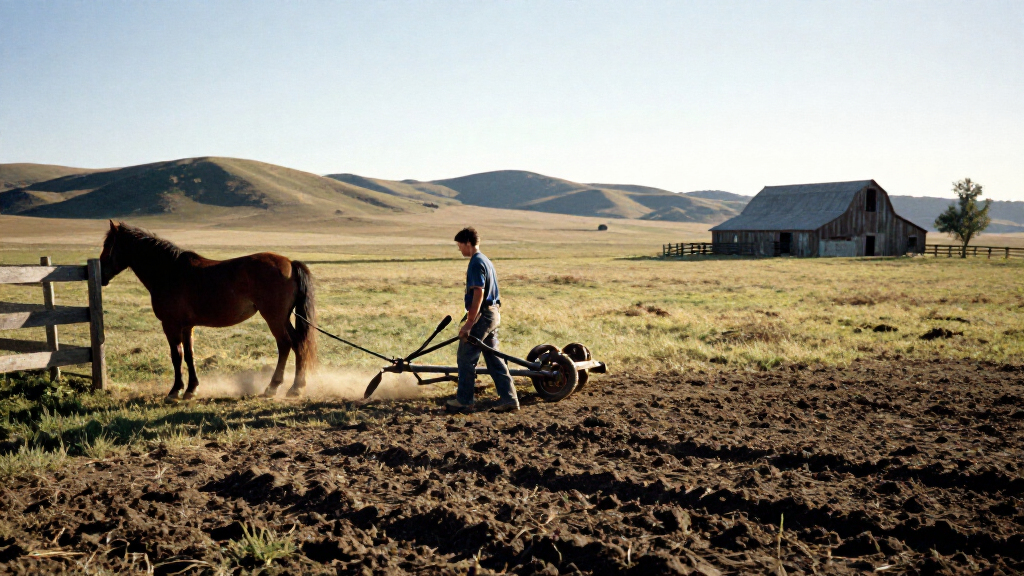

🔍 Read the full analysis: How Mechanized Farming Changed Life For Working Animals on ThorstenMeyerAI.com

Get hardware and tech essentials delivered free with Prime
- Fast, free delivery on millions of items
- Prime Video, Amazon Music and more included
- Member-only deals all year
TL;DR
U.S. farm horses and mules peaked at 26.7 million in 1918, then declined to 3.1 million by 1960 as tractors and other machinery spread. Mechanization reduced demand for working animals and farm labor, while raising questions about how closely that history applies to automation today.
U.S. farm horses and mules declined from a peak of 26.7 million in 1918 to 3.1 million by 1960 as tractors and other machinery took over much of their work, according to historical government statistics cited in a Nov. 4 account by ThorstenMeyerAI.com. The shift changed the use of farmland and reduced demand for both working animals and farm labor, making the episode a reference point in current debates about automation.
The U.S. Census Bureau’s Historical Statistics of the United States, Colonial Times to 1970 reprints Agriculture Department estimates that horses and mules on farms peaked at 26.7 million on Jan. 1, 1918. Horses alone reached 21.4 million in 1915; the combined total later included 5.5 million mules. These animals powered ploughs, seed drills, reapers and wagons, but required land and feed even when not working.
In 1915, farmers grew feed for horses and mules on about 93 million acres, out of 340 million acres of harvested cropland, the source account says. The acreage was still about 90 million in 1920, before falling to around 5 million by 1960. The figures describe land used to produce feed, not land that necessarily became available for a single alternative crop.
Tractor numbers rose rapidly: the account reports about 1,000 on U.S. farms in 1910, 246,000 in 1920 and 4.69 million in 1960. Around 1955, tractors first outnumbered farm horses and mules, with 4.35 million tractors compared with 4.31 million animals. The Fordson, launched by Ford in 1917, was described by The Henry Ford museum as a lightweight, inexpensive mass-produced tractor aimed at smaller farms. Other machinery, including combines, corn pickers, balers and milking machines, also spread.
Machinery Reshaped Farms and Jobs
The shift was not only a change in farm equipment. By replacing animal power, tractors reduced the need to grow feed and freed land for other uses. The source account says the Department of Agriculture’s estimate of how many people one farm worker supplied rose from 7.1 in 1910 to 47.1 in 1970. That measure includes people abroad supplied through exports, so it is not a simple count of domestic consumers per worker.
Farm employment also fell: the figures cited in the account show a peak of 13.6 million in 1916 and 4.5 million by 1970, while the U.S. labor force doubled. The account says new jobs were increasingly in cities, requiring many people to move. Those figures establish a broad employment shift, but do not by themselves show how much of the change was caused by tractors alone; other machinery, agricultural inputs and wider economic changes were also involved.
The history matters in present discussions of automation because it shows that a technology can eliminate demand for a type of work without a single dramatic event. The animals were not retrained: according to the account, farmers stopped breeding replacements, and the working population declined as animals aged. The effects on people were different, involving changes in employment and location rather than a direct equivalent to the loss of animal work.
Products Worth Considering

Bose SoundLink Flex Bluetooth Speaker (2nd Gen) – Portable Outdoor Speaker with Hi‑Fi Audio, Waterproof and Dustproof, USB‑C, Up to 12 Hours

Anker SOLIX S2000 Solar Powered Generator, 2010 Wh, 1500 W

Amazon Kindle Paperwhite (2024), 16 GB, 7-inch Display, Black
As an affiliate, we earn on qualifying purchases.
From Animal Power to Tractors
Tractors existed before the First World War, but early models were heavy, expensive and better suited to large farms, according to the source account. Ford’s 1917 Fordson helped broaden access. The Henry Ford museum calls it “the first mass-produced and inexpensive lightweight tractor” and says it was built “to meet the needs of small farmers.” The account reports that the 100,000th Fordson left the assembly line on Feb. 21, 1920.
The transition unfolded over decades rather than overnight. The cited series puts farm horses and mules at 25.7 million in 1920, 19.1 million in 1930, 14.6 million in 1940 and 7.8 million in 1950. Tractor totals rose over the same period. The underlying counts use census figures taken on somewhat different dates, and the account notes that, from 1951, the Agriculture Department counted horses and mules together.
The comparison with today’s automation has limits. In 1983, economist Wassily Leontief compared workers with horses displaced by tractors, but the source account notes that Leontief also identified a difference: horses could not vote. Current farm automation is not a direct repeat of the earlier change. The source says John Deere’s 16-camera autonomous kit, announced in February 2025, performs tillage on selected large tractors. It also reports China’s claim that about 74% of ploughing, sowing and harvesting was mechanized in 2023; that figure is attributed to China and its precise measurement basis is not specified in the supplied material.
““The first mass-produced and inexpensive lightweight tractor.””
— The Henry Ford museum, describing the Fordson
Limits of the Horse Comparison
The historical counts show the scale and timing of the decline, but the supplied material does not isolate the contribution of tractors from other changes in farming, including combines, improved seeds, fertilizer and other equipment. It also does not provide a detailed account of where individual horses and mules went; it says farmers stopped breeding replacements and the working population aged out.
The analogy to workers today remains an interpretation, not a rule that automation will produce the same employment effects. The account does not establish how many jobs current farm robots will replace, which occupations may grow, or how the consequences will differ across countries. The reported Chinese mechanization share is attributed to China, but the source material does not describe its methodology.
What Current Farm Robots Can Do
The historical account points to narrow, task-specific uses of farm autonomy rather than a fully automated replacement for farm labor. It says John Deere’s 16-camera kit, introduced in February 2025, handles tillage on selected large tractors. The next questions are how widely such systems are adopted, which tasks they can perform reliably and how they affect farm staffing and costs. The supplied material does not give adoption totals or a timeline for broader use.
As more data become available, comparisons with the horse era will depend on evidence about jobs displaced, new work created, and whether affected workers can move into it. For now, the historical record confirms a sharp decline in working animals and a long change in farm employment; it does not settle what the next wave of agricultural automation will mean for people.
Key Questions
When did farm horses and mules peak in the United States?
The cited historical estimates put their combined peak at 26.7 million on Jan. 1, 1918. Horses alone had peaked at 21.4 million in 1915.
How many farm horses and mules remained by 1960?
The account cites a total of 3.1 million in 1960, down from the 1918 peak. It describes the decline as almost 90%.
Why did tractors replace working animals?
Tractors could do farm work without requiring year-round feed. The source says about 93 million acres were used to grow feed for horses and mules in 1915, while the area had fallen to around 5 million acres by 1960.
Did mechanization reduce farm employment?
Farm employment fell from a cited peak of 13.6 million in 1916 to 4.5 million by 1970. The figures show a decline during the mechanization era, but they do not establish that machinery alone caused the entire change.
Does the horse analogy predict what automation will do to human workers?
No. It is a historical comparison, not a settled prediction. The source account notes that human workers differ from horses, including because people can vote, and does not establish the scale or distribution of future job losses from farm robots.
Source: ThorstenMeyerAI.com