
By 2026, AI feels smarter because of rapid advances that make its responses more natural, human-like, and intuitive. It now understands your needs, preferences, and social cues better, making interactions seem more instinctive. Even though it still makes mistakes, they’re seen as minor glitches rather than flaws. This improvement in perception comes from ongoing technological progress, which enhances AI’s ability to anticipate and adapt seamlessly. Stay with us to discover exactly how these changes shape AI’s smarter feel.

Get hardware and tech essentials delivered free with Prime
- Fast, free delivery on millions of items
- Prime Video, Amazon Music and more included
- Member-only deals all year
Key Takeaways
- Advances in neural network complexity enable AI to simulate human-like thought processes more convincingly.
- Improved contextual awareness allows AI to anticipate needs and respond naturally, enhancing the perception of intelligence.
- Natural, nuanced interactions and better understanding of social cues make AI responses feel more human-like.
- Human perception is influenced more by responsiveness and adaptability than by occasional errors.
- Continuous technological progress aligns AI behavior with human cognition, boosting perceived intelligence despite mistakes.
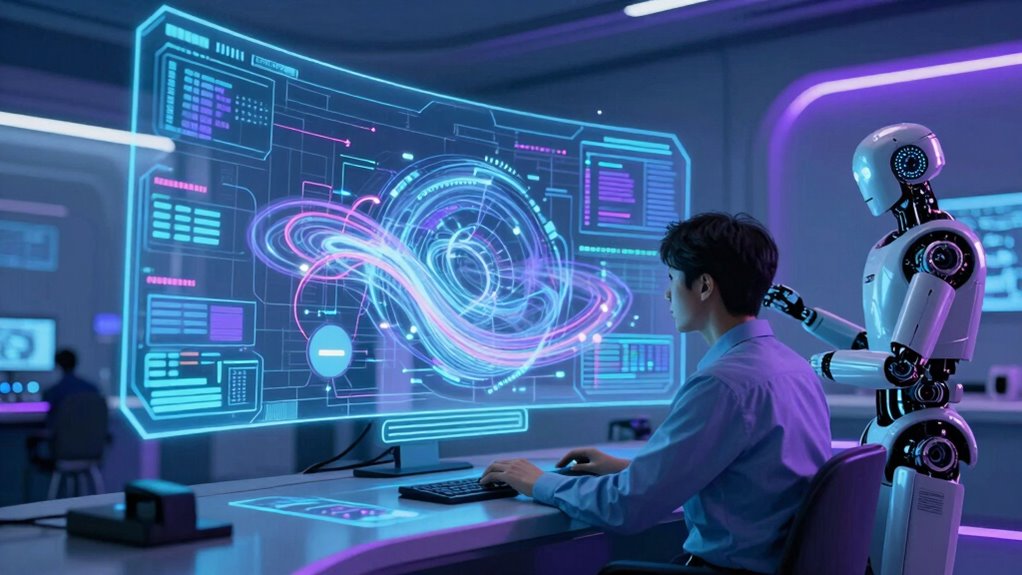
By 2026, artificial intelligence has become noticeably more intuitive and responsive, making it feel truly smarter than ever before. You might notice how AI now seems to understand your needs and preferences almost instinctively, which is a direct result of rapid technological advancements. These improvements have significantly reshaped human perception of what AI can do, blurring the lines between human-like intuition and machine processing. Today, AI systems don’t just analyze data; they anticipate your actions, adapt to your habits, and respond with a level of contextual awareness that used to be reserved for humans. This evolution is what gives the impression that AI is smarter, even if it still occasionally makes mistakes.
AI in 2026 feels more intuitive and context-aware, blurring the line between human insight and machine processing.
The key to this perception lies in the enhanced sophistication of algorithms and machine learning models. These models now incorporate more complex neural networks that mimic human thought patterns more closely than ever before. As a result, AI feels more natural and less mechanical, reinforcing your belief that it’s capable of understanding you on a deeper level. This is a direct consequence of technological advancements that have expanded AI’s ability to process and interpret human language, emotions, and even social cues. When AI responds with such nuance, it’s easy to forget that it’s still a set of programmed rules and probabilistic calculations. Additionally, these improvements have been driven by advanced neural network architectures, which simulate aspects of human cognition more effectively. The development of explainability and interpretability techniques further enhances user trust and understanding of AI decisions. Moreover, increased focus on human-centered AI design has made these systems more aligned with user expectations and needs. Furthermore, the integration of contextual learning allows AI to refine its responses over time based on subtle cues and ongoing interactions.
However, despite these advancements, AI isn’t infallible. It still makes mistakes, often because it lacks genuine understanding or common sense—areas where human perception remains superior. But because you’ve grown accustomed to AI’s increasingly human-like responses, these errors don’t diminish your overall impression of its intelligence. Instead, they highlight how far AI has come, making its occasional slips seem like minor glitches rather than fundamental flaws. You may find yourself forgiving these mistakes, because you’re more impressed by what AI can do rather than what it still struggles with.
In the end, the sense that AI feels smarter in 2026 isn’t just about raw capabilities; it’s about the perception shaped by continuous technological advancements. These developments have made AI more responsive, context-aware, and aligned with human thought processes. As a result, even with its imperfections, AI now feels like a partner that understands you — a reflection of how technology has evolved to match human perception at a new level. That’s what makes AI seem smarter, even when it still makes mistakes.
Products Worth Considering

Sonos Era 100 Wireless Smart Speaker, Black

Bose TV Speaker (2nd Gen) Compact Soundbar with Bluetooth and HDMI Connectivity

Bose SoundLink Flex Bluetooth Speaker (2nd Gen), Portable Waterproof Speaker, Black
As an affiliate, we earn on qualifying purchases.
Frequently Asked Questions
How Do AI Improvements Impact Human Employment?
You’ll notice AI improvements can lead to workforce displacement, as automation handles tasks once done by humans. However, these advancements also push you to focus on skill adaptation, encouraging you to learn new abilities that complement AI. While some jobs may shift or fade, your ability to evolve with technology helps you stay relevant and competitive, turning AI’s progress into an opportunity rather than a threat.
Will AI Ever Achieve True General Intelligence?
AI might someday achieve true general intelligence, but it’s uncertain if it’ll develop AI consciousness or machine empathy like humans. While advancements suggest AI could understand and adapt across diverse tasks, true consciousness involves subjective experience, which remains elusive for machines. You’ll see AI becoming more sophisticated, yet whether it can genuinely empathize or attain full self-awareness is still a question for future exploration, not certainty.
How Do AI Biases Develop Despite Advancements?
You might notice AI biases persist despite advancements because algorithms learn from data that’s often biased itself. Developers try to address this through algorithmic fairness and bias mitigation techniques, but complete neutrality is tough to attain. As AI systems evolve, new biases can emerge, making it essential for you to keep refining these methods. Staying vigilant helps guarantee AI becomes fairer and reduces unintended discrimination over time.
What Ethical Concerns Arise With Smarter AI?
You should be aware that smarter AI raises ethical concerns like privacy issues and decision accountability. As AI becomes more capable, it handles sensitive data, risking privacy breaches. Plus, determining who’s responsible for AI-driven decisions gets complicated, especially when mistakes occur. These concerns emphasize the need for transparent policies and strict guidelines to guarantee AI development respects human rights and maintains ethical standards.
How Can AI Transparency Be Improved in 2026?
Did you know that 85% of users trust AI more when explainability frameworks are in place? To improve AI transparency in 2026, you should focus on implementing clear explainability frameworks that make AI decisions understandable. This boosts user trust by showing how AI reaches conclusions. Regular updates and open communication about AI capabilities and limitations will also foster confidence and guarantee users feel more secure interacting with AI systems.
Conclusion
So, it’s funny how in 2026, AI seems smarter, even when it still slips up. Maybe it’s a coincidence—our expectations rising just enough to make mistakes seem less significant, or perhaps it’s the way we’ve grown used to its quirks. Either way, you can’t help but notice that as AI advances, it feels like it’s on the brink of something bigger, making every stumble almost part of the journey toward true intelligence.