
Choosing between an NPU, GPU, or CPU depends on your AI tasks. If you need fast, energy-efficient inference for real-time applications, an NPU is ideal. For training large models quickly, a GPU offers high parallel processing. CPUs provide flexibility for varied workloads, but may lack speed for intensive AI tasks. Your decision should align with how you plan to use AI, and there’s more to take into account as you explore further options.

Get hardware and tech essentials delivered free with Prime
- Fast, free delivery on millions of items
- Prime Video, Amazon Music and more included
- Member-only deals all year
Key Takeaways
- The choice depends on whether your AI workload involves training (GPU), inference (NPU), or versatile system management (CPU).
- GPUs excel in large-scale parallel processing, ideal for deep learning model training, while NPUs optimize low-latency inference tasks.
- CPUs offer flexibility for diverse tasks like data preprocessing and smaller AI models, but may lack specialized AI acceleration.
- Energy efficiency and power consumption considerations influence hardware selection based on deployment environment and use case.
- Combining hardware types can optimize performance for complex AI systems, with the choice tailored to specific application requirements.
Understanding AI Hardware: NPUs, GPUs, and CPUs
Ever wondered what makes AI computations faster and more efficient? It all comes down to AI hardware evolution and how hardware manufacturing has advanced over time. Today’s AI hardware includes NPUs, GPUs, and CPUs, each designed for specific tasks. NPUs are optimized for neural network operations, making them ideal for deep learning. GPUs excel at parallel processing, handling large data sets swiftly. CPUs are versatile but less specialized. As hardware manufacturing progresses, these components become more powerful and energy-efficient. Innovations like smaller chip sizes and specialized architectures push AI capabilities further. Understanding these hardware differences helps you grasp why certain tasks run faster on specific processors. Additionally, improvements in manufacturing processes contribute to the development of more energy-efficient and powerful AI hardware. For example, advancements in semiconductor design play a crucial role in enhancing overall performance. Understanding these hardware differences helps you grasp why certain tasks run faster on specific processors. Backyard transformation essentials and the evolution of AI hardware shape how effectively AI applications perform, giving you better speed and efficiency tailored to your needs.
Key Differences Between AI Processors
You’ll notice that processing power and efficiency vary markedly among AI processors, affecting how well they handle demanding tasks. While some are highly specialized, offering peak performance for specific operations, others are designed to be more flexible across different workloads. Understanding these key differences helps you choose the right processor for your AI needs. Additionally, considering the ethical implications of AI hardware choices is crucial as technology advances. Recognizing the role of hardware design in influencing AI performance can also guide more sustainable and responsible technology development, especially as hardware efficiency becomes an increasingly important factor in reducing environmental impact. As AI security and surveillance technologies evolve, the impact of hardware on AI capabilities plays a significant role in shaping future innovations and their societal implications.
Processing Power and Efficiency
Understanding the differences in processing power and efficiency among NPU, GPU, and CPU is essential for choosing the right AI hardware. NPUs excel at handling specific AI tasks with high efficiency, reducing power consumption and supporting hardware longevity. GPUs offer massive parallel processing, making them ideal for training large models quickly, though they can be less power-efficient. CPUs provide versatility but may lack the raw power needed for intensive AI workloads. When considering AI ethics, efficiency becomes vital to minimize energy use and environmental impact. Your choice impacts not only performance but also hardware longevity, as more efficient processors tend to wear less over time. Additionally, precious metal investments like gold are increasingly considered as a hedge against economic volatility in the tech sector. Recognizing early indicators of hardware fatigue can help optimize maintenance and prolong the lifespan of AI systems. Moreover, understanding projector technology can inform decisions on how to best utilize hardware for immersive experiences.
Specialization and Flexibility
While all three processors—NPU, GPU, and CPU—are designed for computation, their specialization and flexibility differ markedly. NPUs excel at hardware versatility for specific AI tasks like neural network inference, offering high efficiency but limited task adaptability. GPUs are more flexible, handling a broad range of parallelizable tasks such as graphics rendering and machine learning, thanks to their adaptable architecture. CPUs prioritize task adaptability, capable of managing diverse workloads with greater flexibility, but often at lower efficiency for specialized AI tasks. Here’s a comparison:
| Feature | Specialization | Flexibility |
|---|---|---|
| NPU | Neural network acceleration | Limited to AI inference |
| GPU | Parallel processing for graphics | Moderate, adaptable |
| CPU | General-purpose computing | High, versatile |
Choosing the Right Hardware for Deep Learning Training
When choosing hardware for deep learning training, you need to take into account compatibility with your existing systems and frameworks. Balancing performance with your budget is vital to avoid overspending while still achieving efficient training times. Finding the right mix of hardware depends on your specific workload and long-term goals.
Hardware Compatibility Considerations
Choosing the right hardware for deep learning training hinges on understanding how different components—NPU, GPU, and CPU—match your specific workload needs. Hardware compatibility plays a critical role, especially regarding hardware integration and software compatibility. You need to guarantee that your chosen hardware integrates smoothly with your existing infrastructure and supports your preferred frameworks, like TensorFlow or PyTorch. Some hardware may require specific drivers or libraries, so verifying compatibility beforehand can save time and prevent bottlenecks. Additionally, consider whether your software ecosystem optimizes performance for certain processors. Mismatched hardware and software can lead to inefficiencies or crashes, so thorough research and testing are essential to assure your setup runs seamlessly and efficiently for your deep learning tasks. Understanding hardware integration in specialized environments can help ensure optimal performance and stability.
Furthermore, paying attention to heat management and cooling solutions is vital, as high-performance hardware generates significant heat, which can impact both safety and hardware longevity.
Performance and Cost Balance
Balancing performance and cost is essential when selecting hardware for deep learning training, as investing in the most powerful components isn’t always the most economical choice. You need to weigh factors like training speed, budget, and future scalability. For instance, quantum computing offers breakthroughs for specific tasks but is costly and niche. Blockchain integration can enhance security but adds complexity. To optimize, consider this comparison:
| Hardware Type | Cost Efficiency | Performance Focus | Ideal Use Case |
|---|---|---|---|
| CPU | High | Moderate | Versatile tasks |
| GPU | Moderate | High | Deep learning |
| NPU | Cost-effective | Specialized | AI acceleration |
Choosing the right hardware depends on your project scope and long-term goals.
When to Use a GPU, NPU, or CPU for AI Tasks
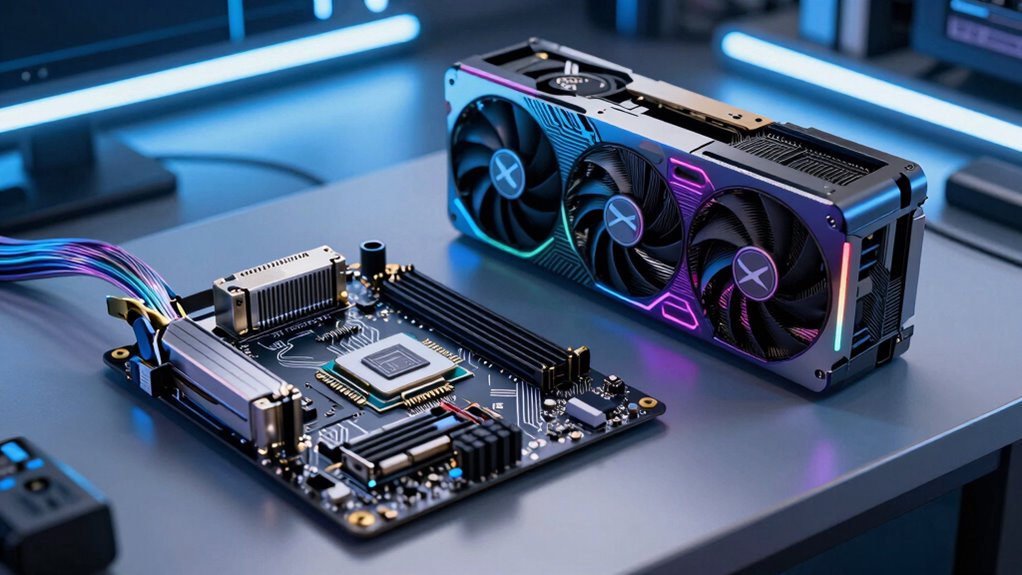
Understanding which processor to use for AI tasks depends on the specific requirements of your project. If you prioritize AI model scalability, a GPU often excels because it handles large neural networks efficiently. GPUs are designed for parallel processing, making them ideal for training complex models quickly. When low hardware latency is critical, such as in real-time applications, an NPU can provide faster inference due to its fine-tuned architecture tailored for AI workloads. Conversely, CPUs are better suited for tasks that require flexibility, data preprocessing, or running smaller models. Consider your project’s focus—whether it’s rapid training, real-time inference, or versatile processing—to determine the most suitable hardware. Choosing the right processor guarantees peak performance while managing AI model scalability and latency effectively. Additionally, understanding halal traditions can inspire ethical considerations in technology development and usage.
Edge AI and Real-Time Inference: Is an NPU the Best Fit?

As AI models become more prevalent at the edge, the need for efficient, low-latency processing in real-time applications grows. An NPU can be a strong choice for edge AI, offering fast inference and power efficiency. It’s ideal for applications like autonomous vehicles, surveillance, and smart devices, where quick decision-making matters. But consider these factors:
- Enhanced AI security through on-device processing
- Reduced data transmission risks and privacy concerns
- Ethical considerations around data handling and bias
- Limited flexibility compared to GPUs or CPUs
- Cost-effectiveness for specific use cases
While NPUs excel at real-time inference, you must weigh their capabilities against potential challenges in AI security and ethical responsibilities. The best fit depends on your application’s sensitivity to latency, security, and ethical implications.
Cost and Budget Considerations for AI Hardware
Choosing the right AI hardware often hinges on your project’s budget constraints, as costs can vary substantially between options like NPUs, GPUs, and CPUs. Many AI hardware myths circulate, leading some to overspend on high-end solutions when simpler options may suffice. To avoid this, focus on your actual needs and plan your hardware procurement accordingly. While GPUs might seem expensive upfront, they offer versatility and scalability, making them cost-effective for diverse tasks. Conversely, NPUs and CPUs can be more budget-friendly but may limit performance. Carefully evaluating your workload and long-term goals helps you avoid unnecessary expenses. Remember, selecting hardware based solely on cost without considering your use case can lead to inefficient investments and hinder your AI project’s success.
Power and Energy Efficiency in AI Hardware
You’ll want to contemplate how different hardware options consume power during AI tasks, as energy efficiency can substantially impact operational costs. Optimizing hardware for better efficiency helps reduce energy use without sacrificing performance. Understanding these differences allows you to choose the most suitable solution for your energy-conscious projects. Additionally, considering the performance characteristics of each hardware type ensures that you select the option best aligned with your specific AI workload requirements. For example, some hardware may handle specific tasks more efficiently, which can influence your overall energy consumption and operational costs. Being aware of security implications related to hardware choices can also be crucial in safeguarding your AI infrastructure. Recognizing the power consumption patterns of each hardware type can further guide you toward more sustainable and cost-effective AI deployments. Furthermore, understanding the energy efficiency metrics used to evaluate hardware can help you make more informed decisions about deployment and scalability.
Energy Consumption Differences
Have you ever wondered which hardware type—NPU, GPU, or CPU—consumes the least power during AI processing? Generally, NPUs excel in energy savings and power efficiency because they’re designed specifically for AI workloads, reducing unnecessary energy use. GPUs tend to consume more power due to their high throughput, making them less efficient for simple tasks. CPUs offer versatility but often fall short in energy efficiency compared to specialized hardware.
- NPUs optimize for low power consumption
- GPUs prioritize speed over energy savings
- CPUs balance versatility and moderate power use
- Energy-efficient hardware reduces operational costs
- Power efficiency varies based on workload and design
Choosing the right hardware depends on your AI task’s energy demands and efficiency goals.
Hardware Efficiency Optimization
Optimizing hardware efficiency involves implementing strategies that maximize performance while minimizing power consumption. You can achieve this through neural network optimization, which streamlines models to require less energy without sacrificing accuracy. Quantum computing also offers promising potential, enabling complex calculations with markedly lower power demands compared to traditional hardware. By leveraging these technologies, you reduce energy waste and improve overall efficiency. Selecting the right hardware—whether NPU, GPU, or CPU—depends on your specific AI workload and how you optimize neural networks. Fine-tuning models and adopting innovative approaches like quantum algorithms allow you to push hardware boundaries, making AI processing faster and more energy-efficient. This focus on efficiency not only conserves power but also enhances scalability and sustainability in AI deployment.
Handling Large-Scale Data: Which Hardware Performs Best?
When it comes to handling large-scale data, selecting the right hardware can considerably impact performance. For massive datasets, GPUs excel with neural network acceleration, speeding up training and inference. CPUs handle diverse tasks efficiently but may lag behind in sheer data volume. Quantum computing shows promise for specific large-scale problems, like optimization, but remains experimental. Consider these factors:
- GPUs offer parallel processing for neural network acceleration.
- CPUs provide flexibility for varied data handling.
- Quantum computing could revolutionize large-scale data processing in the future.
- Distributed systems often combine hardware types for better scalability.
- Hardware with high memory bandwidth handles big datasets more effectively.
- Understanding hardware capabilities and limitations is essential to optimize performance for different data-intensive tasks. Additionally, incorporating parallel processing techniques can further enhance data handling efficiency.
Your choice depends on data size, task complexity, and future scalability needs, especially when considering emerging tech like quantum computing.
Compatibility and Ecosystem Support for AI Hardware
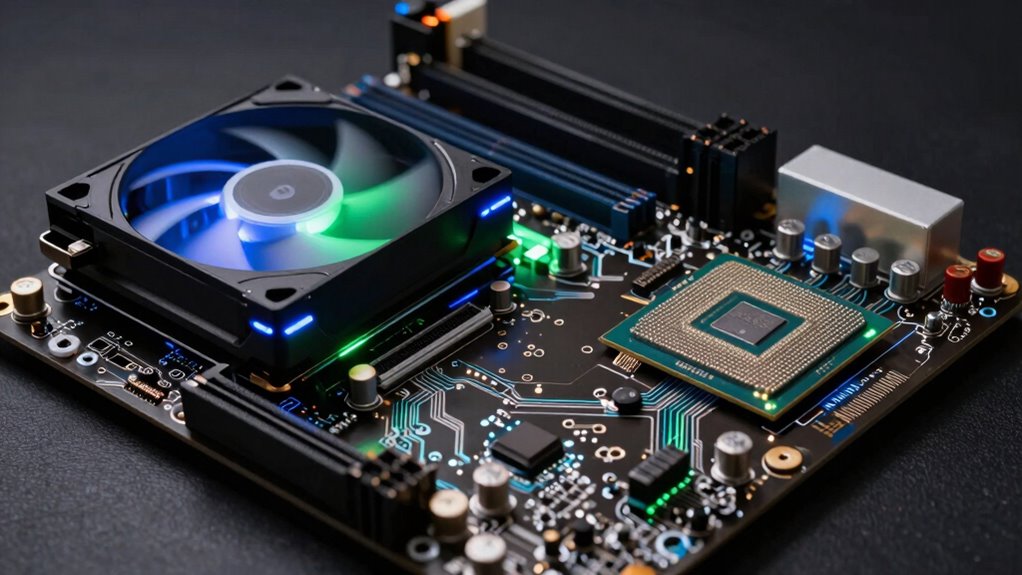
Choosing the right AI hardware isn’t just about raw performance; it also depends heavily on compatibility and ecosystem support. Your choice of AI chipsets matters because software compatibility determines how easily you can develop and deploy models. Some chipsets work seamlessly with popular frameworks like TensorFlow or PyTorch, saving you time and hassle. Others may require custom drivers or lack support for essential tools, limiting your options. Ecosystem support includes the availability of development tools, libraries, and community resources. If the hardware you choose has a robust ecosystem, it’s easier to troubleshoot, optimize, and scale your AI applications. Ensuring compatibility between your hardware and software environment helps you avoid bottlenecks and maximizes your AI system’s efficiency.
Combining Hardware Types to Boost AI Performance
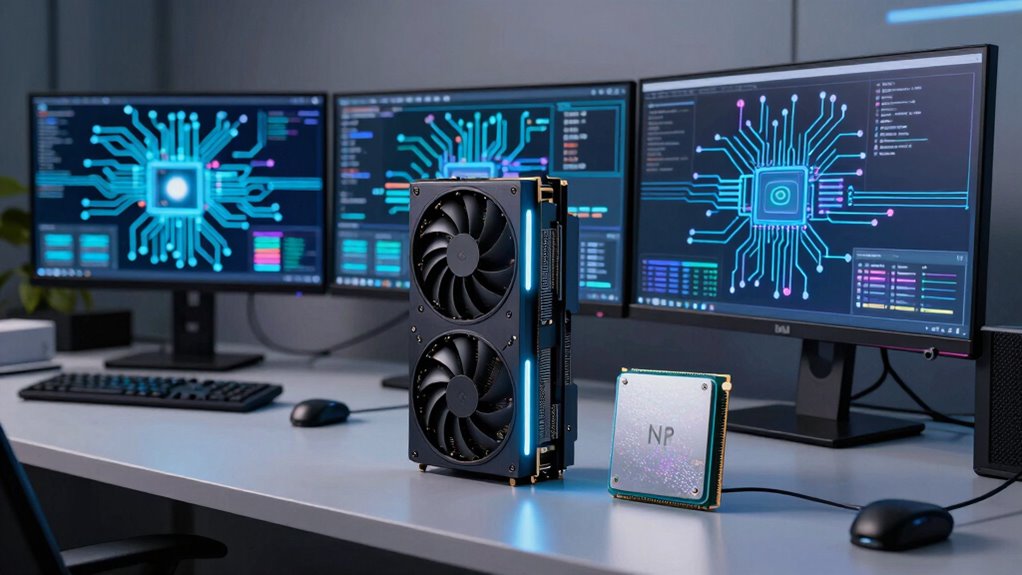
Combining different types of AI hardware can substantially enhance overall performance by leveraging each component’s strengths. You might pair GPUs for fast parallel processing with NPUs optimized for neural networks, or integrate CPUs for flexible control. Incorporating emerging tech like quantum computing can accelerate complex calculations, opening new possibilities. Additionally, selecting the right makeup products can improve user satisfaction with AI-driven beauty applications. However, consider the ethical implications—such powerful combinations raise concerns about data privacy and decision transparency. To maximize efficiency, you could:
- Use GPUs for training deep learning models
- Deploy NPUs for real-time inference
- Integrate CPUs for system management
- Explore quantum computing for complex simulations
- Address ethical issues surrounding AI decision-making
- Understanding AI hardware architecture helps optimize system design and resource allocation.
Recognizing the importance of hardware compatibility ensures smooth integration and operation across diverse systems. Blending hardware types demands careful planning, but it offers a path to smarter, faster AI solutions while steering through the evolving ethical landscape.
Frequently Asked Questions
How Do AI Hardware Options Impact Model Accuracy?
Your hardware options directly impact model accuracy through hardware optimization and model precision. When you select the right hardware, it guarantees efficient processing and reduces errors caused by limitations like lower precision. This means your AI model can perform more accurately, especially with complex tasks. By choosing hardware that supports high-precision calculations and optimization, you improve the reliability and accuracy of your AI outputs.
Can Hardware Upgrades Improve AI Training Speed Without Changing Algorithms?
Ever wonder if faster hardware can boost your AI training speed without tweaking algorithms? Yes, it can—up to a point. Upgrading hardware improves training speed, but only if your system’s compatible and can handle increased power consumption. Ensuring hardware compatibility prevents bottlenecks, while managing power use keeps costs in check. So, a strategic upgrade can accelerate your training, but it’s essential to take into account these factors first.
What Security Concerns Are Associated With Different AI Hardware?
You should be aware that security concerns vary with different AI hardware. Hardware compatibility issues can lead to vulnerabilities, like unintended data leaks or malware infiltration. Additionally, high power consumption may cause overheating or hardware failures, risking data breaches. To safeguard your AI systems, make sure your hardware is compatible with secure protocols and monitor power usage, reducing risks associated with hardware-based security threats.
How Does Hardware Choice Affect AI Deployment Scalability?
Your hardware choice directly impacts AI deployment scalability by affecting hardware compatibility and energy efficiency. Opting for the right hardware guarantees seamless integration with your existing systems, reducing bottlenecks. It also improves energy efficiency, lowering operational costs and enabling you to scale up AI workloads effectively. By selecting hardware suited to your specific needs, you can expand your AI capabilities more reliably and sustainably, supporting growth without unnecessary technical or financial hurdles.
Are There Environmental Impacts of Using Various AI Hardware Types?
Choosing AI hardware is like planting a tree—each type impacts the environment differently. Energy consumption varies, with some chips using more power than others, and manufacturing footprints can be hefty, affecting resources and waste. Your choice influences the ecological footprint, so you should weigh efficiency against sustainability. Opting for greener options helps reduce environmental impacts, ensuring your AI solutions grow responsibly without draining the planet’s resources.
Conclusion
Choosing the right AI hardware is like finding the perfect tool for your craft. Whether it’s a GPU for speed, an NPU for efficiency, or a CPU for versatility, your decision shapes your AI journey. Think of it as tuning an instrument—you’ll get the best sound when each component plays in harmony. So, evaluate your needs carefully, and let the hardware you pick be the steady drumbeat driving your AI success.
Fall Picks
fall essentials
As an affiliate, we earn on qualifying purchases.