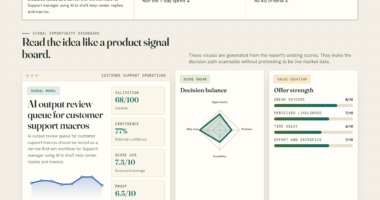

📊 Full opportunity report: The Delegation Ladder: The Four Agentic Loops, And What Each One Lets You Stop Doing on ThorstenMeyerAI.com — validation score, market gap, and execution plan.

Get hardware and tech essentials delivered free — and shop member deals
- Fast, free delivery on millions of items
- Access to Prime Big Deal Days deals on October 6–7
- Prime Video, Amazon Music and more included
TL;DR
The article explains the four types of agentic loops in AI development, from simple turn-based checks to fully autonomous workflows. These loops define how much control humans delegate to AI systems, impacting automation efficiency and safety.
Anthropic’s team has introduced a formal framework called the ‘Delegation Ladder,’ outlining four distinct types of agentic loops in AI systems. These loops describe how control and responsibility are delegated from humans to AI, ranging from simple checks to fully autonomous workflows. This development matters because it offers a structured way to design, evaluate, and manage AI automation, with implications for safety, efficiency, and complexity.
The ‘Delegation Ladder’ categorizes AI loops into four levels: Turn-based, Goal-based, Time-based, and Proactive. Each rung represents a different degree of human control relinquished to the AI. In the first rung, the system performs a cycle of work and self-verification, with humans intervening after each turn. The second introduces goal-setting, where the AI continues until a success criterion is met or a turn limit is reached, reducing human oversight. The third involves scheduled or event-driven triggers, allowing AI to operate continuously or periodically without human prompting. The top rung, proactive loops, enables AI to initiate actions independently based on events or schedules, orchestrating complex workflows without human intervention.
Anthropic emphasizes that not all tasks require the highest level of automation. Starting with simpler loops and climbing only when justified helps manage risks and costs. They also stress that the system surrounding these loops—such as verification, documentation, and code quality—is critical to ensuring AI performs reliably and safely.
The delegation ladder: four agentic loops, and what each lets you stop doing
Strip the hype and a “loop” is simple — an agent repeating work until a stop condition is met. The useful lens isn’t the mechanics, it’s what you hand off. Four loop types = four rungs of delegation, from a tool you operate to a process that runs.
The whole framework reduces to one question about your own work: where am I the bottleneck, and which single piece can I hand off? Can you write the check? Is the goal concrete? Does the work arrive on a schedule? That answer picks your rung — and you climb one step at a time. The real skill isn’t operating a loop; it’s the judgment of what to delegate and how far — enough hands off to gain leverage, enough on the wheel that “runs without you” doesn’t become “runs away from you.”
Implications for AI Control and Safety
This framework clarifies how organizations can structure AI automation to balance efficiency and safety. By understanding the four levels, developers and businesses can choose appropriate control points, reducing risks of unintended behavior. The ladder encourages deliberate escalation—only moving to higher levels of autonomy when necessary—thus supporting responsible AI deployment and minimizing potential errors or misuse.
As an affiliate, we earn on qualifying purchases.
Evolution of AI Delegation Practices
The concept of iterative control in AI has evolved from simple prompting to layered loops that manage increasingly autonomous processes. Previously, AI systems were primarily tools operated directly by humans. Recent developments, including Anthropic’s formalization, reflect a shift towards designing AI as autonomous agents capable of self-verification, goal pursuit, and scheduled operation. This progression aligns with broader trends towards scalable automation, but also raises questions about oversight, verification, and safety standards.
“The four agentic loops provide a clear roadmap for how much responsibility we delegate to AI systems at each stage of development.”
— Thorsten Meyer, AI researcher
As an affiliate, we earn on qualifying purchases.
Unclear Aspects of Implementation and Oversight
It remains unclear how organizations will standardize the use of these loops across different AI systems and industries. Specific guidelines for verifying complex autonomous workflows, especially at the proactive level, are still under development. Additionally, the potential risks of higher-level loops—such as loss of control or unintended consequences—are not fully quantified or addressed in current frameworks.
As an affiliate, we earn on qualifying purchases.
Next Steps in Formalizing AI Loop Deployment
Researchers and practitioners are expected to develop detailed standards and best practices for implementing each rung of the ladder. Further studies will likely evaluate safety protocols, verification methods, and control mechanisms for autonomous AI workflows. Industry adoption may also prompt regulatory discussions on oversight and accountability for higher-level agentic loops.
As an affiliate, we earn on qualifying purchases.
Key Questions
What are the four types of agentic loops?
The four loops are Turn-based, Goal-based, Time-based, and Proactive. They range from simple self-checks to fully autonomous, event-driven workflows.
Why is this framework important?
It helps organizations understand and control how much responsibility they delegate to AI, balancing automation benefits with safety and oversight concerns.
Can all AI tasks be automated using these loops?
No, not all tasks require or benefit from high levels of automation. The framework encourages starting simple and escalating only as needed.
What are the risks of higher-level loops?
Higher loops, especially proactive ones, can lead to loss of human oversight, unintended behaviors, or complex failures if not carefully managed.
How will this influence AI regulation?
The framework could inform standards and policies around autonomous AI systems, emphasizing controlled escalation and verification.
Source: ThorstenMeyerAI.com
Halloween Picks
halloween
As an affiliate, we earn on qualifying purchases.