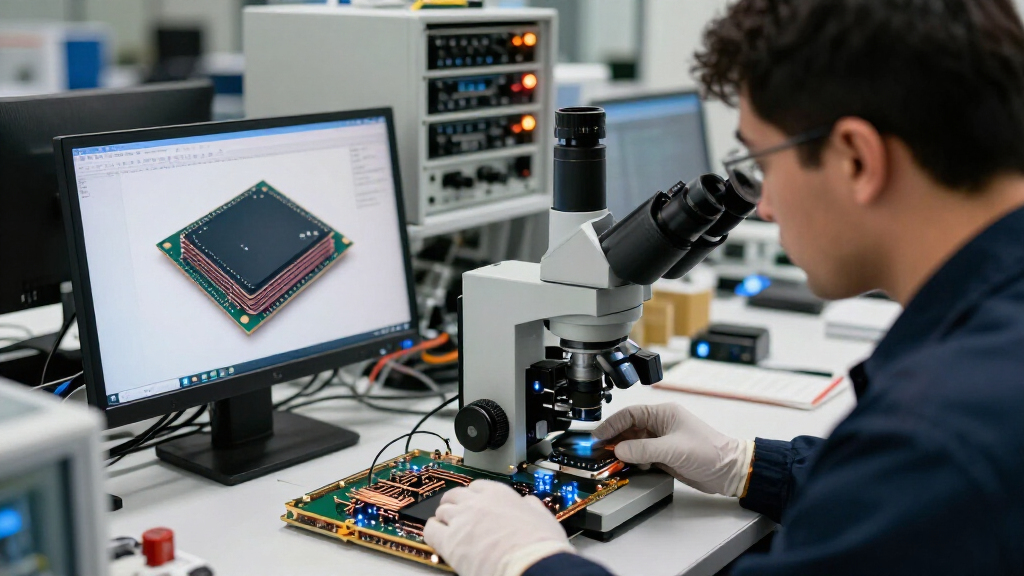
🔍 Read the full analysis: Inside Modern AI Chips: A Guide To Dies And HBM Packaging on ThorstenMeyerAI.com

Get hardware and tech essentials delivered free with Prime
- Fast, free delivery on millions of items
- Prime Video, Amazon Music and more included
- Member-only deals all year
TL;DR
A November 22, 2026, explainer from ThorstenMeyerAI.com describes modern AI accelerators as packages built from multiple compute dies, high-bandwidth memory stacks and silicon interposers, rather than one chip. It also outlines how those packages scale into liquid-cooled racks and why memory bandwidth and advanced packaging can constrain production.
ThorstenMeyerAI.com published an explainer on November 22 showing how modern AI accelerators combine compute dies, stacked high-bandwidth memory (HBM), silicon interposers and cooling hardware. The report argues that memory bandwidth and packaging capacity, not just computing power, are key constraints on building and operating large AI systems.
The article describes an accelerator as a multi-part package rather than a single piece of silicon. A package substrate connects the assembly to a module or circuit board, while a silicon interposer carries dense connections among the compute dies and HBM stacks. The report says TSMC’s CoWoS packaging family is used for this kind of integration; the interposer enables connections that a conventional circuit board could not provide at the same density.
HBM consists of DRAM chips stacked vertically and connected by through-silicon vias, or TSVs. The source cites JEDEC’s April 2025 HBM4 standard, which permits stacks of four, eight, 12 or 16 layers and up to 64 GB per stack. It also reports that Nvidia’s Rubin GPU has two reticle-limited compute dies and 336 billion transistors, while AMD’s MI355X combines eight vertically stacked accelerator complex dies with two I/O dies and eight stacks of 12-high memory.
The explainer follows the hardware into a rack. It says Nvidia’s GB200 and GB300 NVL72 systems contain 72 GPUs and 36 CPUs, distributed across compute and switch trays, with liquid cooling. Nvidia lists 120 kilowatts of cooling capacity for a GB200 NVL72 rack. The source describes its 3D models as schematic in size: it says chip and package dimensions in millimetres are not published by Nvidia or AMD, so the models do not claim exact measurements.
Why Packaging Limits AI Scale
The hardware design matters because large AI models need a steady flow of data to keep compute units working. The report gives a rise in GPU memory bandwidth from 900 GB/s for Nvidia’s V100 to 19.2 TB/s for Rubin, citing Nvidia product information. Those figures show how much bandwidth has increased across the named products, though they do not by themselves establish performance on a particular workload.
Building these packages also depends on specialized manufacturing. The source describes interposer capacity as a production constraint and cites SK hynix’s expectation that HBM demand will exceed supply through 2030. If memory or advanced packaging remains limited, companies may face constraints on how quickly they can deploy accelerator systems. The article’s discussion of price and availability is an implication of those supply conditions, not a measured forecast of costs.
Products Worth Considering

Apple Watch Series 12 GPS 42mm Smartwatch

Bose QuietComfort Wireless Bluetooth Noise-Cancelling Headphones, Ice Blue

Amazon Kindle Scribe (16GB) with Premium Pen, Tungsten
As an affiliate, we earn on qualifying purchases.
From Silicon Layers to Full Racks
The report explains the assembly from the bottom up. A miniature multi-layer substrate provides power and signals; an interposer acts as a high-density wiring layer; compute dies perform calculations; and HBM stacks sit alongside them. A cold plate above the package carries liquid cooling. The source notes that AMD’s MI355X platform is supplied with bare GPU dies and that server vendors install cold plates, while Nvidia describes coolant passing through plates attached to CPUs and GPUs.
There are limits to how large a single interposer can be. TSMC says CoWoS-S can accommodate an interposer up to 3.3 times reticle size, or about 2,700 mm². For larger designs, the article describes CoWoS-L as using silicon bridges within a carrier layer. It cites TSMC’s October 15, 2026, statement that it was in real-world production of five-reticle-size packaging and working on nine- and 14-reticle sizes. These statements concern manufacturing capabilities, not the dimensions of every commercial package.
At rack scale, the explainer cites Nvidia documentation for 18 compute trays, each containing two Grace CPUs and four Blackwell GPUs, alongside nine NVLink switch trays and management switches. Its example shows how packaging and interconnects extend beyond an individual accelerator to the system that links and cools many of them.
Limits of the Published Specifications
The source says Nvidia and AMD do not publish the physical dimensions, in millimetres, of the dies, packages or HBM stacks discussed, so its 3D models use schematic sizes. Some details also concern products at different stages or generations; the article does not provide a common test method for comparing their bandwidth figures or compute performance. The cited supply outlook is SK hynix’s expectation, not a guarantee of future market conditions. The report does not quantify how packaging or HBM constraints affect prices, delivery times or output for particular customers.
Packaging and HBM Capacity Ahead
The next developments to watch are HBM production, advanced packaging capacity and rack deployment. The source cites TSMC’s work on larger CoWoS-L formats and SK hynix’s supply outlook, but does not give delivery dates or production volumes for the capabilities discussed. Nvidia’s product listing describes the Vera Rubin NVL72 as available, while the article does not provide independent shipment or deployment figures. Further disclosures from manufacturers and system vendors will clarify how quickly these designs reach customers and whether supply keeps pace with demand.
Key Questions
What is an AI accelerator package?
It is an assembly that can include compute dies, HBM stacks, an interposer and a package substrate, rather than one monolithic chip. Cooling hardware is attached at the system level.
What does HBM do?
High-bandwidth memory places DRAM chips in vertical stacks connected by through-silicon vias. Its location near compute dies and its bandwidth help supply data to the processor.
What is a silicon interposer?
A silicon interposer is a wiring layer that links compute dies and memory with many dense connections. The source says this packaging layer can itself limit how many advanced systems manufacturers can produce.
Why do AI racks use liquid cooling?
High-density racks combine many GPUs and CPUs, generating heat that must be removed. The report says liquid coolant runs through cold plates attached to processors in Nvidia systems.
Are the report’s 3D models exact-size representations?
No. The source says the models show layer order and counts but use schematic dimensions, because the companies do not publish the physical measurements cited in the explainer.
Source: ThorstenMeyerAI.com