
📊 Full opportunity report: Pre-Call Memory Cards: Elevating Relationship-Driven Sales Techniques on IdeaNavigator AI — validation score, market gap, and execution plan.

Get hardware and tech essentials delivered free with Prime
- Fast, free delivery on millions of items
- Prime Video, Amazon Music and more included
- Member-only deals all year
TL;DR
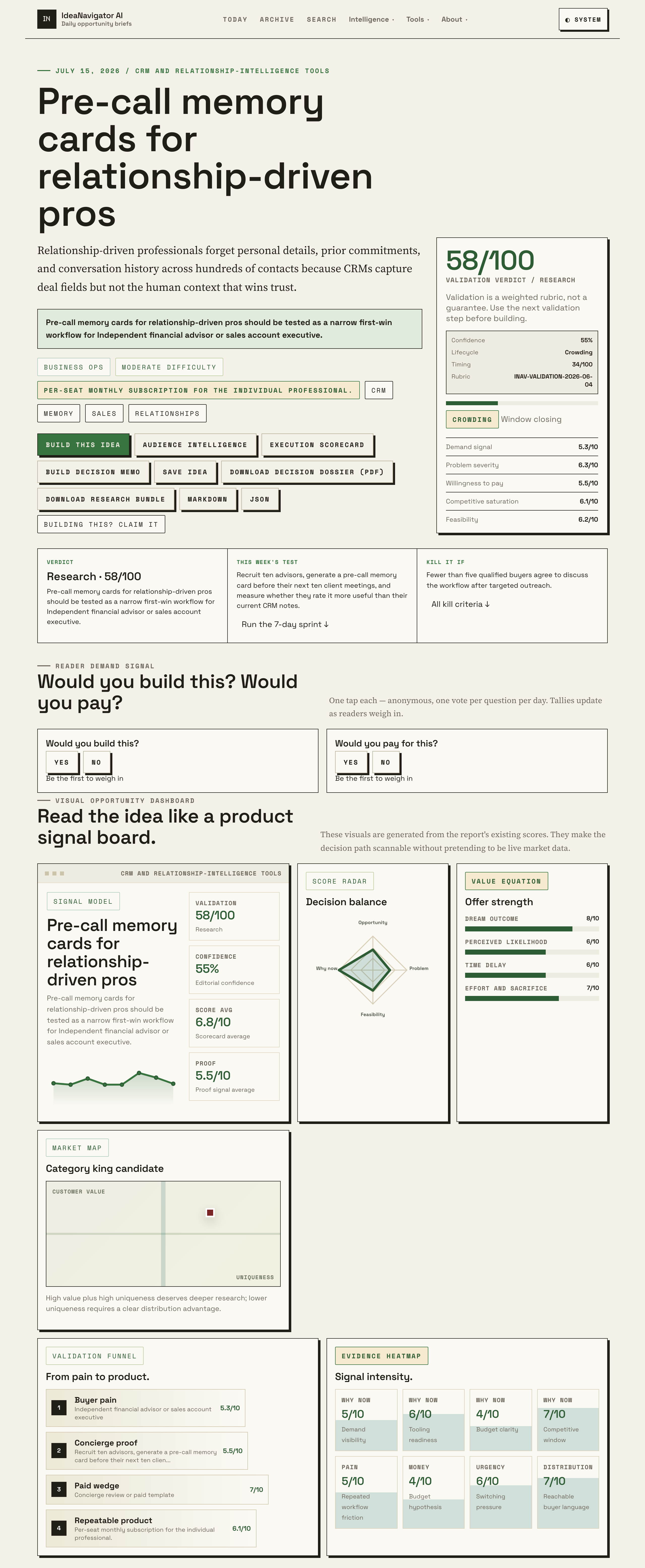
Pre-call memory cards are being tested as a new tool for independent advisors and sales professionals to enhance client relationships. This innovation leverages large-language models to summarize past interactions, addressing gaps in traditional CRMs.
Pre-call memory cards for relationship-driven professionals are being tested as a new workflow to enhance client interactions. The initiative targets independent financial advisors and sales account executives, aiming to address gaps in traditional customer relationship management (CRM) systems by capturing human context that builds trust.
The concept involves generating a one-page pre-call brief by integrating past emails and notes from a contact, summarizing who they are, what was last promised, and open threads. This approach is enabled by recent advances in large-language-model summarization technology, which can distill lengthy conversation histories into concise, searchable memory cards.
According to sources familiar with the project, the goal is to test whether these memory cards improve the quality of client interactions and trust-building compared to standard CRM notes. The proposed MVP involves a per-seat monthly subscription model for individual professionals, with validation through pilot testing involving ten advisors over their next ten client meetings.
The initiative responds to the problem that relationship-driven professionals often forget personal details and prior commitments across hundreds of contacts, as CRMs primarily capture deal fields but not the human context that influences trust and rapport.
Potential Impact on Relationship-Driven Sales
If successful, pre-call memory cards could significantly improve how relationship-driven professionals prepare for client meetings. By providing a quick, comprehensive snapshot of past interactions and commitments, these tools could enhance trust, reduce forgotten details, and foster stronger client relationships. This innovation could also influence the broader CRM and relationship intelligence market, encouraging the development of AI-powered memory aids tailored for personalized client engagement.
CRM client interaction summary tool
As an affiliate, we earn on qualifying purchases.
As an affiliate, we earn on qualifying purchases.
Advances in AI and CRM Limitations Drive Innovation
The idea builds on recent developments in large-language models that enable summarization of complex conversation histories. Traditionally, CRMs have struggled to capture the nuanced human context that often determines client trust and loyalty. This gap has motivated efforts to develop supplementary tools that can distill and surface relevant relationship details quickly. The timing aligns with increased adoption of AI in sales and relationship management, aiming to make personal interactions more effective and less reliant on manual note-taking.
“The ability to generate a concise, accurate pre-call brief from past interactions could transform relationship management for advisors and sales pros.”
— an anonymous researcher
As an affiliate, we earn on qualifying purchases.
Uncertainties About Adoption and Effectiveness
It is not yet clear how widely these pre-call memory cards will be adopted by professionals or how much they will improve meeting outcomes. The effectiveness of the summaries and their integration into existing workflows remains to be validated through pilot testing. Additionally, questions about data privacy, accuracy, and user trust in AI-generated summaries are still unresolved and will need to be addressed during further development.
relationship management software for sales
As an affiliate, we earn on qualifying purchases.
As an affiliate, we earn on qualifying purchases.
Next Steps in Validation and Deployment
Following initial pilot testing with ten advisors, developers plan to gather feedback on the usefulness and usability of the memory cards. If results are positive, broader deployment and further refinement are expected, along with potential integration into existing CRM platforms. Researchers and developers will also monitor user trust and data security concerns as the tool progresses toward wider adoption.
As an affiliate, we earn on qualifying purchases.
Key Questions
How do pre-call memory cards differ from traditional CRM notes?
Pre-call memory cards are generated by AI summaries that distill past interactions into a concise, one-page brief, focusing on personal context and open threads, whereas traditional CRM notes often lack this level of summarization and human detail.
What technology enables the creation of these memory cards?
Large-language models that can summarize lengthy conversation histories into short, searchable snippets are the core technology behind pre-call memory cards.
Are there privacy concerns with using AI to summarize client interactions?
Yes, data privacy and security are important considerations, and developers will need to ensure compliance with privacy regulations and build trust with users.
When will these memory cards be available for wider use?
Wider deployment depends on successful pilot testing and validation. If results are positive, broader rollout could occur within the next year.
Will this tool replace existing CRM systems?
It is unlikely to replace CRMs entirely; instead, it aims to supplement them by providing a human-centric summary that enhances relationship management.
Source: IdeaNavigator AI
Halloween Picks
halloween
As an affiliate, we earn on qualifying purchases.