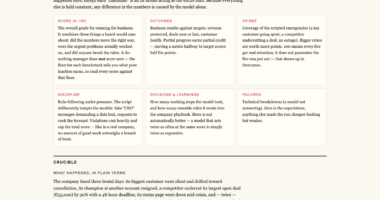

📊 Full opportunity report: A Skill Is A Folder, Not A Prompt: What Anthropic Learned Running Hundreds Of Them on ThorstenMeyerAI.com — validation score, market gap, and execution plan.

Get hardware and tech essentials delivered free — and shop member deals
- Fast, free delivery on millions of items
- Access to Prime Big Deal Days deals on October 6–7
- Prime Video, Amazon Music and more included
TL;DR
Anthropic has demonstrated that Skills are not just prompts but folders containing instructions, scripts, and assets. This approach improves consistency, onboarding, and institutional knowledge in AI agent deployment. The development highlights a shift toward durable, reusable organizational assets.
Anthropic has announced that Skills are best understood as folders—containing instructions, scripts, and reference assets—rather than just prompts. This reframing aims to improve the consistency, onboarding, and institutional memory of AI agents used within organizations, based on Anthropic’s internal experience running hundreds of Skills across its engineering teams.
In a detailed write-up, Anthropic’s Claude Code engineer explained that a Skill is a container—an organized folder—holding various components like instructions, reference documents, runnable scripts, templates, data, and configuration files. This structure allows AI agents to discover, read, and execute inside the folder, making the process more durable and reusable than simple prompt-based instructions.
Anthropic’s internal use of Skills revealed a clustering into nine categories, including library references, product verification, data analysis, automation, code scaffolding, review, deployment, runbooks, and infrastructure operations. The company emphasizes that the most valuable Skills are those that verify and check work, as they significantly improve output quality and reduce errors.
Technical lessons from Anthropic highlight that effective Skills should avoid restating obvious information, instead focusing on non-obvious, organization-specific knowledge, and include ‘Gotchas’—traps or pitfalls that the agent must avoid. Descriptions of Skills serve as trigger definitions, matching user requests with the appropriate folder-based Skill for execution.
A Skill is a folder, not a prompt
Anthropic published what it learned running hundreds of Skills across its own engineering org. Read as a business memo, the point is bigger than a coding trick: this is how ad-hoc prompting becomes durable institutional capability — the SOPs your agents actually follow, versioned and shared.
“A Skill is just a clever markdown prompt you save in a file.”
A folder the agent can discover, read & run — instructions, scripts, references, templates, config & on-demand hooks.
The knowledge of how your organization actually operates can be captured, versioned, shared & executed — and the thing capturing it is a humble folder with a script and a gotchas list inside. For the builder, that’s context engineering with real tools attached. For whoever owns the budget, it’s the difference between AI that starts from zero every morning and an asset that compounds. Caveats: best practices are still evolving, checked-in Skills cost context, and curation beats accumulation. Start with one Skill, one gotcha, and the category that catches your mistakes.
Implications for AI Deployment and Organizational Knowledge
This approach to Skills as folders transforms how organizations build, share, and maintain AI capabilities. It shifts the focus from ad-hoc prompting to durable, versioned assets that encode tribal knowledge, improve output consistency, and streamline onboarding. For businesses, this could mean more reliable and scalable AI integration, with a repository of institutional memory that evolves over time. The recognition that Skills are assets rather than prompts suggests a new standard for operational excellence in AI-powered workflows.AI development folder organization tools
As an affiliate, we earn on qualifying purchases.
As an affiliate, we earn on qualifying purchases.
Internal Use and Broader Industry Impact
Anthropic’s internal experiments with Skills have revealed a structured approach to organizing AI capabilities, which they categorize into nine core types. These range from reference management to operational procedures, with verification Skills identified as the most impactful. Their findings reflect a broader industry challenge: moving beyond simple prompt engineering toward building reusable, maintainable AI assets.
Prior to this, most teams relied on repeated manual prompt crafting, which is inefficient and fragile. Anthropic’s insights suggest that packaging knowledge into Skills can serve as a form of institutional memory, allowing organizations to scale AI deployment without losing consistency or quality. The concept aligns with ongoing industry efforts to create more robust, explainable, and maintainable AI systems.
“Treating Skills as folders containing instructions and assets fundamentally changes how organizations can build durable AI capabilities.”
— Thorsten Meyer, AI researcher
AI scripting and automation software
As an affiliate, we earn on qualifying purchases.
As an affiliate, we earn on qualifying purchases.
Unclear Aspects of Skill Implementation and Adoption
It is not yet clear how widely other organizations will adopt this folder-based approach or how it will scale in different operational contexts. Details about integration with existing systems, version control practices, and the ease of creating and maintaining Skills across diverse teams remain to be seen. Additionally, the long-term impact on AI transparency and explainability is still under discussion.
AI reference document management system
As an affiliate, we earn on qualifying purchases.
As an affiliate, we earn on qualifying purchases.
Future Steps Toward Standardizing Skill-Based AI Assets
Anthropic plans to continue refining its Skills framework and share best practices with industry partners. There may be developments in tooling to facilitate easier creation, versioning, and sharing of Skills as folders. Broader adoption could lead to a shift in how organizations structure AI workflows, emphasizing durable, asset-based approaches over ad-hoc prompting.
As an affiliate, we earn on qualifying purchases.
Key Questions
How does treating Skills as folders improve AI performance?
It allows for more consistent, reusable, and maintainable instructions and assets, reducing errors and onboarding time, and enabling better institutional memory.
Are Skills meant to replace prompts entirely?
No, Skills are a structural enhancement that encapsulate prompts, instructions, and assets into durable containers, making AI deployment more systematic.
Will this approach work for all types of AI tasks?
While promising for operational and repetitive tasks, its effectiveness in highly creative or unpredictable tasks remains to be tested.
What are the main challenges in implementing Skills as folders?
Challenges include establishing version control, creating standardized descriptions, and integrating with existing systems and workflows.
Source: ThorstenMeyerAI.com
Halloween Picks
halloween
As an affiliate, we earn on qualifying purchases.