📊 Full opportunity report: AI output review queue for customer support macros on IdeaNavigator AI — validation score, market gap, and execution plan.

Get hardware and tech essentials delivered free with Prime
- Fast, free delivery on millions of items
- Prime Video, Amazon Music and more included
- Member-only deals all year
TL;DR
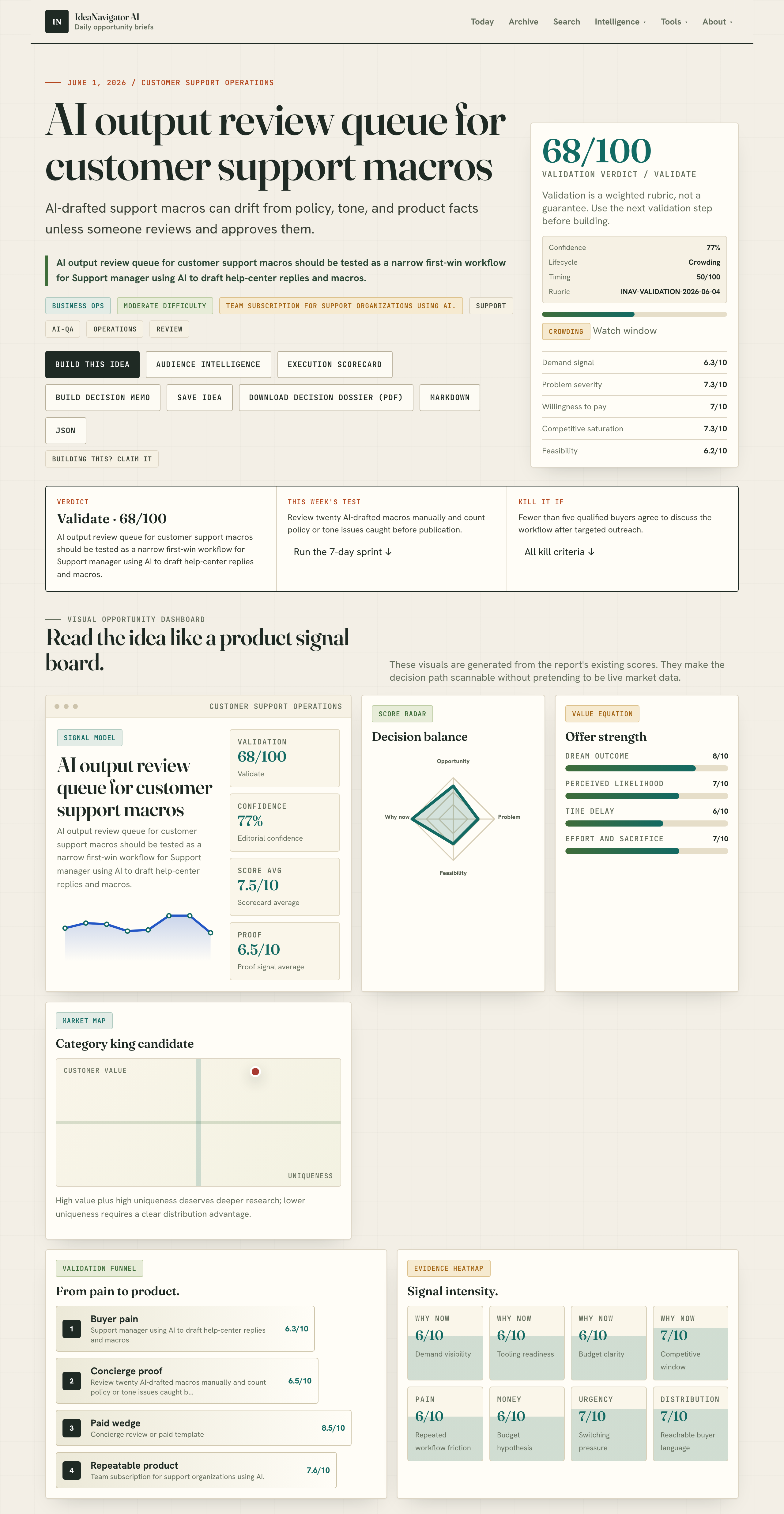
Support managers are piloting a new AI output review queue for customer support macros. The system scores drafts for policy fit, tone, and accuracy, aiming to improve quality control amid rapid AI adoption.
Support teams are testing a new AI output review queue for customer support macros, aimed at ensuring policy adherence and tone consistency before macros are published. This development responds to the rapid adoption of AI tools in support operations without established approval workflows, highlighting a move toward formalized quality control measures.
The review queue, currently in a testing phase, evaluates AI-generated support macros based on criteria such as policy compliance, tone, source support, risky promises, and approval status. The goal is to catch issues before macros go live, reducing the risk of policy violations or miscommunication. Support managers will manually review twenty AI-drafted macros during the pilot to assess the system’s effectiveness in identifying potential problems.
This initiative is driven by the observation that support teams are adopting AI faster than they are establishing formal approval workflows. The review queue aims to serve as a narrow, first-win workflow that helps support managers maintain quality control without significantly slowing down operations. The system scores each draft and flags those that deviate from policy or tone standards, facilitating quicker, more consistent approvals.
According to an anonymous researcher involved in the project, the primary purpose is to improve the accuracy and reliability of AI-drafted support responses, especially as organizations scale their AI use. The subscription-based model targets customer support organizations seeking to integrate AI more safely and effectively into their workflows.
Why the AI Macro Review Queue Matters for Support Quality
This development is significant because it addresses a key challenge in AI-supported customer support: maintaining policy adherence and tone consistency at scale. As AI adoption accelerates, support organizations risk deploying macros that may inadvertently breach policies or mislead customers. The review queue offers a structured way to mitigate these risks, potentially setting a new standard for AI governance in support environments.
By formalizing a review process, companies can improve customer trust, compliance, and brand reputation. It also helps support managers identify recurring issues in AI-generated responses, informing ongoing training and system improvements. Overall, this initiative could lead to more reliable and responsible AI use in customer service, with broader implications for the industry.
As an affiliate, we earn on qualifying purchases.
Supporting Support Teams in Managing AI-Generated Content
The use of AI to generate support macros has grown rapidly, driven by the need for faster, scalable customer service responses. Currently, many organizations rely on manual review or informal approval processes, which can be inconsistent and inefficient. The new review queue aims to formalize this process by providing an automated scoring system that assists support managers in identifying problematic drafts.
Previous efforts to integrate AI in support have faced challenges related to quality control, especially around policy compliance and tone. The introduction of a dedicated review queue reflects an industry trend toward embedding governance and oversight into AI workflows. The pilot program is part of a broader movement to balance AI automation with responsible oversight, ensuring support responses remain accurate and aligned with company standards.
“The primary goal is to catch policy or tone issues before support macros go live, helping support teams scale responsibly.”
— an anonymous researcher
customer support macro approval tool
As an affiliate, we earn on qualifying purchases.
As an affiliate, we earn on qualifying purchases.
Unclear Aspects of the AI Macro Review System
It is not yet confirmed how effective the scoring system will be in real-world scenarios, or how support teams will adapt workflows based on its feedback. Details about the specific algorithms used, the criteria weighting, and the scalability of the system remain undisclosed. Additionally, the long-term impact on support team efficiency and customer satisfaction is still to be evaluated.
AI policy compliance review system
As an affiliate, we earn on qualifying purchases.
As an affiliate, we earn on qualifying purchases.
Next Steps for Testing and Implementation
Support organizations will continue testing the review queue by manually reviewing twenty AI-drafted macros, assessing its ability to catch policy or tone issues. Results from this pilot will inform potential wider rollout, with plans to refine scoring criteria and integration processes. Further updates are expected as the system matures and as organizations provide feedback on its performance.
support team quality control tools
As an affiliate, we earn on qualifying purchases.
As an affiliate, we earn on qualifying purchases.
Key Questions
How will the AI review queue improve support macro quality?
The review queue scores AI-generated macros based on policy compliance, tone, and accuracy, helping support managers identify and approve only suitable responses.
Is this system mandatory for all support teams?
No, it is currently in a testing phase and will be adopted gradually based on pilot results and organizational needs.
Will the review process slow down support response times?
The goal is to streamline quality control without significant delays, using automated scoring to assist support managers in making quicker decisions.
What issues does the review queue aim to address?
It aims to prevent policy violations, tone inconsistencies, and risky promises in AI-drafted support responses, ensuring compliance and customer trust.
When might wider adoption of this system occur?
Wider rollout depends on pilot outcomes; if successful, organizations could implement it within the next few months.
Source: IdeaNavigator AI
Fall Picks
fall essentials
As an affiliate, we earn on qualifying purchases.