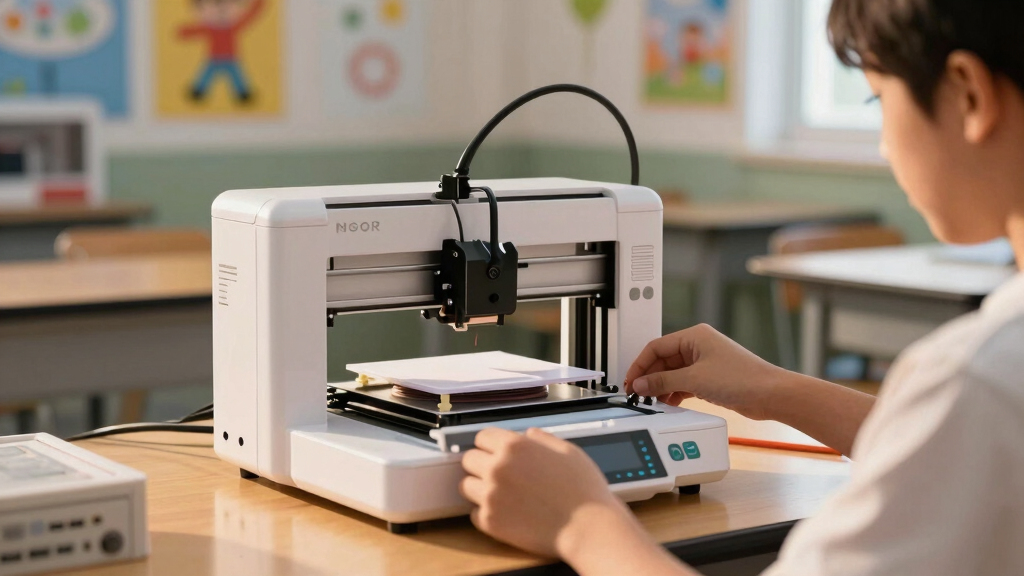

Finding the best 3D printers for schools and clubs involves balancing ease of use, safety, affordability, and versatility. The Creality Ender 3 stands out as the best overall choice, offering reliability and open-source flexibility. For quick-start setups, the FLASHFORGE Adventurer 5M Pro provides fast, automated printing ideal for busy classrooms. Meanwhile, the Entina Mini 3D Printer is perfect for beginners and younger students thanks to its auto-leveling and safety features. Each option presents tradeoffs—higher speed often means higher cost, while simpler models might lack advanced features. Continue reading for a detailed breakdown of these standout options and how they meet diverse educational needs.
Key Takeaways
- The top picks balance ease of use with advanced features, ensuring suitability across different skill levels.
- Auto-leveling and safety features are critical for minimizing setup time and ensuring student safety.
- Speed and build volume vary widely; choosing the right depends on project scope and classroom size.
- Open-source models like the Ender 3 provide customization but may require more maintenance and technical know-how.
- Price often correlates with features—more affordable printers tend to have fewer automated functions and smaller build sizes.


More Details on Our Top Picks
Official Creality Ender 3 3D Printer Fully Open Source with Resume Printing Function DIY Printers Build Volulme 8.66×8.66×9.84 inch
The Creality Ender 3 stands out for its open-source design, making it ideal for schools and clubs that want to customize or upgrade their equipment. Compared with the Entina TINA2, it offers a larger print volume and a highly active community, which simplifies troubleshooting and upgrades. Its resume printing feature provides resilience against power outages, a vital feature in busy classroom settings. However, assembly takes around 2 hours, and it only prints via SD card or direct connection—lacking phone app control. This model is perfect for students eager to learn the fundamentals of 3D printing and customization but might require more initial setup and supervision than plug-and-play options. Pros: Open-source flexibility, large build volume, reliable power resume, supported by a vast community. Cons: Moderate assembly required, limited connectivity options, no auto bed leveling.
Verdict: An excellent choice for schools seeking a versatile, upgradeable printer for students to learn hands-on skills.
Specs: Build Volume: 8.66×8.66×9.84 inches; Open-source; Resume printing; Filament Compatibility: Standard; Connectivity: SD card, USB; Assembly: Partial, around 2 hours.Pros:- Open-source design allows for extensive customization
- Large build volume supports diverse projects
- Resume printing feature enhances reliability
Cons:- Requires about 2 hours of assembly, which may be challenging for some students
- Limited connectivity options—no Wi-Fi or app control
- Lacks auto bed leveling, requiring manual calibration
Best for: Schools and clubs wanting a customizable, community-supported printer for hands-on learning.
Not ideal for: Beginners who prefer fully assembled, simple-to-use printers with app control and minimal setup.
- Build Volume:8.66×8.66×9.84 inches
- Open Source:Yes
- Resume Printing:Yes
- Connectivity:SD card, USB
- Assembly:Partial, about 2 hours
Bottom line: Best suited for educational environments where students can explore customization and foundational 3D printing skills.
FLASHFORGE Adventurer 5M Pro 3D Printer with 1 Click Auto Printing System, 600mm/s High-Speed, Quick Detachable 280°C Nozzle, Core XY All-Metal Structure, Multi-Functional 220x220x220mm 3D Printer
This FlashForge Adventurer 5M Pro excels in rapid, high-speed printing, making it ideal for classrooms that prioritize quick project turnaround. Its impressive 600mm/s speed blows past the Ender 3, with a fully enclosed design that enhances safety for younger students. The auto bed leveling and dual-material compatibility improve print quality and ease of use, comparable to the Entina TINA2 but with a focus on speed and safety. Its mobile app allows remote monitoring and control, which is a significant advantage over the Ender 3’s limited connectivity. The main tradeoff is the smaller build volume—220x220x220mm—less than the Ender 3’s larger capacity. This pick is perfect for rapid prototyping and detailed models, especially in environments needing fast iteration. Pros: High-speed printing, auto bed leveling, enclosed design for safety, mobile app control. Cons: Smaller build volume, higher price point, limited upgradeability.
Verdict: Ideal for schools that need fast, safe, and reliable printing with remote management capabilities.Pros:- Exceptional high-speed printing up to 600mm/s
- Full enclosure for safety and temperature control
- Auto bed leveling reduces setup time
- Remote operation via mobile app
Cons:- Smaller build volume limits larger projects
- Higher cost compared to entry-level models
- Limited upgrade options due to integrated design
Best for: Educational settings focusing on quick production of detailed prototypes and remote operation.
Not ideal for: Projects requiring larger build size or extensive customization/upgrades.
- Build Volume:220x220x220mm
- Speed:Up to 600mm/s
- Nozzle Temperature:280°C
- Connectivity:Wi-Fi, App control
- Frame:All-metal Core XY
- Auto Bed Leveling:Yes
Bottom line: Best suited for fast-paced classrooms emphasizing speed, safety, and remote control features.
Entina Mini 3D Printers Tina2 Basic, Fully Assembled and Auto Leveling 3D Printer for Beginners and Kids, Easy Setup, Safe Design, High Precision Printing FDM Mini 3D Printer for Home & School
The Entina Tina2 Basic is tailored for newcomers and younger students, offering a fully assembled, easy-to-use experience with automatic bed leveling. Its compact size and pre-included slicing software make it accessible for small classrooms or home use, particularly for those new to 3D printing. Compared to the FlashForge Adventurer 5M Pro, it sacrifices speed for simplicity and affordability, but still supports detailed printing thanks to its high-precision dual Z-axis system. The safety features, including a fully enclosed design, make it suitable for children, while the open-source compatibility encourages experimentation. Its small build volume (100x105x100mm) is a tradeoff for its portability and ease of use. This printer is perfect for introducing students to 3D printing basics without the complexity of manual calibration. Pros: Fully assembled, automatic bed leveling, compact size, high-precision dual Z-axis. Cons: Small build volume, limited upgrade potential, slower print speeds.
Verdict: A perfect starter printer for early learners and small projects in educational or home settings.Pros:- Fully assembled for immediate use
- Automatic bed leveling simplifies setup
- High precision with dual Z-axis design
- Compact and portable
Cons:- Limited build volume of 100x105x100mm
- Slower printing speeds compared to larger models
- Limited upgradeability
Best for: Beginners and elementary students learning 3D printing fundamentals in a safe, easy-to-manage device.
Not ideal for: Advanced users needing larger build sizes or high-speed production for complex prototypes.
- Build Volume:100x105x100mm
- Auto Leveling:Yes
- Assembly:Fully assembled
- Connectivity:SD card, Wi-Fi
- Print Precision:High
- Frame:Compact
Bottom line: Ideal for introducing young students to 3D printing with minimal setup and high safety standards.
3D Printer for Kids, Safe for Children, Toy 3D Printer, STEM Learning Mate, Wi-Fi & App Control, Weekly Update Toy Library, Touch Screen, Includes 4 PLA Filaments for Home & School Use
The Toybox Alpha Three emphasizes ease of use, safety, and fun, making it ideal for younger children and beginner students. Its pre-assembled, enclosed design with a child-safe lock reduces risks, while one-touch printing and a 5-inch touch screen make operation simple. The included app offers remote control and access to a vast library of over 7,000 licensed toys, which is a major advantage over more basic models like the Ender 3. Its speed—up to 600mm/s—is impressive for a toy-focused device, enabling quick projects. However, its smaller build size (11x11x8 inches) limits the complexity of models, and it’s less suitable for advanced or large-scale projects. This printer is perfect for engaging children in STEM activities and fostering creativity through accessible technology. Pros: Child-safe enclosed design, Wi-Fi & app control, large model library, fast printing speed. Cons: Small build volume, limited to simpler projects, less upgrade potential.
Verdict: Excellent for early STEM education and family use, where ease and safety are priorities.Pros:- Safe, fully enclosed design with child lock
- Simple one-touch and app-controlled operation
- Access to a vast library of licensed digital toys
- Fast printing speeds up to 600mm/s
Cons:- Limited build size restricts complex models
- Designed primarily for simple, educational projects
- Less upgradeability than open-frame printers
Best for: Elementary and middle school environments focused on creative learning and safe, engaging 3D printing activities.
Not ideal for: Advanced students or projects requiring large or highly detailed models.
- Build Size:11x11x8 inches
- Speed:Up to 600mm/s
- Connectivity:Wi-Fi, App control
- Safety Features:Enclosed, child lock
- Included Filament:4 PLA spools
- Screen:5-inch touch
Bottom line: Best for early learners and families wanting safe, fun, and quick 3D printing experiences with extensive digital content.
AOSEED 3D Printer for Kids & Beginners, AI-Powered Fully Assembled 3D Printer with Up to 400mm/s Speed, Auto Leveling, 15 Mini Apps, Includes 8 PLA Filaments for Home and School Use, X-Maker AI+
This AI-enhanced 3D printer stands out for its fully enclosed design, making it ideal for young users and classroom safety. Compared with the Geeetech M1 Mini, it offers faster speeds of up to 400mm/s and incorporates AI-driven creative apps, transforming how students and beginners approach 3D design. The built-in AI Assistant and educational modules make it perfect for STEM curricula, though the complexity of some mini apps might be overwhelming for very young children. Its automatic leveling and safety enclosure reduce setup time and risk, ensuring frustration-free operation. However, its 3.5-inch touchscreen, while intuitive, can be less responsive in noisy environments. This pick is best suited for schools and homes prioritizing creative, guided learning with minimal manual calibration, but less ideal for those needing ultra-compact or open-source options.
Pros:- Fully enclosed safety design with fumes isolation
- AI-powered creative apps and curriculum modules
- Auto-leveling and quiet operation (<50dB)
Cons:- Higher price point compared to basic models like Geeetech M1
- Limited upgradeability due to closed system
Best for: Educators and parents seeking a safe, user-friendly platform that fosters creativity and STEM skills in children aged 9–16.
Not ideal for: Schools or clubs requiring open-source, highly customizable printers or those with very limited space, due to its relatively larger enclosed frame.
- Print Size:150 x 150 x 150mm
- Speed:up to 400mm/s
- Accuracy:0.1/0.05mm
- Filament:PLA, 8 rolls included
- Connectivity:Wi-Fi, SD, USB
- Enclosure:Fully enclosed safety shell
Bottom line: This AI-enabled printer is ideal for classrooms and homes focused on guided, creative STEM projects without manual calibration hassles.
FLASHFORGE Adventurer 5M 3D Printer with Fully Auto Leveling, Max 600mm/s High Speed Printing, 280°C Direct Extruder with 3S Detachable Nozzle, CoreXY All Metal Structure, Print Size 220x220x220mm
The Adventurer 5M excels in high-speed printing, making it ideal for schools and clubs that need quick turnaround times for multiple projects. Its impressive 600mm/s max speed and 220x220x220mm build volume surpass the slower Ender 3, which, while open-source and highly customizable, often requires manual leveling and more maintenance. The automatic bed leveling simplifies setup, and the detachable nozzle allows for quick swaps during complex tasks. Its robust CoreXY metal frame ensures durability and precision, suitable for more advanced students or frequent use. However, the high speed can sometimes compromise detail in smaller prints, and its price is higher than basic models. This printer best supports fast prototyping and creative experimentation but might be less suitable for detailed miniatures or very limited budgets.
Pros:- Blazing fast print speeds up to 600mm/s
- Auto bed leveling for quick setup
- All-metal, durable CoreXY structure
Cons:- Potentially lower detail resolution compared to slower printers
- Higher cost and power consumption
Best for: Schools and clubs focusing on fast iteration, prototyping, and high-volume project cycles with an emphasis on speed and durability.
Not ideal for: Small classrooms or beginner hobbyists who prioritize detailed miniatures over speed or who prefer open-source customization.
- Build Volume:220x220x220mm
- Speed:up to 600mm/s
- Nozzle Temp:280°C
- Frame:CoreXY all-metal
- Auto Leveling:Yes
- Connectivity:USB, SD, Wi-Fi
Bottom line: This high-speed, robust machine is perfect for rapid prototyping environments that value speed and reliability over ultra-fine detail.
Geeetech 3D Printer for Kids & Beginners, High-Speed Mini 3D Printer, Auto-Leveling, Fully Open Source Pre-Assembled STEM Learning Tool, 3.94×4.33×3.94in Print Size for Home/School
The Geeetech M1 offers a compact footprint and open-source flexibility, making it an excellent choice for younger students or beginners in classroom settings. Its 250mm/s speed and full auto-leveling simplify operation, drawing comparisons to larger, more complex printers like the Ender 3 but with a focus on ease of use and safety. The fully assembled design minimizes setup time, and the small size fits easily into limited spaces. The open-source firmware and community support encourage tinkering and learning about mechanics and electronics. Yet, its limited build volume and somewhat basic interface may restrict more advanced or larger-scale projects. This model is best for early STEM education and small groups, but less suited for detailed or large prints requiring more capacity or customization.
Pros:- Extremely compact and portable design
- Open-source firmware and community support
- Auto-leveling and pre-assembled for quick start
Cons:- Limited build volume (3.94×4.33×3.94 inches)
- Basic interface may limit advanced features
Best for: Elementary and middle school classrooms or clubs needing a safe, simple, and easily upgradable mini 3D printer for basic projects.
Not ideal for: Advanced students or hobbyists seeking larger build volumes or highly customizable open-source systems for complex models.
- Build Volume:3.94×4.33×3.94 inches
- Speed:250mm/sec
- Auto Leveling:Yes
- Connectivity:USB, SD
- Frame:Pre-assembled, compact
- Filament:PLA, flexible
Bottom line: This tiny, open-source printer is a perfect starter for young students and small groups emphasizing safety and learning fundamentals.
Entina TINA2S 3D Printers with WiFi Cloud Printing, Fully Assembled with Auto Leveling, Huge Library, DIY Mini 3D Printer for Beginners and Kids, High Precision 3D Printer for Home, Office & School
The TINA2S is distinguished by its WiFi cloud printing capability and extensive model library, making it ideal for schools and clubs that want a hassle-free, connected experience. Its fully assembled, auto-leveling design simplifies setup, similar to the Entina Tina2 Basic but with added remote management features. The 3D printer supports offline printing via TF card too, offering flexibility for various environments. With a 200mm/s speed and 0.04mm resolution, it balances quality and efficiency, suitable for classroom projects and small design prototypes. The dual Z-axis enhances stability for consistent results, but its slightly larger footprint may be a concern for tight spaces. This model suits educational programs emphasizing digital integration and broad model access but is less ideal for high-speed, large-volume manufacturing.
Pros:- WiFi cloud printing with remote management
- Extensive model library with regular updates
- Auto-leveling and quiet operation
Cons:- Moderate print speed compared to high-speed models
- Slightly larger size for small classrooms
Best for: Schools and clubs that prioritize remote control, cloud access, and a large digital library for varied projects and lessons.
Not ideal for: Limited space environments or users seeking ultra-high-speed or ultra-fine detail for advanced technical work.
- Print Size:120 x 120 x 150mm
- Speed:200mm/s
- Resolution:0.04mm
- Connectivity:WiFi, TF card, USB
- Auto Leveling:Yes
- Build Structure:Dual Z-axis
Bottom line: This connected, library-rich printer is perfect for educational settings that want broad model access and easy remote operation.
3D Printer for Kids and Beginners,Geeetech Mini 3D Printers with Auto Leveling,High Speed and Fully Open Source,Fully Assembled Direct Drive Extruder,for Home and School,Print Area 3.94×4.33×3.94 in
The Geeetech Mini 3D Printer offers an excellent balance of affordability, open-source flexibility, and ease of use, making it ideal for small classrooms and hobbyist clubs. Its 250mm/s speed and auto-leveling technology reduce setup time, much like the larger Geeetech M1, but with a smaller footprint (3.94×4.33×3.94 inches). The fully assembled design allows instant operation, and its open firmware encourages students to learn about mechanics, electronics, and software. Its dual-drive extruder ensures better accuracy and material versatility, suitable for diverse projects. The main tradeoff is limited build volume, which restricts larger or multiple simultaneous prints, and the basic interface might frustrate advanced users. This printer is perfect for early STEM lessons and small-scale projects, but less so for large-scale or detailed miniatures.
Pros:- Compact, lightweight, and ready to use out of the box
- Open-source firmware with active community
- Auto leveling and dual-drive extruder for accuracy
Cons:- Limited build size (3.94×4.33×3.94 inches)
- Basic UI may limit complex printing functions
Best for: Elementary and middle school STEM programs needing a compact, open-source, beginner-friendly printer for small projects and tinkering.
Not ideal for: Users requiring large build volumes or highly detailed, professional-grade prototypes for advanced coursework.
- Build Volume:3.94×4.33×3.94 inches
- Speed:250mm/s
- Auto Leveling:Yes
- Firmware:Open source
- Extruder:Dual-drive
- Connectivity:USB, SD
Bottom line: This small, open-source printer is ideal for young students and small groups exploring the fundamentals of 3D printing and electronics.
Fully Assembled Mini 3D Printer for Kids & Beginners – Complete Starter Kit with Auto Leveling 3D Printing Machine, 1 Roll of Filament, and SD Card, High-Speed 250mm/s, High Precision, for School Home
This fully assembled mini 3D printer is designed specifically for kids and beginners, standing out for its user-friendly features like one-touch auto-leveling and automatic nozzle cleaning, which simplify setup and maintenance. Compared with the AOSEED 3D Printer for Kids, this model offers faster speeds at 250mm/s and a top precision of 0.01mm, making it ideal for quick, high-quality projects. Its direct drive extruder minimizes jams, but the small print volume and limited advanced control options mean it’s less suited for more complex or larger prints. The included heated PEI bed ensures easy model removal, and the friendly warranty supports new users. However, its speed can sometimes lead to minor accuracy tradeoffs with larger models, and the small build volume limits scope for bigger projects. Best for educators, parents, and young learners seeking an intuitive, ready-to-go printer.
Pros:- Fully assembled and ready to use out of the box
- One-touch auto-leveling and nozzle cleaning simplify setup
- High speed for quick project completion
- Includes friendly warranty and lifetime tech support
Cons:- Small print volume limits larger projects
- Speed may sacrifice some print detail on complex models
- Limited control options for advanced users
Best for: Beginners, young children, and educators needing a simple, reliable entry-level printer for basic projects
Not ideal for: Advanced users or those wanting to print larger or more detailed models due to limited build size and control options
- Build Volume:4.33 x 4.33 x 4.33 inches
- Print Speed:250mm/s
- Layer Resolution:0.01mm
- Heated Bed:PEI Heated Bed
- Extruder Type:Direct Drive
- Assembly:Fully Assembled
Bottom line: This printer makes the most sense for educators and parents seeking an easy, fast, and reliable option for young children and beginners.
TINA2S 3D Printer, HEPHI3D 3D Printers for Beginners, WiFi Cloud Printing Mini 3D Printer Fully Assembly, Auto Leveling 3D Printers for Kids Silent Print, Open Source DIY 3D Printer for Home, School
This model excels in ease of use, thanks to full assembly and WiFi cloud printing, supporting both beginners and experienced users who want flexible control. Compared with the AOSEED 3D Printer for Kids, the TINA2S offers open-source software support, including Cura and Wiibuilder, for advanced customization, alongside a built-in filament sensor and power-loss resume feature for reliability. Its compact size makes it perfect for home or classroom environments, but its speed is slightly lower at around 220–250mm/s, which is still fast for its class, though not for high-speed bulk production. The magnetic build plate simplifies model removal, and the speed of setup and operation is excellent for quick project turnarounds. A minor drawback is that its small build volume may limit larger or multiple models in a session. Ideal for schools and families emphasizing connectivity, customization, and ease of use.
Pros:- Fully assembled and ready with WiFi cloud printing
- Open-source support for customization
- Auto bed leveling and filament sensor for reliability
- Compact, space-saving design
Cons:- Limited print volume for larger projects
- Slightly slower than some high-speed models
- More complex setup for advanced customization
Best for: Home users, educators, and students who want a versatile, internet-connected printer for creative projects and learning
Not ideal for: Users requiring large print volumes or high-speed production for advanced engineering or prototyping
- Build Volume:4.72 x 4.72 x 4.72 inches
- Print Speed:220–250mm/s
- Layer Resolution:0.05mm
- Connectivity:WiFi Cloud Printing
- Auto Leveling:Yes
- Assembly:Fully Assembled
Bottom line: This printer suits users seeking connectivity, open-source flexibility, and ease of use in educational or home settings.
AOSEED 3D Printer for Kids, AI-Powered Fully Assembled 3D Printer with Up to 400mm/s Speed, Auto Leveling, 1500+ Models & 17+ Modules, Includes 8 PLA Filaments for Home and School Use, X-MAKER JOY AI+
This AI-powered 3D printer is tailored for highly creative projects, offering an impressive speed of up to 400mm/s and a library of over 1500 models and modules. Compared with the Fully Assembled Mini 3D Printer, the AOSEED AI+ provides advanced AI features like voice commands, model customization, and real-time guidance, making it ideal for tech-savvy students and creative learning. Its enclosed design ensures safety for kids while supporting high-speed printing, though this can sometimes lead to tradeoffs in precision for very detailed models. The package includes 8 PLA filaments and an intuitive app, enabling quick setup and diverse projects, but the higher speed could affect accuracy on very fine details. The extensive model library and AI features make it a standout for innovative classrooms. Best suited for schools and families aiming to combine speed, AI creativity, and educational engagement.
Pros:- Up to 400mm/s high-speed printing
- AI-powered design and voice control
- Enclosed, safe design with 1500+ models
- Includes 8 PLA filaments and 17+ modules
Cons:- Speed may slightly reduce fine detail accuracy
- Small build volume limits larger projects
- Higher cost compared to entry-level models
Best for: Advanced learners and educators interested in AI-driven models, rapid prototyping, and creative exploration
Not ideal for: Beginners or those needing large build volumes or ultra-fine detail for professional prototypes
- Build Volume:4.33 x 4.33 x 4.33 inches
- Print Speed:Up to 400mm/s
- Layer Resolution:0.05mm
- AI Features:Voice control and model customization
- Included Filaments:8 PLA
- Assembly:Fully Assembled
Bottom line: This printer is perfect for creative, tech-forward learning environments where speed and AI features enhance educational projects.
TINA2 Plus 3D Printer with WiFi Cloud, HEPHI3D DIY 3D Printers 250mm/s High Speed, Auto Leveling Mini 3D Printer for Beginners and Kids, Fully Assembly 3D Printers Open Source for Home, Office, School
This model stands out for its high-speed capability of up to 250mm/s and its fully assembled, compact design, making it an excellent choice for busy classrooms or homes where quick turnarounds matter. Compared with the Fully Assembled Mini 3D Printer for Kids, the TINA2 Plus offers a more modern interface with WiFi cloud support and compatibility with popular slicer software like Cura. Its quick heating bed and quick-release nozzle streamline setup and model removal, although the smaller build volume (8.66×8.66×9.84 inches) may restrict larger projects. The open-source nature allows advanced users to customize and optimize prints, but the high speed may sometimes compromise ultra-fine details. Its space-saving size is ideal for limited areas, but larger, more detailed prints will need a different model. Best for schools and users prioritizing rapid, high-quality prints in limited space.
Pros:- High-speed printing up to 250mm/s
- Fully assembled and ready to use
- WiFi cloud printing and software compatibility
- Compact, space-efficient design
Cons:- Limited build size for larger projects
- Speed may slightly affect fine detail precision
- Less suited for very detailed or large models
Best for: Educational settings and home users needing quick, reliable prints in a small footprint
Not ideal for: Users requiring large build volumes or ultra-fine resolution for detailed modeling
- Build Volume:8.66 x 8.66 x 9.84 inches
- Print Speed:Up to 250mm/s
- Layer Resolution:0.1mm
- Connectivity:WiFi Cloud
- Assembly:Fully Assembled
- Heated Bed:Yes
Bottom line: This printer offers a compelling combination of speed, ease of use, and space efficiency for educational environments and casual users.

How We Picked
Our evaluation centered on performance, ease of use, safety, build quality, and value. We prioritized printers that are reliable in educational settings, with features that support beginners while offering room for growth. Models with auto-leveling, safety enclosures, and straightforward setup ranked higher, as these reduce barriers for teachers and students. We also considered maintenance requirements and the availability of educational resources or pre-assembled options. The ranking reflects a balance between cost and capability, ensuring that each pick serves a distinct role within school or club environments.Factors to Consider When Choosing Best 3D Printers For Schools And Clubs
Choosing the best 3D printer for schools and clubs depends on several key factors. Understanding these can help prevent common pitfalls like overpaying for unnecessary features or selecting models that are too complex for your users. Prioritize safety features and ease of setup for beginner-friendly environments, but also consider speed and build volume if your projects demand larger or faster outputs. Budget constraints are real, but investing a bit more can significantly improve reliability and support for educational activities. Keep in mind that ongoing maintenance and available support are just as important as initial features.Ease of Use and Safety Features
In educational settings, simplicity and safety are paramount. Auto-leveling beds, enclosed designs, and intuitive touchscreen controls reduce setup time and minimize hazards. Avoid models that require extensive calibration or technical adjustments, especially if students will operate them independently. Safety features like filament detection, enclosed chambers, and automatic shutoffs help prevent accidents and material waste, making them essential for schools and clubs with younger users.
Build Volume and Speed
Consider your typical project size and timeline. Larger build volumes allow for bigger models, which are useful for creating prototypes or teaching larger projects. Speed impacts classroom efficiency—faster printers can handle more projects within limited class periods. However, high-speed models often come at a higher cost and may require more maintenance. Balancing these factors ensures your printer can meet your specific educational needs without unnecessary expense.
Setup and Maintenance
Pre-assembled models save time and reduce setup errors, making them ideal for busy school environments. Look for printers with straightforward calibration procedures and easily available replacement parts. Consider the manufacturer’s support and whether they provide educational resources or community forums. Keeping maintenance manageable helps sustain printer uptime and reduces downtime caused by technical issues, which is vital for ongoing learning projects.
Cost and Long-Term Value
While budget constraints are real, investing in a slightly pricier model with better reliability and features can lower total ownership costs. Cheaper printers may require frequent repairs or replacements, which can disrupt lessons and increase expenses over time. Think about the value of included features like filament sensors, auto-leveling, and connectivity options, which can streamline classroom workflows and improve student outcomes.
Educational and Support Resources
Opt for brands that offer comprehensive tutorials, classroom guides, and active user communities. These resources can significantly reduce the learning curve for teachers and students, especially when integrating 3D printing into curriculum modules. Additionally, check whether the manufacturer provides software updates, warranty options, and technical support tailored for educational institutions. This support can extend the lifespan and usability of your investment.
Frequently Asked Questions
Is auto-leveling necessary for a school 3D printer?
Auto-leveling significantly simplifies the setup process, especially for new users or busy classrooms. It reduces calibration time and helps ensure consistent print quality, which is essential when multiple students or teachers operate the printer. While manual leveling can work, it often requires more technical skill and ongoing adjustments, making auto-leveling a worthwhile feature for educational environments focusing on ease of use and reliability.
What safety features should I look for in a school 3D printer?
Safety features like enclosed print chambers, filament detection sensors, and automatic shutoffs protect students from burns, fumes, and other hazards. Enclosures contain potentially harmful particles and hot components, while filament sensors prevent printing failures or fires caused by running out of material. These features are especially important when students are involved in the printing process, helping to create a safer learning environment.
How much build volume do I need for typical school projects?
For most classroom activities, a build volume of around 200x200x200mm provides sufficient space for a variety of projects, from small models to larger prototypes. Larger volumes are advantageous if you plan to print bigger items regularly but come with increased costs and maintenance. Smaller printers can be more affordable and easier to manage but may limit project scope, so consider your typical project size before choosing.
Are higher speeds worth the extra cost?
Faster printing speeds can significantly reduce project turnaround time, which is valuable in busy school schedules. However, high-speed models tend to be more expensive and may require more maintenance or precision tuning. For general classroom use, moderate speeds around 100-250mm/s often strike a good balance; only opt for maximum speeds if your projects demand rapid production and budget allows.
Should I prioritize open-source or proprietary models?
Open-source printers like the Ender 3 offer customization, a large community, and potentially lower costs for parts, making them suited for more technically inclined schools or clubs. Proprietary models often come with streamlined support, warranty, and easier setup, ideal for educational environments where reliability and minimal maintenance are priorities. Your choice depends on your technical expertise and support needs.
Conclusion
For schools seeking a dependable, easy-to-use option, the Creality Ender 3 offers excellent value and flexibility. If quick setup and high throughput are priorities, the FLASHFORGE Adventurer 5M Pro is a compelling choice. For beginner-friendly environments or younger students, models like the Entina Mini 3D Printer or Geeetech Mini provide safety and simplicity. Budget-conscious schools should weigh the tradeoffs between initial cost and long-term durability, while more advanced programs might invest in higher-speed, larger-volume machines. Ultimately, selecting the right printer depends on your specific educational goals and classroom needs.