📊 Full opportunity report: Fair-value appraisals for used GPUs and AI hardware on IdeaNavigator AI — validation score, market gap, and execution plan.

Get hardware and tech essentials delivered free with Prime
- Fast, free delivery on millions of items
- Prime Video, Amazon Music and more included
- Member-only deals all year
TL;DR
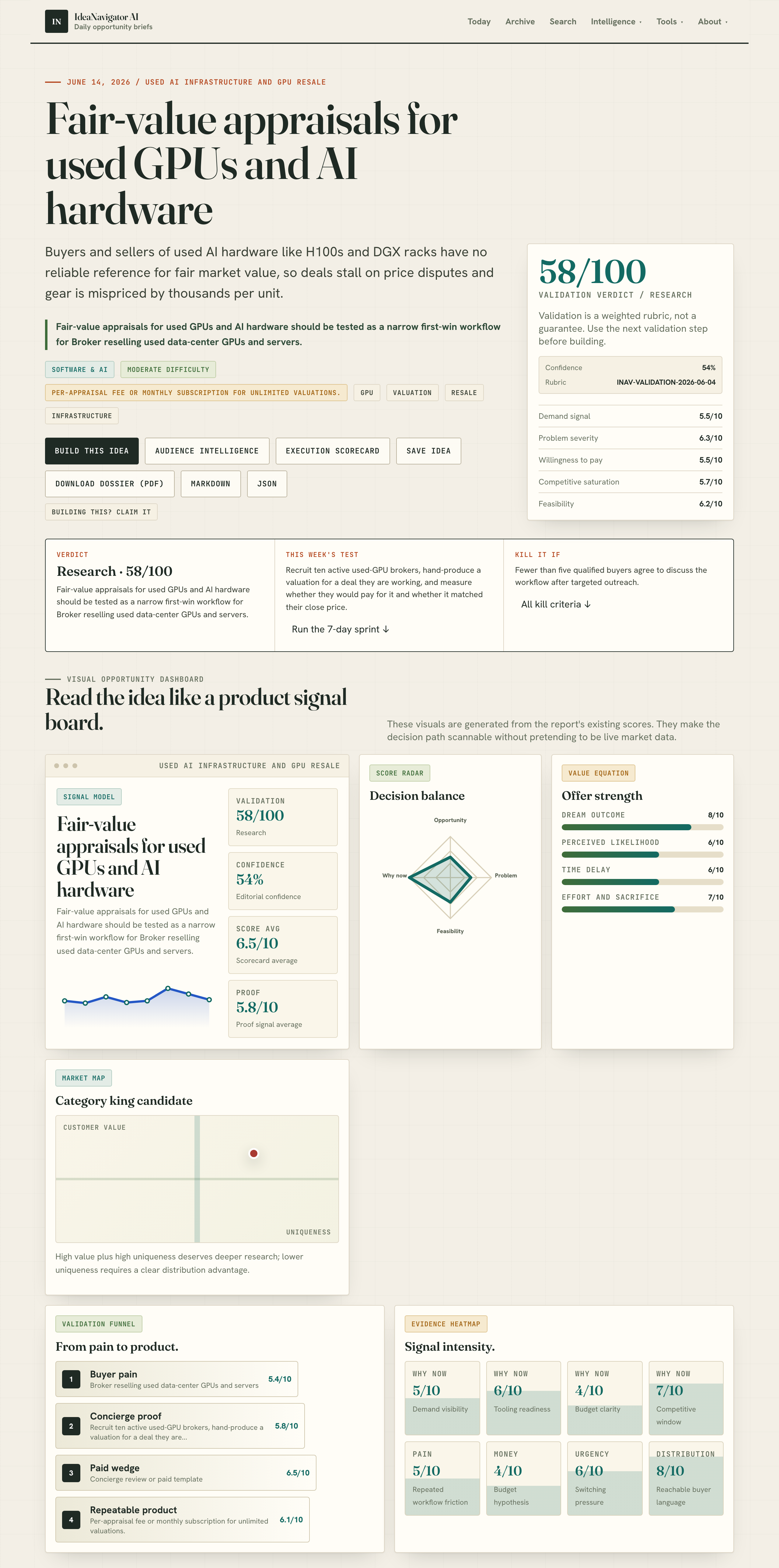
A proposed manual valuation tool aims to provide reliable fair market prices for used GPUs and AI hardware. This development targets brokers reselling secondhand data-center equipment, addressing a major pricing transparency gap. Its success could streamline secondary market transactions and reduce disputes.
IdeaNavigator AI is developing and testing a manual valuation sheet designed to provide brokers with fair-value ranges for used data-center GPUs and AI hardware, addressing a key gap in secondary market pricing transparency.
The initiative aims to create a simple, manual tool where brokers input hardware details such as model, condition, and quantity, and receive a curated fair-value range based on recent comparable sales. This approach is intended to resolve persistent pricing disputes and reduce mispricing, which often results in thousands of dollars difference per unit.
The market focus is on used AI infrastructure, including high-demand hardware like NVIDIA H100s and DGX racks, which are being rapidly refreshed by hyperscalers and research labs. These organizations are dumping recent-generation hardware onto secondary markets with little transparent pricing reference, leading to instability and uncertainty for buyers and sellers alike.
Initial validation involves recruiting ten active used-GPU brokers to test the valuation sheet against their current deals. The goal is to determine whether brokers find the tool useful enough to pay for and whether the valuations align with their actual sale prices, potentially creating a scalable revenue model through per-appraisal fees or subscriptions.
Potential Impact on Used AI Hardware Market Pricing
If successful, this manual valuation approach could establish a reliable benchmark for fair market prices, reducing deal stalls caused by price disputes and enabling more efficient transactions. It could also lead to the development of standardized pricing practices, increasing transparency and confidence among buyers and sellers in the secondary market.
Given the rapid turnover of AI hardware and the increasing volume of equipment being resold, a trusted valuation method could significantly influence market dynamics, helping prevent over- or under-pricing and fostering healthier trading conditions.
As an affiliate, we earn on qualifying purchases.
Background of Pricing Challenges in Used AI Hardware Markets
The secondary market for used data-center GPUs and AI hardware has grown rapidly as organizations refresh their hardware fleets more aggressively. Large hyperscalers and labs are frequently replacing equipment like NVIDIA H100s and DGX racks, often selling their previous hardware into secondary markets.
However, the lack of transparent, standardized pricing benchmarks has led to frequent disagreements over fair value, with prices sometimes diverging by thousands of dollars per unit. This has resulted in stalled deals and mispricing risks, complicating resale efforts and reducing market efficiency.
Currently, brokers rely on anecdotal data, manual comparisons, and limited public listings, which do not provide a consistent or reliable reference point for fair valuation.
“The absence of a standard valuation tool has been a significant barrier to transparent pricing in the used AI hardware market.”
— an anonymous researcher
secondhand AI hardware valuation tool
As an affiliate, we earn on qualifying purchases.
As an affiliate, we earn on qualifying purchases.
Unconfirmed Aspects of the Valuation System’s Effectiveness
It is not yet clear how accurately the manual valuation sheet will reflect actual market prices over time, or whether brokers will adopt it widely enough to influence pricing standards. The long-term scalability and integration into existing workflows remain to be tested.
As an affiliate, we earn on qualifying purchases.
Next Steps in Validation and Market Adoption
The initial testing phase involves recruiting ten active used-GPU brokers to apply the valuation sheet to current deals. Their feedback will determine whether the tool provides sufficiently accurate and useful estimates. Pending positive results, further development could include automation and integration into broader valuation platforms, potentially expanding its adoption across the industry.
As an affiliate, we earn on qualifying purchases.
Key Questions
How will the manual valuation sheet improve market transparency?
It will provide brokers with a standardized, data-driven fair-value range based on recent comparable sales, reducing guesswork and disputes.
Can this tool be used for all types of used AI hardware?
Initially, it will focus on high-demand hardware like GPUs and servers, with potential expansion to other components as the model proves effective.
Will brokers pay for this valuation service?
Yes, the plan is to test a per-appraisal fee or a subscription model for unlimited valuations, depending on broker feedback and market acceptance.
What are the limitations of the current manual approach?
The accuracy depends on the quality of recent comparable sales data and broker input, and it may require refinement to handle different hardware conditions and configurations.
When might this valuation method become widely adopted?
If initial testing shows positive results, broader adoption could occur within the next 6 to 12 months as the industry seeks more transparent pricing benchmarks.
Source: IdeaNavigator AI
Halloween Picks
halloween
As an affiliate, we earn on qualifying purchases.