📊 Full opportunity report: AI Changelog Digest For Open-source Maintainers on IdeaNavigator AI — validation score, market gap, and execution plan.

Get hardware and tech essentials delivered free with Prime
- Fast, free delivery on millions of items
- Prime Video, Amazon Music and more included
- Member-only deals all year
TL;DR
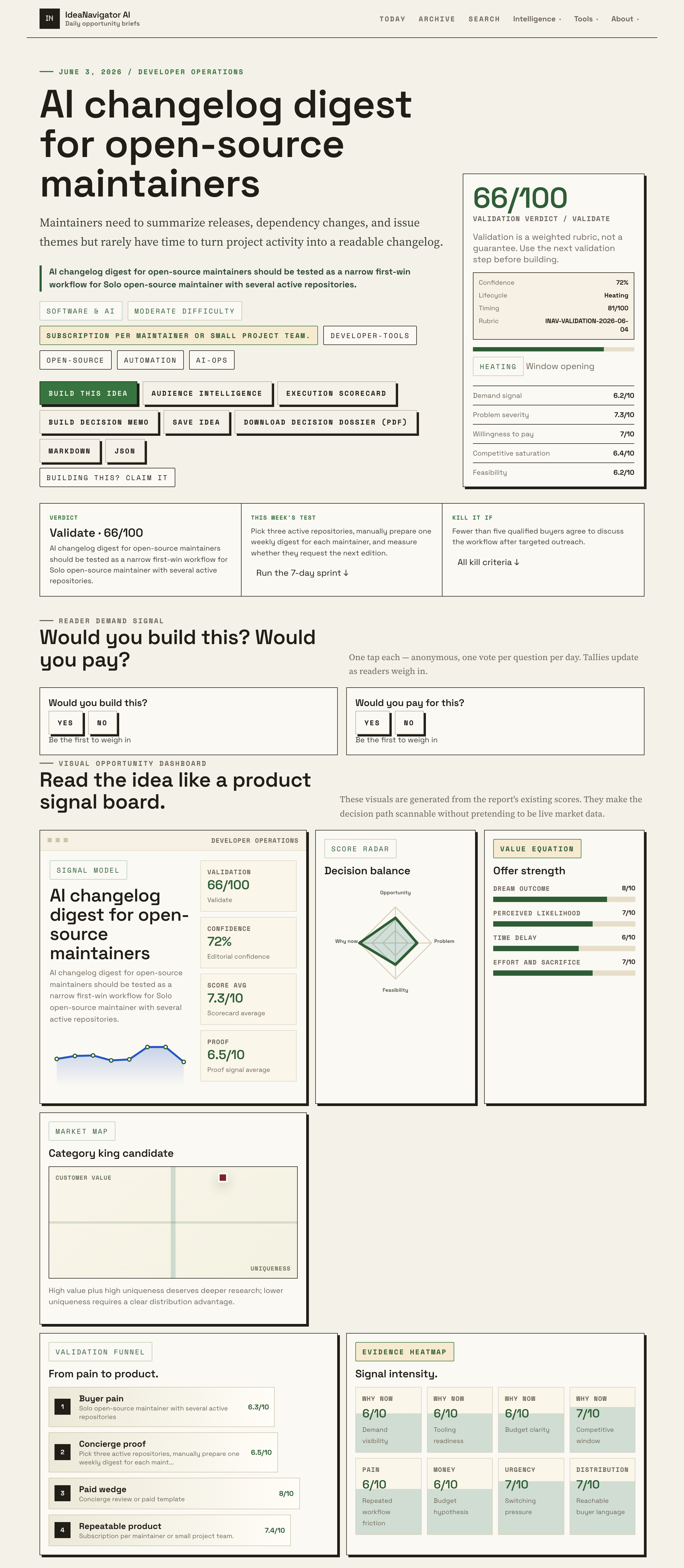
A proposed AI-based weekly digest tool for open-source maintainers is in testing. It aims to automate summarizing releases, dependencies, and issues, reducing manual effort. Validation involves selecting repositories and measuring request rates for the digest.
AI changelog digest for open-source maintainers is being tested as a new workflow designed to help solo maintainers with multiple repositories automate release summaries and issue themes. The initiative aims to reduce manual effort in maintaining clear, readable changelogs, leveraging repository metadata and AI summarization tools.
The project targets solo open-source maintainers managing several repositories, who often lack the time to compile detailed changelogs from releases, dependency updates, and issue discussions. The proposed weekly digest generator would automatically read release feeds, merged pull requests, and top issues, then draft a summarized changelog email for approval.
This approach is made feasible by recent advances in AI summarization and the availability of repository metadata, enabling a narrow, focused workflow without requiring a full developer-relations team. The initial testing involves selecting three active repositories, manually preparing one digest per maintainer, and measuring whether they request subsequent editions to evaluate usefulness.
The model proposes a subscription-based revenue stream per maintainer or small project team, targeting the developer operations market. Validation hinges on whether maintainers find the generated digests valuable enough to request ongoing updates.
Potential Impact on Open-Source Maintenance Workflow
This development could significantly reduce the manual effort required for maintaining clear communication about project updates, especially for solo maintainers. Automating changelog creation can improve transparency, help with onboarding new contributors, and streamline release management. If successful, it may set a precedent for broader AI integration in developer operations, making open-source maintenance more efficient and accessible.
software development changelog tools
As an affiliate, we earn on qualifying purchases.
As an affiliate, we earn on qualifying purchases.
Emergence of AI Tools in Developer Operations
Recent years have seen increasing adoption of AI tools to assist in software development, including code review, documentation, and project management. This initiative builds on that trend, focusing specifically on automating changelog summaries—a traditionally manual, time-consuming task. The concept has gained attention as repositories grow larger and more active, making manual summaries impractical for solo maintainers.
The idea originates from the recognition that repository metadata, combined with AI summarization, can deliver concise updates without extensive manual input. Similar efforts have been seen in automated release notes and dependency management, but this project specifically targets the weekly digest workflow for individual maintainers managing multiple projects.
“Leveraging AI for changelog summaries could transform how solo maintainers handle project updates, making it more scalable and less time-consuming.”
— an anonymous researcher
AI-powered project management software
As an affiliate, we earn on qualifying purchases.
As an affiliate, we earn on qualifying purchases.
Unconfirmed Aspects of the AI Digest Initiative
It is not yet clear how accurately the AI will summarize complex release notes and issue discussions, or how well maintainers will accept and adopt the generated digests. The effectiveness of the workflow across diverse repositories and project types remains to be validated through ongoing testing. Additionally, the long-term business model and potential scalability are still under consideration.
As an affiliate, we earn on qualifying purchases.
Next Steps for Validation and Development
Developers plan to test the digest generator on three active repositories, gather feedback from maintainers, and refine the AI summarization algorithms. Success will be measured by the number of maintainers requesting ongoing digests. Further development may include expanding to more repositories, automating approval workflows, and exploring integration with existing project management tools.
developer workflow automation tools
As an affiliate, we earn on qualifying purchases.
As an affiliate, we earn on qualifying purchases.
Key Questions
How will the AI generate the changelog summaries?
The AI will analyze repository metadata, recent releases, merged pull requests, and top issues to produce a concise, readable summary suitable for email or documentation updates.
Who is the target user for this AI digest tool?
Solo open-source maintainers managing multiple repositories who lack the time to manually compile detailed changelogs.
What are the main benefits of using this AI tool?
It aims to save time, improve communication clarity, and help maintainers keep project stakeholders informed with minimal manual effort.
Is this tool currently available for use?
No, it is still in the testing phase, with initial validation efforts underway. Broader availability will depend on the success of early trials.
Could this AI digest replace manual changelog writing entirely?
While it could automate much of the process, human oversight will likely remain essential to ensure accuracy and context, especially for complex projects.
Source: IdeaNavigator AI
Halloween Picks
halloween
As an affiliate, we earn on qualifying purchases.