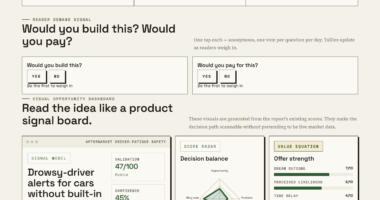
📊 Full opportunity report: The Impact Of AI On Scope-of-Work Evaluation In B2B SaaS Procurement on IdeaNavigator AI — validation score, market gap, and execution plan.

Get hardware and tech essentials delivered free — and shop member deals
- Fast, free delivery on millions of items
- Access to Prime Big Deal Days deals on October 6–7
- Prime Video, Amazon Music and more included
TL;DR

AI-based scope-of-work review tools are emerging as a game-changer in B2B SaaS procurement. They analyze proposals, benchmark rates, and flag ambiguities, helping companies select agencies more effectively. This development could reduce costly disputes and streamline decision-making.
AI-driven scope-of-work review tools are now being tested for agency selection in B2B SaaS procurement, targeting SMB and mid-market companies. These tools analyze proposals, compare deliverables, pricing, and scope language, and flag ambiguities, potentially transforming how companies evaluate vendors and avoid costly disputes.
The opportunity arises from recent advances in large language models (LLMs), which can parse complex proposal documents against benchmark libraries of real scope and rates. This enables companies to gain pattern recognition similar to that of experienced marketing executives, without needing to hire specialized staff.
Currently, the focus is on a minimum viable product (MVP): companies upload competing proposals, and the AI extracts key elements such as deliverables, cadence, and pricing into a comparison grid. It also flags vague or one-sided clauses, benchmarks rates against industry norms, and generates clarifying questions to send to each agency. This process aims to improve transparency and reduce the risk of scope creep or under-delivery.
Market participants view this as a significant step toward more objective and data-driven procurement processes. The model is designed for ongoing use, with companies paying per review and subscribing for continuous access to benchmarking data and tools. Early validation involves reviewing twenty live agency selections, tracking which flagged clauses lead to disputes, and assessing buyer willingness to pay for these services.
Why AI-Driven Scope Evaluation Matters for Procurement
This development matters because it addresses longstanding challenges in B2B SaaS procurement—namely, the difficulty companies face in objectively evaluating proposals with vague scopes and unbenchmarked pricing. By automating and standardizing proposal analysis, AI tools can reduce the likelihood of scope misunderstandings, which often lead to costly disputes and project delays.
For SMBs and mid-market firms, which typically lack dedicated procurement teams, AI-assisted review offers a way to make more informed decisions quickly. It also democratizes access to pattern recognition capabilities traditionally limited to large organizations with experienced CMOs or procurement specialists. Ultimately, this can lead to more competitive vendor selection, better project outcomes, and cost savings.
However, the technology’s effectiveness depends on the quality of benchmark libraries and the sophistication of the AI models. As these tools are still in pilot phases, their real-world impact will become clearer as more companies adopt and refine the process.
AI scope of work review tools for SaaS procurement
As an affiliate, we earn on qualifying purchases.
As an affiliate, we earn on qualifying purchases.
Background of Proposal Evaluation Challenges in SaaS Procurement
In B2B SaaS procurement, selecting the right agency or vendor often involves reviewing complex proposals with vague deliverables, unstandardized pricing, and scope language designed to allow flexibility or under-delivery. Companies frequently rely on manual review processes, which are time-consuming and prone to human bias or oversight.
Historically, experienced procurement teams or marketing leaders have used their expertise to identify risks and compare proposals, but smaller companies lack such resources. As a result, they often discover scope gaps or pricing issues only after contract signing, leading to disputes and project delays.
Recent advances in large language models and AI have opened possibilities for automating parts of this review process. IdeaNavigator AI is testing a scope-of-work reviewer that leverages these models to parse proposals, benchmark rates, and flag ambiguities, aiming to improve the accuracy and efficiency of vendor evaluation.
“AI tools can now parse proposal documents against benchmark libraries, providing pattern recognition similar to experienced CMOs.”
— an anonymous researcher
proposal comparison software for B2B SaaS
As an affiliate, we earn on qualifying purchases.
As an affiliate, we earn on qualifying purchases.
Uncertainties in AI Effectiveness and Adoption Pace
It is not yet clear how accurately these AI tools will perform across diverse proposal formats and industry-specific language. The effectiveness depends heavily on the quality of benchmark libraries and AI training data.
Additionally, the rate of adoption among companies, especially in smaller firms with limited technical resources, remains uncertain. The impact on dispute reduction and procurement efficiency will only be measurable after broader deployment and longitudinal studies.
Further, questions remain about how well these tools can handle complex scope language or detect nuanced contractual risks that require human judgment.
As an affiliate, we earn on qualifying purchases.
Next Steps in Validating AI’s Role in Proposal Review
Next, the pilot testing phase will evaluate how well AI tools identify scope gaps and flag problematic clauses in real-world procurement scenarios. Companies will track whether flagged issues correlate with actual disputes or project delays.
Further development will focus on refining benchmark libraries, improving AI language understanding, and integrating feedback from procurement professionals. Broader adoption will depend on demonstrating clear cost and time savings, as well as dispute reduction.
Expect more case studies and industry reports over the next year, assessing AI’s impact on procurement efficiency and vendor quality in SaaS and related sectors.
As an affiliate, we earn on qualifying purchases.
Key Questions
How does AI improve proposal evaluation in SaaS procurement?
AI analyzes proposals to extract key elements like deliverables, pricing, and scope language, benchmarks rates against industry norms, and flags ambiguities or vague clauses, aiding more objective comparisons.
Can AI prevent scope-related disputes?
While AI can identify potential risks and inconsistencies early, it is not yet certain how effectively it can prevent disputes. It aims to reduce the likelihood by improving clarity and transparency during review.
Who benefits most from AI-driven scope reviews?
SMBs and mid-market companies with limited procurement resources stand to benefit most, gaining access to pattern recognition and benchmarking previously available mainly to large organizations.
What are the limitations of current AI proposal review tools?
Limitations include dependence on quality benchmark data, difficulty handling complex or nuanced scope language, and potential challenges in integrating into existing procurement workflows.
What is the timeline for broader adoption of these AI tools?
Broader adoption depends on pilot results, refinement of models, and demonstrated cost and time savings. Industry-wide impact may unfold over the next 12 to 24 months.
Source: IdeaNavigator AI
Fall Picks
fall essentials
As an affiliate, we earn on qualifying purchases.