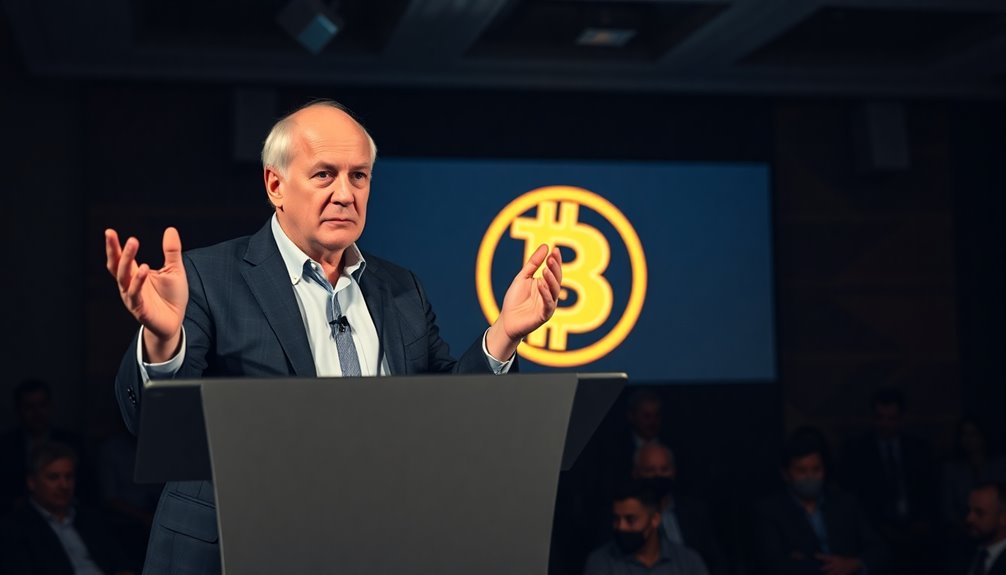

You might be surprised to hear Peter Schiff's take on Bitcoin as a reserve asset. He labels its promotion as "fraudulent," pointing to the extreme volatility that could wreak havoc on economies. Schiff warns that governments could face serious risks if they invest in such an unpredictable currency. As institutional interest in Bitcoin grows, it raises questions about what this means for financial stability. What could the future hold for cryptocurrencies amidst these concerns?

When it comes to the idea of a Bitcoin reserve, many people might think Peter Schiff is on board, but that's far from the truth. Schiff's initial comments about Bitcoin were quickly misunderstood by the crypto community as a sign of support. He later clarified that this interpretation was incorrect. Instead, he's made it clear that he views Bitcoin and its promotion with skepticism, labeling the tactics used by its advocates as "fraudulent."
You can't ignore Schiff's strong concerns about Bitcoin's volatility. He argues that this unpredictability makes it an unreliable reserve asset, one that could destabilize economies rather than bolster them. The thought of a national Bitcoin reserve, which some politicians have floated, raises alarms for Schiff. He warns that if the government starts printing more money to buy Bitcoin, it could lead to further economic instability. Interestingly, despite Schiff's harsh criticism, discussions around a Bitcoin reserve have spurred significant gains in the crypto market. Bitcoin prices surged, and trading volumes spiked as investors reacted to this potential development. It shows how the market can shift rapidly, even in the face of skepticism from notable figures like Schiff.
While the idea of a Bitcoin reserve sounds appealing to some, Schiff's view reminds you that there are serious risks involved, particularly with Bitcoin's erratic price swings. Schiff isn't just critical of Bitcoin; he also questions the legitimacy of other cryptocurrencies like XRP for a national reserve. He points out their differing use cases and remains skeptical about any digital currency serving as a reliable reserve asset. He acknowledges the "digital gold" narrative surrounding Bitcoin but maintains that it doesn't meet the necessary criteria for stability. In a market that thrives on optimism, Schiff's warnings can often go unheeded. Still, it's essential to consider the broader implications of adopting such a volatile asset as a reserve.
The potential for regulatory changes could further legitimize Bitcoin in the eyes of institutional investors, but Schiff emphasizes the economic risks involved, urging caution. He previously supported Bitcoin as an alternative to XRP for a reserve, which shows the complexity of his evolving stance. In the end, while the prospect of a Bitcoin reserve excites many, Schiff's criticisms serve as a sobering reminder of the complexities and risks surrounding cryptocurrencies.
Whether you agree with him or not, his perspective pushes you to think critically about the future of digital assets.

Bitkey Bitcoin Hardware Wallet – The Most Secure Way to Buy, Store and Manage Bitcoin
BITCOIN EXCLUSIVE: Bitkey is designed from the ground up exclusively for Bitcoin, offering a dedicated hardware wallet solution…
As an affiliate, we earn on qualifying purchases.
As an affiliate, we earn on qualifying purchases.
cryptocurrency volatility monitor
As an affiliate, we earn on qualifying purchases.
As an affiliate, we earn on qualifying purchases.

The New Digital Gold: A Simple Guide to Cryptocurrency: A Beginner's Manual for Learning the Basics, Buying, Selling, Storing Safely, Avoiding Mistakes, and Building Smart Investment Habits
As an affiliate, we earn on qualifying purchases.
As an affiliate, we earn on qualifying purchases.

TANGEM Crypto Wallet Pack of 2 – Trusted Cold Storage Hardware Wallet for Bitcoin, Ethereum, NFTs & Altcoins – 100% Offline Crypto Cold Wallet
Proven security at scale: Over 9 years and millions of cards issued with no known remote hacks, while…
As an affiliate, we earn on qualifying purchases.
As an affiliate, we earn on qualifying purchases.