
You’ve seen how mobile networks evolved from 1G, which used analog signals, to digital 2G, then faster 3G, and increasingly powerful 4G LTE. Now, 5G offers incredible speed, lower latency, and connects more devices than ever. Each generation added new infrastructure like base stations, core networks, and spectrum management to improve performance and capacity. To discover how these changes paved the way for today’s ultra-connected world, keep exploring the advancements behind each step.
Key Takeaways
- Mobile networks evolved from analog 1G to digital 2G, enabling better voice quality and basic text messaging.
- Each generation introduced advanced infrastructure components like base stations, core networks, and backhaul links.
- Spectrum allocation shifted from unregulated to strategic licensing, supporting increased data demands across generations.
- Technologies like LTE in 4G and millimeter-wave bands in 5G dramatically increased speed and network capacity.
- Ongoing innovations aim to deliver faster, more reliable, and smarter connectivity for users worldwide.
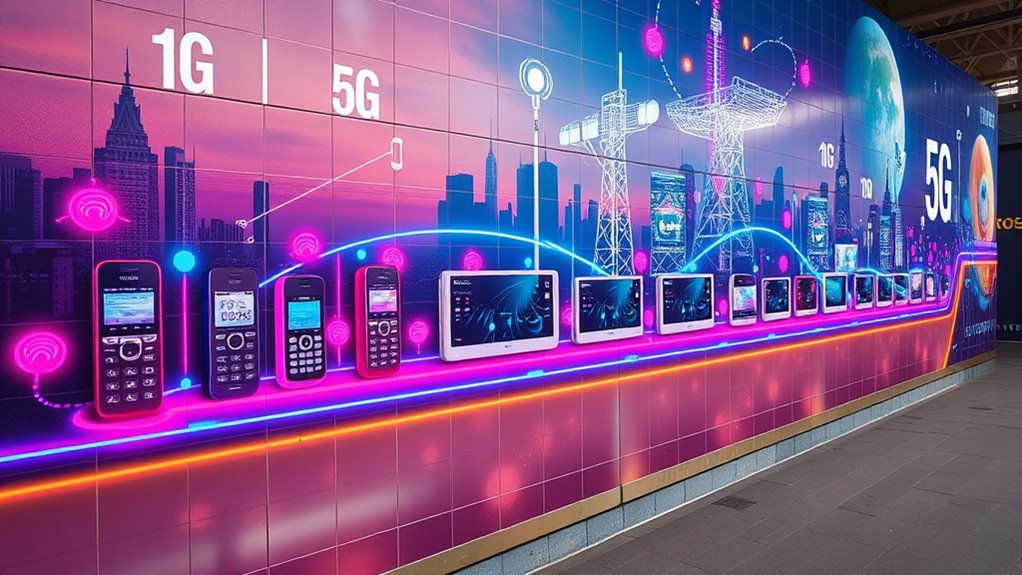
Mobile networks have rapidly evolved over the past few decades, transforming how we communicate and access information. As these networks advanced, the design of their network architecture played a pivotal role in supporting increasing demand for faster, more reliable connections. Early generations, like 1G, used simple analog systems with limited capacity and basic infrastructure. But as users sought better quality and more features, network architecture became more sophisticated, leading to the digital systems of 2G, 3G, 4G, and now 5G. Each new generation introduced new layers of complexity, including the deployment of base stations, core networks, and backhaul links that guaranteed seamless connectivity. These innovations allowed for increased capacity, lower latency, and the ability to support an ever-growing number of devices. Additionally, ongoing research into AI security helps optimize network management and safeguard against emerging threats. Spectrum allocation is another essential aspect that evolved alongside network architecture. In the early days, spectrum was relatively unregulated, but as mobile use surged, authorities began assigning specific frequency bands to prevent interference and optimize usage. With each generation, spectrum allocation strategies became more refined. For instance, 2G primarily used narrowband frequencies suitable for voice and text, while 3G introduced wider bands to support data and multimedia services. 4G expanded this further, utilizing LTE technology and broader spectrum bands to deliver high-speed internet. Now, with 5G, spectrum allocation involves not just traditional frequencies but also millimeter-wave bands, which offer enormous bandwidth potential but require dense infrastructure deployment. This spectrum management ensures that the network can handle massive data flows while minimizing interference and maximizing efficiency. Throughout this evolution, the way spectrum is allocated has also adapted to technological innovations. Dynamic spectrum sharing, for example, allows different services to operate within the same bands, improving utilization. Additionally, the structuring of spectrum blocks and licensing policies have become more flexible, enabling network operators to optimize their infrastructure investments. The combination of advanced network architecture and strategic spectrum allocation underpins the remarkable improvements in speed, capacity, and reliability of modern mobile networks. These developments have empowered you, the user, to stream high-definition videos, participate in real-time gaming, and communicate effortlessly across the globe. As we move toward 5G and beyond, the ongoing refinement of network architecture and spectrum management promises even more transformative experiences, making connectivity faster, smarter, and more responsive to your needs.

CyberPower CP1500AVRLCD3 Intelligent LCD UPS Battery Backup
- Power Capacity: 1500VA/900W UPS with simulated sine wave
- Outlet Configuration: 12 NEMA 5-15R outlets with surge protection
- Charging Ports: USB Type-A and Type-C ports for quick device charging
As an affiliate, we earn on qualifying purchases.
Frequently Asked Questions
How Did Each Generation Improve User Data Speeds?
You experience faster data speeds with each generation due to improved spectral efficiency and advanced modulation techniques. As networks evolved, they used higher frequency bands and sophisticated modulation, like QAM, to pack more data into the same bandwidth. This means you get quicker downloads and smoother streaming. Each new generation boosts spectral efficiency, allowing more data to flow efficiently, directly enhancing your overall user experience.
What Were the Main Technological Breakthroughs in Mobile Network Evolution?
You’re about to witness the tech miracles that transformed your mobile experience! The main breakthroughs include spectral efficiency, which packed more data into less space, and antenna diversity, giving your connection superhero strength and reliability. These innovations, along with advanced modulation and massive MIMO, turbocharged network capacity and speed. It’s like upgrading from a bike to a rocket, making your calls clearer, faster, and more reliable than ever before!
How Has Network Security Evolved From 1G to 5G?
Your network security has markedly evolved, incorporating advanced encryption protocols and robust authentication mechanisms. In 1G, security was minimal, mainly relying on analog signals. As technology advanced, 2G introduced digital encryption, improving privacy. By 3G and 4G, stronger encryption and multi-factor authentication became standard. With 5G, you benefit from enhanced encryption protocols and sophisticated authentication mechanisms, making your data more secure against cyber threats and unauthorized access.
What Challenges Were Faced During the Transition Between Generations?
During the shift between generations, you faced challenges like spectrum allocation and infrastructure deployment. Governments and providers had to find enough spectrum for new technologies, often causing delays. Upgrading infrastructure required significant investment and coordination, disrupting existing networks. You also dealt with compatibility issues and ensuring seamless coverage, which slowed adoption. These hurdles demanded strategic planning and innovation to smoothly evolve from one generation to the next.
How Do Future 6G Networks Compare to Current 5G Capabilities?
Future 6G networks will surpass current 5G capabilities by offering quantum connectivity and AI integration, enabling unprecedented speed and efficiency. You’ll experience near-instantaneous data transfer with ultra-reliable, low-latency connections that support advanced applications like holographic communication and autonomous systems. AI will optimize network performance dynamically, making your connections smarter and more responsive, while quantum tech guarantees enhanced security and immense data processing power.

CyberPower CP1500PFCLCD PFC Sinewave UPS Battery Backup and Surge Protector, 1500VA/1000W, 12 Outlets, AVR, Mini Tower, UL Certified
- Power Capacity: 1500VA/1000W PFC sine wave UPS
- Number of Outlets: 12 outlets with surge protection
- Outlet Types: Six battery backup, six surge protected
As an affiliate, we earn on qualifying purchases.
Conclusion
As you reflect on the journey from 1G to 5G, it’s clear how far we’ve come in staying connected. Each step has gently paved the way for more seamless communication, whispering promises of a more integrated future. While the path has its twists and turns, your everyday life now benefits from this quiet evolution. Embrace the ongoing progress, knowing that the next chapter in mobile networks will continue to quietly enrich your world, one connection at a time.

CyberPower EC850LCD Ecologic UPS Battery Backup and Surge Protector
- Power Capacity: 850VA/510W backup power
- Output Waveform: Simulated sine wave output
- Outlet Count: 12 NEMA 5-15R outlets
As an affiliate, we earn on qualifying purchases.

APC UPS 600VA/330W UPS Battery Backup for Computer, Router, NAS, BE600M1
- Battery Backup for Devices: Keeps computer and router running during outages
- Extended Runtime: Provides 23 minutes of backup at 100W load
- Surge Protection: Protects against power surges and spikes
As an affiliate, we earn on qualifying purchases.