

Web 3.0 and Web 2.0 differ mainly in how they handle data and user control. Web 2.0 relies on centralized platforms like Facebook and Google, giving these companies control over your content and data. Web 3.0 shifts that power to you, using blockchain and decentralized networks that let you own your digital assets and online identity. If you’re curious about how this change impacts your online experience and privacy, keep exploring further.
Key Takeaways
- Web 2.0 is centralized, relying on platforms like Facebook and Google, while Web 3.0 emphasizes decentralization and user ownership of data.
- Web 2.0 fosters social interaction but limits control over personal data; Web 3.0 empowers users with data ownership and privacy.
- Blockchain technology underpins Web 3.0, enabling transparent, tamper-proof transactions, unlike Web 2.0’s opaque data storage.
- Web 2.0 is driven by user-generated content on centralized servers; Web 3.0 promotes participation in decentralized applications and governance.
- Web 3.0 enhances trust and security through blockchain, reducing reliance on centralized authorities and increasing transparency.
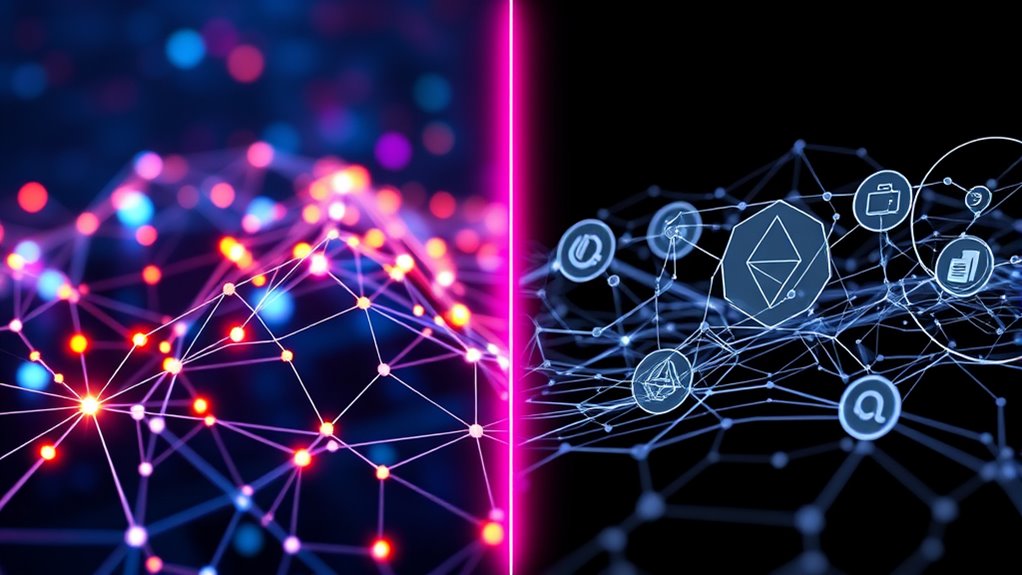
Web 3.0 and Web 2.0 represent two distinct phases in the evolution of the internet, each bringing different capabilities and user experiences. In the era of Web 2.0, the focus was on social media, user-generated content, and centralized platforms. Companies like Facebook, Google, and Twitter gained dominance by controlling vast amounts of data and shaping user interactions. As a user, you experienced a more interactive web, but your data was often stored on servers owned by these corporations, giving them significant control. This centralization meant that your online activities depended heavily on these platforms, which could change policies or shut down services at any time. Web 2.0 made the internet more social and engaging but also raised concerns about privacy, data ownership, and censorship. Meanwhile, Web 3.0 introduces the concept of decentralized data ownership, empowering users to have more control over their digital identities and assets. Now, with Web 3.0 emerging, the focus shifts toward decentralization and user empowerment. Instead of relying on a few big companies to hold your data, Web 3.0 leverages blockchain technology and peer-to-peer networks to distribute control across a wider user base. You become more than just a passive consumer—you’re an active participant in managing your data and online identity. This shift aims to give you greater control over what you share and how it’s used, reducing the influence of centralized authorities. Blockchain-based platforms enable you to own your digital assets securely, participate directly in decentralized applications (dApps), and even earn rewards for your contributions. As a result, your online experience becomes more secure, private, and aligned with your interests, rather than dictated by platform policies. The decentralization focus of Web 3.0 also enhances transparency. Because transactions and data exchanges are recorded on tamper-proof blockchains, you can verify information independently. This transparency fosters trust and accountability, especially in areas like finance, voting, and content creation. User empowerment is at the core of Web 3.0, meaning you have more say in the development and governance of digital ecosystems. You can participate in decentralized autonomous organizations (DAOs), vote on proposals, and influence how platforms evolve. This shift reduces reliance on centralized gatekeepers, giving you more control over your digital life. In essence, Web 2.0 created a more social and interactive web, but with significant control concentrated in the hands of a few corporations. Web 3.0 aims to democratize the internet, emphasizing decentralization and user empowerment. As you navigate this new landscape, you’ll notice greater ownership of your data, increased privacy, and a more participatory online environment where your voice truly matters.

The Blockchain Future: Bitcoin, Cryptocurrency, Blockchain Technology, De-centralised Ledgers, Smart Contracts, Crypto Wallets, NFTS and Web 3.0. What … do in the real world now and in the future!
As an affiliate, we earn on qualifying purchases.
As an affiliate, we earn on qualifying purchases.
Frequently Asked Questions
How Will Web 3.0 Impact Online Privacy?
Web 3.0 will improve your online privacy by enabling decentralized identity, so you control your personal data. This shift promotes data sovereignty, meaning you decide who accesses your information and when. With blockchain technology, your data becomes more secure and transparent, reducing risks of misuse. You’ll experience a safer browsing environment where your privacy’s prioritized, giving you greater confidence and control over your digital footprint.
What Are the Main Technologies Behind Web 3.0?
Web 3.0 relies on blockchain decentralization and the semantic web to enhance your online experience. Blockchain decentralization removes central authorities, giving you more control over your data and transactions. The semantic web enables machines to understand and interpret information meaningfully, making your interactions smarter and more personalized. Together, these technologies create a more secure, private, and interconnected web, empowering you with greater ownership and better insights.
Can Web 3.0 Replace Web 2.0 Entirely?
Imagine Web 3.0 as a bustling marketplace where decentralized applications and a token economy empower everyone, while Web 2.0 is like a well-organized town run by a few. Web 3.0 can replace Web 2.0 in many areas, but it’s unlikely to fully replace it overnight. Both will coexist, with Web 3.0 gradually transforming how you interact online, emphasizing decentralization and ownership.
How Does User Control Differ Between Web 2.0 and Web 3.0?
In Web 2.0, you have limited control over your data, often relying on platforms that prioritize their interests. With Web 3.0, user empowerment increases as you gain more control over your data, supporting data sovereignty. You can decide what information to share and how it’s used, fostering trust and transparency. This shift puts you in the driver’s seat, ensuring your digital identity remains more secure and under your control.
What Industries Are Most Affected by the Shift to Web 3.0?
You’ll find industries like finance and supply chain management most affected by Web 3.0. Decentralized finance (DeFi) transforms banking by removing intermediaries, giving you more control. Supply chain transparency improves as blockchain provides real-time, tamper-proof data, making processes more reliable. These changes empower consumers and businesses alike, fostering trust and efficiency. As Web 3.0 evolves, expect even deeper integration into sectors that value security, decentralization, and data integrity.

Unlocking Blockchain on Azure: Design and Develop Decentralized Applications
As an affiliate, we earn on qualifying purchases.
As an affiliate, we earn on qualifying purchases.
Conclusion
Understanding the difference between Web 3.0 and Web 2.0 is like comparing a bustling city to a quiet village—you’ll see how each shapes your online journey. Web 3.0 offers a more decentralized, smarter experience, empowering you to control your data. As the web evolves, it’s clear that Web 3.0 is paving the path toward a more open, interconnected digital world—like a bridge connecting countless islands, inviting you to explore its endless possibilities.

ComplianceSigns.com Take Care of Our Most Valuable Asset Digital Safety Scoreboard, 28×20 inch Aluminum
- Size: 28×20 inches with 1-inch thickness
- Display: Colorful digital accident-free days counter
- LED Numbers: 2.5-inch bright LED, counts up to 9,999 days
As an affiliate, we earn on qualifying purchases.
As an affiliate, we earn on qualifying purchases.

JCWINY Webcam Cover, 2 Pack Desktop Computer External Webcam Lens Covers Shutter Cap Hood, Streaming Web Camera Privacy Cover Clip Compatible with Logitech HD Pro Web Cam C270/C615/C920/C930e/C922X
- Premium Webcam Cover: No interference or device damage
- Privacy and Dust Protection: Prevents hacking and keeps lens clean
- Durable and Strong: Made of high-strength plastic with 3M adhesive
As an affiliate, we earn on qualifying purchases.
As an affiliate, we earn on qualifying purchases.