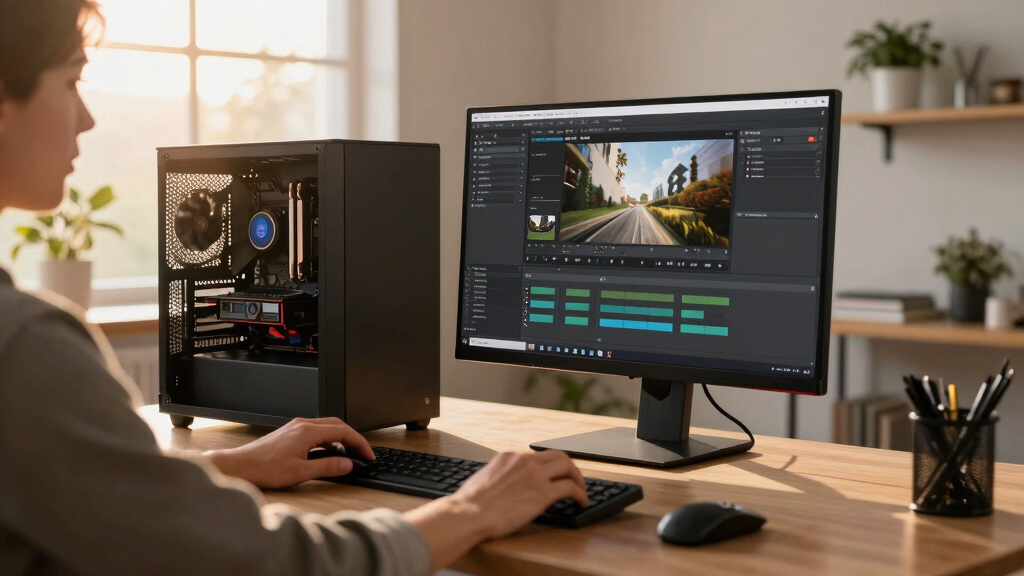

When selecting the best AMD GPU for video editing, performance, reliability, and feature set are key factors. The ASRock Radeon AI PRO R9700 Creator stands out as the top choice for demanding professional workflows thanks to its 32GB memory and advanced AI-accelerators. For those on a budget, the ASRock Radeon RX 7700 XT Challenger offers solid performance without breaking the bank. Meanwhile, the GIGABYTE RX 9070 XT Gaming OC provides a strong balance of high-end features and gaming versatility. Choosing the right GPU involves tradeoffs between raw power, price, and feature set, so continue reading for the full breakdown to find the best fit for your needs.

Get hardware and tech essentials delivered free with Prime
- Fast, free delivery on millions of items
- Prime Video, Amazon Music and more included
- Member-only deals all year
Key Takeaways
- The top-tier professional GPU, the ASRock Radeon AI PRO R9700, excels in AI acceleration and memory capacity, ideal for heavy editing and rendering tasks.
- High VRAM (16GB or more) remains a crucial factor for smooth 4K and higher resolution editing, as seen with the GIGABYTE RX 9060 XT and ASRock Challenger models.
- Premium models like the ASUS Prime RX 9070 XT deliver high performance but come with a significant price premium, making them best suited for professional studios.
- Budget-friendly options such as the ASRock Radeon RX 7700 XT Challenger balance performance and affordability, but may lack some high-end features for intensive workflows.
- Cooling solutions and build quality vary significantly; models with triple fans or blower cooling tend to run quieter and cooler under load, extending hardware lifespan.
| ASUS Prime Radeon RX 9070 XT 16GB GDDR6 OC Edition Gaming Graphics Card |  | Best Overall for High-End Video Editing | Graphics Coprocessor: AMD RX9070 | Memory: 16 GB GDDR6 | GPU Clock Speed: 3030 MHz | VIEW LATEST PRICE | See Our Full Breakdown |
| XFX Swift AMD Radeon RX 9060 XT OC Triple Fan Gaming Edition with 16GB GDDR6 |  | Best Value for High-Resolution Video Editing | Chipset: AMD RX 9060 XT | Memory: 16 GB GDDR6 | Boost Clock: 3320 MHz | VIEW LATEST PRICE | See Our Full Breakdown |
| GIGABYTE Radeon RX 9060 XT Gaming OC ICE 16G Graphics Card |  | Best for High-Performance and Durability | VRAM: 16GB GDDR6 | Interface: PCIe 5.0 | Display Outputs: HDMI 2.1b, DisplayPort 2.1a | VIEW LATEST PRICE | See Our Full Breakdown |
| GIGABYTE Radeon RX 9070 XT Gaming OC 16G Graphics Card |  | Best for 8K Video Editing and High-Res Work | Graphics Coprocessor: AMD Radeon RX 9070 XT | Memory: 16 GB GDDR6 | GPU Clock Speed: 3060 MHz | VIEW LATEST PRICE | See Our Full Breakdown |
| ASRock Radeon RX 7700 XT Challenger 12GB OC Graphics Card |  | Best for Mid-Range Content Creators | Architecture: AMD RDNA 3 | Compute Units: 54 | Memory: 12GB GDDR6 | VIEW LATEST PRICE | See Our Full Breakdown |
| ASRock Radeon RX 9060 XT Challenger 16GB OC Graphics Card |  | Best Overall for Versatile High-Performance Video Editing | Graphics Coprocessor: AMD Radeon RX 9060 XT | Memory: 16 GB | GPU Clock Speed: 3290 MHz | VIEW LATEST PRICE | See Our Full Breakdown |
| ASRock Radeon AI PRO R9700 Creator 32GB Professional Graphics Card, 2920 MHz Boost Clock, GDDR6, AMD RDNA 4, AI-Accelerators, DisplayPort 2.1a, PCIe 5.0, Blower Cooler |  | Best for AI and Large-Scale Content Creation | Graphics Coprocessor: AMD Radeon AI PRO R9700 | Memory: 32 GB | GPU Clock Speed: 2920 MHz | VIEW LATEST PRICE | See Our Full Breakdown |
| XFX Swift AMD Radeon RX 9060 XT OC Graphics Card with 16GB GDDR6 |  | Best for Demanding High-Performance Editing and Gaming | Chipset: AMD RX 9060 XT | Memory: 16 GB GDDR6 | Cooling: Triple Fan | VIEW LATEST PRICE | See Our Full Breakdown |
| AMD GPUs for video editing | Memory | Graphics Ram Type | Maximum Resolution | Graphics Coprocessor |
|---|---|---|---|---|
| ASUS Prime Radeon RX 9070 XT 1 | 16 GB GDDR6 | GDDR6 | 7680 x 4320 | AMD RX9070 |
| XFX Swift AMD Radeon RX 9060 X | 16 GB GDDR6 | GDDR6 | 3840×2160 | — |
| GIGABYTE Radeon RX 9060 XT Gam | — | — | 7680 x 4320 | — |
| GIGABYTE Radeon RX 9070 XT Gam | 16 GB GDDR6 | GDDR6 | 7680 x 4320 | AMD Radeon RX 9070 XT |
| ASRock Radeon RX 7700 XT Chall | 12GB GDDR6 | — | — | — |
| ASRock Radeon RX 9060 XT Chall | 16 GB | GDDR6 | — | AMD Radeon RX 9060 XT |
| ASRock Radeon AI PRO R9700 Cre | 32 GB | GDDR6 | 7680 x 4320 | AMD Radeon AI PRO R9700 |
| XFX Swift AMD Radeon RX 9060 X | 16 GB GDDR6 | — | — | — |
More Details on Our Top Picks
ASUS Prime Radeon RX 9070 XT 16GB GDDR6 OC Edition Gaming Graphics Card
The ASUS Prime Radeon RX 9070 XT OC Edition stands out for its exceptional boost clock of up to 3030 MHz, making it ideal for demanding video editing tasks that benefit from raw GPU power. Compared to the GIGABYTE Radeon RX 9060 XT Gaming OC, it offers slightly higher clock speeds and dual BIOS options, giving users flexibility for performance tuning or quieter operation. Its advanced axial-tech fans and dual-ball bearings help manage heat during intensive editing sessions, but the large size and high power draw may limit compatibility with smaller cases. This card is best suited for professionals with spacious builds who want top-tier performance without compromise. However, users with limited case space or budget constraints might find this model less practical. Pros: Highest boost clock in this lineup; Dual BIOS for flexibility; Superior cooling system; PCIe 5.0 support for future-proof bandwidth.
Cons: Large size may not fit all cases; High power consumption; Premium price.
Verdict: This GPU is best for professionals who prioritize top performance and have the space and power capacity to handle it.- Graphics Coprocessor:AMD RX9070
- Memory:16 GB GDDR6
- GPU Clock Speed:3030 MHz
- Video Output Interface:DisplayPort 2.1a x 3, HDMI 2.1b
- Graphics Ram Type:GDDR6
- Maximum Resolution:7680 x 4320
Our verdict“Best Overall for High-End Video Editing — a strong pick in this lineup.”
XFX Swift AMD Radeon RX 9060 XT OC Triple Fan Gaming Edition with 16GB GDDR6
The XFX Swift AMD Radeon RX 9060 XT OC offers a compelling combination of performance and price, with a boost clock of up to 3320 MHz that rivals higher-end models like the GIGABYTE RX 9060 XT Gaming OC ICE. Its triple fan cooling system ensures effective thermal management, enabling sustained performance during lengthy editing sessions. While it supports 4K UHD resolution, it lacks some of the premium features such as PCIe 5.0 support or customizable RGB, which might matter to enthusiasts. This card makes the most sense for users seeking strong editing performance without the steep price tag of premium models. Those with very tight budgets or less demanding workflows might find it more than sufficient, but it may not handle future workloads with the same ease as more expensive options. Pros: High boost clock up to 3320 MHz; Effective triple fan cooling; 16 GB GDDR6 memory; Good value for price.
Cons: Lacks PCIe 5.0 support; No RGB customization; No detailed overclocking tools specified.
Verdict: This GPU suits budget-conscious creators who need solid performance for 4K editing.- Chipset:AMD RX 9060 XT
- Memory:16 GB GDDR6
- Boost Clock:3320 MHz
- Video Output:HDMI, DisplayPort
- Graphics Ram Type:GDDR6
- Maximum Resolution:3840×2160
Our verdict“Best Value for High-Resolution Video Editing — a strong pick in this lineup.”
GIGABYTE Radeon RX 9060 XT Gaming OC ICE 16G Graphics Card
The GIGABYTE Radeon RX 9060 XT Gaming OC ICE combines high-end specs with durability, featuring 16GB GDDR6 VRAM and PCIe 5.0 support for faster data transfer—ideal for intense video editing workflows. Its WINDFORCE cooling system with Hawk fans and thermal gel ensures thermal stability under load, surpassing many competitors like the ASUS RX 9070 XT in cooling efficiency. The addition of customizable RGB lighting and a reinforced metal backplate adds a premium feel, but the card’s size and weight could pose installation challenges in smaller cases. This makes it a strong choice for users who demand high performance and reliability over time, especially those with spacious builds. Less suitable for compact setups or users seeking budget options. Pros: Excellent cooling with WINDFORCE tech; 16GB VRAM for demanding tasks; PCIe 5.0 support; Durable, reinforced build.
Cons: Larger and heavier than some models; Higher price point; Requires ample space and a robust power supply.
Verdict: Best for users who need a durable, high-performance GPU with excellent thermal management and don’t mind the size.- VRAM:16GB GDDR6
- Interface:PCIe 5.0
- Display Outputs:HDMI 2.1b, DisplayPort 2.1a
- Cooling System:WINDFORCE with Hawk fans
- Features:Dual BIOS, RGB lighting, reinforced metal backplate
- Maximum Resolution:7680 x 4320
Our verdict“Best for High-Performance and Durability — a strong pick in this lineup.”
GIGABYTE Radeon RX 9070 XT Gaming OC 16G Graphics Card
The GIGABYTE Radeon RX 9070 XT Gaming OC provides a substantial boost in high-resolution editing, supporting up to 8K displays with its 16GB GDDR6 VRAM and a GPU clock of 3060 MHz. It surpasses many in this lineup in raw performance, thanks to PCIe 5.0 support that accelerates data transfer for large video files. Its compact dimensions make it easier to fit into most mid-tower cases, unlike some bulkier options like the ASUS RX 9070 XT. However, the high power requirement and premium pricing might be a barrier for some. This card is ideal for editors working with ultra-high-resolution footage who also want a more manageable size. Less suited for budget builds or users with limited case space. Pros: Supports 8K resolution; PCIe 5.0 support; 16 GB GDDR6 VRAM; Good balance of performance and size.
Cons: Expensive compared to some models; High power consumption; Might be overkill for 4K workflows.
Verdict: Perfect for high-end editors needing robust 8K support in a relatively compact form.- Graphics Coprocessor:AMD Radeon RX 9070 XT
- Memory:16 GB GDDR6
- GPU Clock Speed:3060 MHz
- Video Output Interface:DisplayPort, HDMI
- Graphics RAM Type:GDDR6
- Maximum Resolution:7680 x 4320
Our verdict“Best for 8K Video Editing and High-Res Work — a strong pick in this lineup.”
ASRock Radeon RX 7700 XT Challenger 12GB OC Graphics Card
The ASRock Radeon RX 7700 XT Challenger offers a balanced option for content creators and editors seeking reliable performance without the premium price tag. With AMD RDNA 3 architecture and a boost clock up to 2584 MHz, it handles most editing workflows smoothly, especially when paired with monitors at 1440p or high-refresh-rate 4K. Its dual fan cooling system keeps temperatures in check, and the 12GB of GDDR6 memory is sufficient for many editing tasks. Unlike the ASUS RX 9070 XT, it does not support PCIe 5.0, which might limit future bandwidth needs. This pick is ideal for those who want a capable GPU that balances performance and affordability but should be avoided by users working on very large files or 8K editing, where more VRAM and higher specs are beneficial. Pros: Good performance for mid-range workflows; Efficient dual fan cooling; Supports high-res, high-refresh-rate monitors; Decent price point.
Cons: Limited VRAM for very large projects; No PCIe 5.0 support; Slightly lower clock speeds than high-end models.
Verdict: Best suited for content creators who need reliable, mid-tier performance for 1440p or 4K editing.- Architecture:AMD RDNA 3
- Compute Units:54
- Memory:12GB GDDR6
- Boost Clock:2584 MHz
- Game Clock:2226 MHz
- Display Outputs:3 x DisplayPort 2.1, 1 x HDMI 2.1
Our verdict“Best for Mid-Range Content Creators — a strong pick in this lineup.”
ASRock Radeon RX 9060 XT Challenger 16GB OC Graphics Card
This card excels in delivering a balanced mix of high memory capacity and raw speed, making it well-suited for 1440p editing workflows. Its 16GB GDDR6 memory outperforms many competitors, including the GIGABYTE Radeon RX 9060 XT Gaming OC, especially in handling large 4K video files. The boost clock of up to 3290 MHz ensures smooth rendering and playback, while dual fans keep temperatures manageable during extended editing sessions. However, its larger size and power needs require careful case and PSU compatibility checks, which could be a hurdle for smaller builds. Compared to the XFX Swift AMD Radeon RX 9060 XT OC, this model offers quieter operation and better cooling efficiency. For users seeking a reliable, future-proof GPU that balances performance with broad compatibility, this pick stands out.
Pros:- Large 16GB GDDR6 memory supports complex projects and large files
- High boost clock of 3290 MHz for fast rendering
- Dual fan cooling system maintains stable temperatures
- Supports PCIe 5.0 for future hardware upgrades
Cons:- Requires verification of case clearance and power supply capacity
- Large size (249mm length) may not fit all cases
Best for: Video editors working at 1440p or 4K with moderate to heavy project demands who need a reliable, balanced GPU.
Not ideal for: Casual editors or those with smaller cases and limited power supplies, as size and power draw may be problematic.
- Graphics Coprocessor:AMD Radeon RX 9060 XT
- Memory:16 GB
- GPU Clock Speed:3290 MHz
- Video Output Interface:DisplayPort, HDMI
- Graphics Ram Type:GDDR6
- Graphics Card Interface:PCI-Express x16
- Memory Clock Speed:3290 MHz
- Number of Fans:2
- Display Maximum Resolution:7680 x 4320
Our verdict“This card offers a robust, versatile solution for serious video editors needing high memory and performance without sacrificing compatibility.”
ASRock Radeon AI PRO R9700 Creator 32GB Professional Graphics Card, 2920 MHz Boost Clock, GDDR6, AMD RDNA 4, AI-Accelerators, DisplayPort 2.1a, PCIe 5.0, Blower Cooler
This professional-grade GPU is tailored for demanding AI, 8K video editing, and multi-GPU setups, with a hefty 32GB GDDR6 that far surpasses the memory capacity of most gaming-focused cards like the ASRock RX 9060 XT Challenger. Its RDNA 4 architecture, combined with AI accelerators, makes it ideal for accelerated rendering and complex workflows. The blower cooling system ensures reliable operation in multi-GPU environments, but may produce more noise compared to dual or triple fan solutions. Its over-specification makes it less suitable for casual or single-GPU users, and compatibility with certain workstation software should be confirmed. Compared to the GIGABYTE Radeon RX 9070 XT Gaming OC, this model emphasizes professional workflows over gaming. It’s a strong choice for high-end, compute-heavy editing tasks that require maximum memory and AI capabilities.
Pros:- Massive 32GB GDDR6 memory supports large AI models and 8K workflows
- Advanced RDNA 4 architecture with AI accelerators for optimized performance
- Reliable blower cooling system suited for multi-GPU setups
- Durable metal build designed for 24/7 professional use
Cons:- Primarily designed for professional workloads, less ideal for gaming
- Single blower design can generate more noise under load
- Overpowered for casual users, with potentially higher power demands
Best for: AI developers, high-end content creators, and professionals working with 8K footage or large AI models who need maximum memory and processing power.
Not ideal for: Casual editors or gamers who don’t require extensive memory or AI features, as the overkill specs and professional focus may be unnecessary.
- Graphics Coprocessor:AMD Radeon AI PRO R9700
- Memory:32 GB
- GPU Clock Speed:2920 MHz
- Video Output Interface:DisplayPort
- Graphics RAM Type:GDDR6
- Compatible Devices:Desktop
- Interface:PCI-Express x16
- Memory Clock Speed:20 GHz
- Maximum Resolution:7680 x 4320
Our verdict“This GPU is best suited for high-end professional environments demanding immense memory and AI acceleration, rather than casual or gaming use.”
XFX Swift AMD Radeon RX 9060 XT OC Graphics Card with 16GB GDDR6
This model offers a compelling mix of high memory and impressive clock speeds, making it a solid choice for video editors who also game or need quick rendering times. Its 16GB GDDR6 memory is comparable to the ASRock RX 9060 XT Challenger, but the triple fan cooling system and higher boost clock of up to 3320 MHz give it an edge in sustained performance and thermal management. However, the lack of detailed pricing and potential high power consumption could be concerns for budget-conscious builders or those with limited power supplies. Compared with the ASRock Challenger, this GPU emphasizes raw speed, which benefits rendering tasks but may come at the cost of higher noise levels and power draw. It’s best for users seeking top-end performance without sacrificing high memory capacity.
Pros:- Triple fan cooling system provides excellent heat dissipation
- High boost clock of up to 3320 MHz for fast rendering and gaming
- 16GB GDDR6 memory supports demanding workflows
- Effective cooling and high clock speeds for sustained performance
Cons:- Potentially high power consumption requiring robust power supply
- Lack of detailed pricing info makes budget planning difficult
Best for: Power users who want a high-clock speed GPU for both intensive editing and gaming, especially where thermal performance is a priority.
Not ideal for: Budget-conscious editors or those with smaller cases, since high power consumption and no detailed price info could be limiting factors.
- Chipset:AMD RX 9060 XT
- Memory:16 GB GDDR6
- Cooling:Triple Fan
- Boost Clock:up to 3320 MHz
- Outputs:HDMI, 2x DisplayPort
Our verdict“This GPU is ideal for users who need high clocks and cooling efficiency for demanding editing and gaming, with some tradeoffs in power use.”
How We Picked
These GPUs were evaluated based on their performance benchmarks in video editing workloads, VRAM capacity, build quality, and feature set. We also considered price-to-performance ratios and how well each card handles demanding editing tasks such as 4K rendering and color grading. The ranking emphasizes real-world usability, ensuring the options cater to different user needs from hobbyists to professionals. Our goal was to identify options that offer the best value at their respective price points, balancing raw performance with practical features for video editing.| AMD GPUs for video editing | Graphics Coprocessor | Video Output Interface |
|---|---|---|
| ASUS Prime Radeon RX 9070 XT 1 | AMD RX9070 | DisplayPort 2.1a x 3, HDMI 2.1b |
| XFX Swift AMD Radeon RX 9060 X | — | — |
| GIGABYTE Radeon RX 9060 XT Gam | — | — |
| GIGABYTE Radeon RX 9070 XT Gam | AMD Radeon RX 9070 XT | DisplayPort, HDMI |
| ASRock Radeon RX 7700 XT Chall | — | — |
| ASRock Radeon RX 9060 XT Chall | AMD Radeon RX 9060 XT | DisplayPort, HDMI |
| ASRock Radeon AI PRO R9700 Cre | AMD Radeon AI PRO R9700 | DisplayPort |
| XFX Swift AMD Radeon RX 9060 X | — | — |
Factors to Consider When Choosing Best AMD GPUs For Video Editing
Choosing the best AMD GPU for video editing requires understanding several key factors that influence performance and workflow. Beyond raw speed, aspects like VRAM capacity, cooling solutions, and support for modern interfaces can significantly impact your experience. Making the right choice depends on your specific editing needs, budget, and future-proofing considerations. Here are the main factors to keep in mind when selecting a GPU for video editing.Performance and VRAM Capacity
For smooth editing of high-resolution footage, a GPU with ample VRAM—preferably 16GB or more—is essential. VRAM allows the GPU to handle large textures and complex effects without bottlenecks. While mid-range cards with 12GB may suffice for 1080p or light 4K editing, professionals working with 6K or 8K footage should prioritize models with 16GB or higher. Balancing raw power and VRAM is key to future-proofing your editing setup.
Cooling Solutions and Build Quality
Effective cooling extends your GPU’s lifespan and maintains consistent performance during intensive editing sessions. Dual or triple-fan configurations generally run cooler and quieter, especially under sustained loads. Blower-style coolers are better for compact cases or multi-GPU setups, as they exhaust heat directly out of the case. Investing in a GPU with robust cooling can prevent thermal throttling and protect your investment over time.
Compatibility and Interface Support
Ensure your system supports the GPU’s connection standards, such as PCIe 4.0 or 5.0, to maximize data transfer speeds. Support for DisplayPort 2.1a and HDMI 2.1 can improve connectivity with high-resolution monitors. Compatibility with your editing software’s hardware acceleration features and driver stability are also critical. Avoid overspending on features you won’t utilize, but don’t compromise on essential interfaces needed for your workflow.
Price-to-Performance Ratio
While high-end GPUs offer cutting-edge features, they come with a hefty price tag. For most video editors, mid-range models provide a better balance of cost and capability, especially if your workflow doesn’t demand the absolute latest hardware. Look for cards that deliver strong performance in editing benchmarks relative to their price, and consider ongoing costs like power consumption and cooling requirements.
Future-Proofing and Upgrade Path
Investing in a GPU with support for the latest standards and higher VRAM can extend its relevance as software updates increase hardware demands. Consider the longevity of your investment by choosing models with features aligned to upcoming editing software enhancements and emerging formats. While premium models may seem costly upfront, they often provide better longevity, saving money in the long run.
Frequently Asked Questions
Is VRAM more important than GPU core count for video editing?
For video editing, especially at higher resolutions like 4K and above, VRAM tends to be more critical than core count. Adequate VRAM allows the GPU to handle large files and complex effects without performance drops. While a higher core count can improve rendering speeds, without enough VRAM, the GPU will struggle with data throughput, leading to bottlenecks. Therefore, prioritize VRAM capacity to ensure smooth editing workflows.
Should I choose a more powerful GPU if I mainly edit 1080p footage?
If your primary focus is 1080p editing, a mid-range GPU with 8-12GB of VRAM might suffice, saving you money without sacrificing performance. High-end GPUs with 16GB or more are beneficial if you plan to upgrade to 4K or higher in the near future. Overinvesting in top-tier hardware for mainly 1080p work could lead to diminishing returns, so focus on balanced options that meet your current needs.
Is a GPU with AI acceleration necessary for video editing?
AI-accelerated features can significantly speed up tasks like noise reduction, color grading, and rendering, especially in professional editing suites. GPUs like the ASRock Radeon AI PRO R9700 are designed with these capabilities in mind. However, for basic editing or hobbyist workflows, AI features may not justify the extra cost. Determine whether your editing software leverages AI tools before prioritizing these features.
How does cooling affect GPU longevity and performance during editing?
Proper cooling helps maintain optimal operating temperatures, preventing thermal throttling and reducing wear on components. During extended editing sessions, overheating can cause performance dips and potentially shorten hardware lifespan. Choosing a GPU with good cooling solutions, such as multiple fans or blower design, ensures sustained performance and protects your investment over time.
When should I consider investing in a premium AMD GPU for video editing?
Premium GPUs are most beneficial if you work with high-resolution footage, complex effects, or require the fastest rendering times. They also provide better future-proofing as software demands increase. If your workflow involves professional-grade editing or 3D compositing, investing in a high-end model like the ASUS Prime RX 9070 XT can pay off through improved efficiency and longer hardware relevance.
Conclusion
For most casual or semi-professional editors, a mid-range GPU like the ASRock Radeon RX 7700 XT Challenger offers excellent value and performance. Professionals working with high-res footage and complex projects should consider the ASRock Radeon AI PRO R9700 for its extensive VRAM and AI capabilities. Those seeking the best overall performance will find the ASUS Prime RX 9070 XT to be the top pick, albeit at a higher price. Newcomers or budget-conscious buyers should focus on balanced options with ample VRAM, while experienced editors with demanding workflows might choose premium cards for longevity and speed.
Halloween Picks
halloween
As an affiliate, we earn on qualifying purchases.