
For cybersecurity enthusiasts, selecting a NAS isn’t just about storage capacity; it’s about robust security features, reliable performance, and flexible management. The Synology DS1825+ stands out as the best overall thanks to its strong security protocols and enterprise-grade features. Meanwhile, the Asustor Lockerstor 10 Gen3 offers impressive hardware for those needing advanced protection combined with high-speed networking. The main tradeoffs often involve balancing security capabilities with ease of use and cost. Continue reading to see a detailed breakdown of these options and find the best fit for your cybersecurity needs.

Get hardware and tech essentials delivered free with Prime
- Fast, free delivery on millions of items
- Prime Video, Amazon Music and more included
- Member-only deals all year
Key Takeaways
- High-end models like the Synology DS1825+ and Asustor Lockerstor 10 excel in security features and hardware performance.
- Expandable storage and network options are critical for future-proofing a cybersecurity-focused NAS.
- Ease of management and security updates vary significantly; enterprise-grade units tend to offer more control.
- Price often correlates with security features—cheaper models may lack advanced protections.
- Versatility in connectivity (like 10GbE and M.2 slots) enhances security workflows and data integrity.
| Synology DS225+ Private Cloud Media Server – 2-Bay Diskless NAS with Intel CPU |  | Best Overall for Cybersecurity and Personal Cloud Security | Storage Bays: 2-Bay | CPU: Intel | Transfer Speed: 282 MB/s | VIEW LATEST PRICE | See Our Full Breakdown |
| Synology DS425+ Private Cloud Media Server – 4-Bay Diskless NAS |  | Best for Team Collaboration and Multi-User Security | Number of Bays: 4 | Type: Diskless NAS | Data Transfer Speed: 278 MB/s | VIEW LATEST PRICE | See Our Full Breakdown |
| Synology DS1825+ Enterprise Video Production & Storage – 8-Bay Diskless NAS, 360TB Capacity, 25GbE Speed |  | Best for High-Performance Media Workflows and Enterprise-Level Security | Storage Capacity: up to 360TB | Number of Bays: 8 | Network Speed: 25GbE | VIEW LATEST PRICE | See Our Full Breakdown |
| Asustor Lockerstor 10 Gen3 AS6810T 10-Bay NAS, AMD Ryzen V3C14 Quad-Core, 16GB ECC DDR5 RAM, Dual 10GbE + Dual 5GbE, 4 M.2 NVMe Slots, USB4 40Gbps, Diskless |  | Best for Enterprise-Grade Virtualization and AI Workloads | Processor: AMD Ryzen V3C14 Quad-Core | Memory: 16GB ECC DDR5 (expandable to 64GB) | Storage Bays: 10 | VIEW LATEST PRICE | See Our Full Breakdown |
| Synology 2-Bay DiskStation DS223j (Diskless) |  | Best Budget-Friendly Private Cloud for Security-Conscious Users | Number of Bays: 2 | Diskless: Yes | Warranty: 2 years | VIEW LATEST PRICE | See Our Full Breakdown |
| Synology 8-Bay DiskStation DS1823xs+ (Diskless) |  | Best for Enterprise-Grade Scalability and High Availability | Drive Bays: 8 | Expansion Support: Up to 18 drives with two DX517 units | Type: Diskless NAS | VIEW LATEST PRICE | See Our Full Breakdown |
| Synology 4-Bay DiskStation DS925+ (Diskless) |  | Best for High-Speed Data Transfer and Versatility | Drive Bays: 4 | Network Ports: 2 x 2.5GbE | Throughput: 522/565 MB/s | VIEW LATEST PRICE | See Our Full Breakdown |
| Synology DS223 2-Bay Diskless NAS Home & Office Backup Hub | 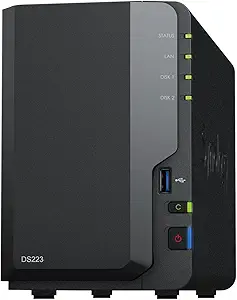 | Best for Centralized Data and Automated Backup | Model: DS223 | Type: 2-Bay NAS | Diskless: Yes | VIEW LATEST PRICE | See Our Full Breakdown |
| MINISFORUM N5 Pro 5-Bay Desktop AI NAS with AMD Ryzen AI 9 HX PRO 370 |  | Best for High-Performance AI and Customization | Processor: AMD Ryzen AI 9 HX PRO 370, 12-core/24-thread | Storage Capacity: Up to 188TB | Drive Bays: 5 SATA HDD, 3 NVMe M.2 | VIEW LATEST PRICE | See Our Full Breakdown |
| NAS for cybersecurity minded user | Warranty |
|---|---|
| Synology DS225+ Private Cloud | 3 Years |
| Synology DS425+ Private Cloud | 3 years |
| Synology DS1825+ Enterprise Vi | 3 years |
| Asustor Lockerstor 10 Gen3 AS6 | — |
| Synology 2-Bay DiskStation DS2 | 2 years |
| Synology 8-Bay DiskStation DS1 | — |
| Synology 4-Bay DiskStation DS9 | 3 years |
| Synology DS223 2-Bay Diskless | 2 years |
| MINISFORUM N5 Pro 5-Bay Deskto | — |
More Details on Our Top Picks
Synology DS225+ Private Cloud Media Server – 2-Bay Diskless NAS with Intel CPU
The Synology DS225+ stands out for combining reliable data protection with multimedia capabilities, making it ideal for users who prioritize privacy and security. Its support for automated backups, RAID redundancy, and surveillance with AI detection offers multi-layered defense, comparable to larger enterprise solutions but scaled for personal or small business use. While being diskless adds flexibility, it also means additional cost and setup time for drives, which might deter less experienced users. Compared to the DS223j, this model offers better performance and security features, but at a higher price and complexity. This NAS is well-suited for security-conscious individuals needing private cloud storage that can double as a surveillance hub.
Pros:- Supports 4K media streaming and personal cloud storage
- Automated backups with multi-layered data protection
- Supports surveillance with AI detection and alerts
- Reliable 3-year warranty
Cons:- Diskless, requiring separate purchase of drives
- Setup can be complex for users unfamiliar with advanced configurations
Best for: Cybersecurity-minded users seeking private, secure cloud storage with integrated surveillance features
Not ideal for: Beginners or users who want an all-in-one solution with pre-installed drives and simple setup
- Storage Bays:2-Bay
- CPU:Intel
- Transfer Speed:282 MB/s
- Surveillance Support:Up to 30 IP cameras
- Warranty:3 Years
Our verdict“This NAS makes the most sense for security-focused users who want a flexible, privacy-centric media and surveillance server.”
Synology DS425+ Private Cloud Media Server – 4-Bay Diskless NAS
The Synology DS425+ offers a balanced blend of high-speed data transfer and multi-user security features, making it a compelling choice for small teams or security-conscious organizations. Its 4-bay design and support for RAID, snapshots, and remote access provide robust data protection, surpassing the 2-bay DS223j by offering greater scalability for collaborative environments. However, as a diskless unit, it requires additional drives, and the setup might be daunting for beginners. Compared to enterprise-focused models like the DS1825+, the DS425+ offers less raw capacity but is more accessible for small business security needs. Its surveillance support further enhances its role as a secure, centralized storage solution.
Pros:- High-speed transfer suitable for media and file sharing
- Supports multiple users with concurrent access
- Advanced data protection with RAID, snapshots, and remote access
- Integrated surveillance capabilities
Cons:- Requires additional disks to operate
- Setup complexity may challenge beginners
Best for: Small teams or small business owners needing secure, multi-user storage with surveillance options
Not ideal for: Home users seeking simple, plug-and-play solutions without complex setup or multi-user management
- Number of Bays:4
- Type:Diskless NAS
- Data Transfer Speed:278 MB/s
- Supports IP Cameras:Yes, up to 30
- Warranty:3 years
Our verdict“Ideal for collaborative teams that need secure, scalable storage with surveillance and remote access features.”
Synology DS1825+ Enterprise Video Production & Storage – 8-Bay Diskless NAS, 360TB Capacity, 25GbE Speed
The Synology DS1825+ targets demanding media environments, supporting over 50 concurrent users editing 4K/8K videos and expandable to 360TB, making it suitable for professional media production and enterprise security. Its 25GbE networking and extensive storage capacity provide both speed and scale that surpass smaller models like the DS425+. However, its complexity and high cost restrict it to large organizations or advanced users comfortable with technical setups. Compared with the Asustor Lockerstor 10, the DS1825+ offers less raw power but is more tailored to media workflows that require high security. Its modular design and networking flexibility make it a solid choice for enterprise data management with a focus on security.
Pros:- Supports high concurrency for editing large media files
- Expandable up to 360TB for long-term storage growth
- Flexible high-speed networking with 25GbE
- Robust security and data protection features
Cons:- Premium price and complexity for setup
- No included drives, additional purchase needed
Best for: Large media production teams or enterprise users needing scalable, high-speed, secure storage
Not ideal for: Small businesses or hobbyists with limited budgets or simpler storage needs
- Storage Capacity:up to 360TB
- Number of Bays:8
- Network Speed:25GbE
- Expansion Support:Yes
- Warranty:3 years
Our verdict“This NAS is best for media professionals and enterprises that demand high capacity, speed, and security in their storage infrastructure.”
Asustor Lockerstor 10 Gen3 AS6810T 10-Bay NAS, AMD Ryzen V3C14 Quad-Core, 16GB ECC DDR5 RAM, Dual 10GbE + Dual 5GbE, 4 M.2 NVMe Slots, USB4 40Gbps, Diskless
The Asustor Lockerstor 10 Gen3 excels in enterprise environments requiring virtualization, AI, and heavy data processing, thanks to its powerful AMD Ryzen V3C14 processor and extensive networking options. Its dual 10GbE ports provide high throughput, suitable for large-scale data transfers, while the 4 M.2 NVMe slots allow for caching to boost performance further. Compared with the Synology DS1825+, this NAS offers more raw power and expandability for demanding workloads, though it also involves a steeper learning curve and higher investment. It’s ideal for organizations needing a flexible, high-performance platform that combines security, virtualization, and AI capabilities, but not suited for casual or small-scale use.
Pros:- High-speed dual 10GbE and 5GbE networking
- Supports multiple NVMe SSDs for caching
- Expandable memory and extensive storage capacity
- Optimized for virtualization and AI workloads
Cons:- Requires additional drives for storage
- Premium price and setup complexity
Best for: Enterprises or advanced users needing virtualization, AI, and large-scale secure storage
Not ideal for: Home or small business users without technical expertise or budget for high-end hardware
- Processor:AMD Ryzen V3C14 Quad-Core
- Memory:16GB ECC DDR5 (expandable to 64GB)
- Storage Bays:10
- Network Ports:Dual 10GbE + Dual 5GbE
- USB:USB4 40Gbps
Our verdict“This NAS is tailored for enterprise users who need a flexible, high-performance platform for virtualization, AI, and large-scale data management security.”
Synology 2-Bay DiskStation DS223j (Diskless)
The Synology DS223j provides a straightforward, secure private cloud experience with essential backup and remote access features. Its 2-bay design makes it suitable for small-scale, personal security needs, offering reliable hardware and ongoing software updates. Compared with larger models like the DS425+, it sacrifices capacity and advanced surveillance capabilities, but remains accessible for users new to NAS security setups. Its limited bays mean less expansion potential, and setup may be challenging for complete beginners. However, it delivers dependable privacy-focused storage for those prioritizing data security over scale.
Pros:- Secure private cloud access
- Automated backups for multiple devices
- Supports remote IP camera monitoring
- Reliable hardware with ongoing updates
Cons:- Requires additional disks to function properly
- Limited to 2 bays, less scalable
Best for: Individual users or small households seeking secure, easy-to-manage private cloud storage
Not ideal for: Users needing large capacity or advanced surveillance and multi-user features
- Number of Bays:2
- Diskless:Yes
- Warranty:2 years
Our verdict“This NAS is perfect for security-minded individuals wanting reliable, private cloud storage without complex enterprise features.”
Synology 8-Bay DiskStation DS1823xs+ (Diskless)
The Synology DS1823xs+ stands out for its ability to scale up to 18 drives with expansion units, making it ideal for organizations with growing storage needs. Compared with the Synology DS1825+, it offers more flexible expansion options and high availability clustering, which enhances uptime and data protection. However, it requires additional hardware investments and doesn’t come with pre-installed drives, adding to initial costs. This model is better suited for medium to large businesses that demand robust, scalable storage with high redundancy, rather than smaller setups that don’t need extensive expansion. Its support for hot-swappable drives and online volume expansion simplifies maintenance, but its complexity and cost may be overkill for smaller or less technical users.Pros:- Supports up to 18 drives with expansion units for future growth
- Hot-swappable drives simplify maintenance
- High availability clustering maximizes uptime
Cons:- Requires additional expansion units for full capacity, increasing complexity and cost
- No pre-installed drives, adding to initial setup expense
Best for: Large businesses or data centers needing scalable, high-availability storage infrastructure.
Not ideal for: Small offices or home users who prioritize simplicity and lower upfront costs.
- Drive Bays:8
- Expansion Support:Up to 18 drives with two DX517 units
- Type:Diskless NAS
- Features:Hot-swappable drives, online volume expansion, high availability clustering
Our verdict“This NAS is perfect for enterprise users requiring scalable, highly available storage with extensive customization options.”
Synology 4-Bay DiskStation DS925+ (Diskless)
The Synology DS925+ is tailored for users who need rapid data throughput combined with versatile functionality, supporting up to 522/565 MB/s transfer speeds thanks to dual 2.5GbE ports. This is a notable upgrade over smaller NAS like the Synology DS223, with more network bandwidth and advanced features such as virtualization and surveillance management. Its diskless design means it’s ready for high-performance drives, but the setup can be complex for beginners and its higher cost might deter casual users. Compared to the DS1823xs+, it offers less in scalability but excels in speed and network redundancy, making it ideal for demanding workflows that prioritize quick data access. Its main tradeoff is the need for additional drives and a more technical setup process.Pros:- Supports high-speed data transfers up to 565 MB/s
- Dual 2.5GbE ports for redundancy and faster networking
- Versatile features including virtualization and surveillance solutions
Cons:- Diskless, requiring separate drives for operation
- May be complex for beginners to configure
Best for: Tech-savvy professionals or small businesses requiring fast data transfer and multi-purpose capability.
Not ideal for: Users new to NAS or those seeking a simple, plug-and-play solution without added complexity.
- Drive Bays:4
- Network Ports:2 x 2.5GbE
- Throughput:522/565 MB/s
- Warranty:3 years
Our verdict“This NAS makes the most sense for experienced users needing speed and multi-functionality over raw scalability.”
Synology DS223 2-Bay Diskless NAS Home & Office Backup Hub
The Synology DS223 offers an accessible solution for home and small office environments, centralizing data and automating backups across multiple devices. Unlike the larger, more complex NAS like the DS925+, it emphasizes simplicity and affordability, though it demands separate disks to operate. Its surveillance feature transforms it into a basic security hub, which can be appealing for small setups but falls short for larger security needs. Compared to the enterprise-focused DS1823xs+, it lacks scalability and high availability, making it suitable for users prioritizing straightforward backup and file sharing with minimal technical overhead. The main tradeoff is that its limited capacity and features are less suitable for demanding cybersecurity applications.Pros:- Centralizes data from multiple devices for easy access
- Supports automated backups and version control
- Transforms IP cameras into surveillance with remote alerts
Cons:- Requires separate disks to operate
- Limited capacity and features for complex security needs
Best for: Home users or small offices seeking easy data centralization and automated backups.
Not ideal for: Businesses with advanced security and scalability needs or those managing large, sensitive data sets.
- Model:DS223
- Type:2-Bay NAS
- Diskless:Yes
- Warranty:2 years
Our verdict“This NAS is best for users wanting a simple, reliable backup and file-sharing solution at home or small office.”
MINISFORUM N5 Pro 5-Bay Desktop AI NAS with AMD Ryzen AI 9 HX PRO 370
The MINISFORUM N5 Pro exemplifies a different approach, combining enterprise-level hardware with AI acceleration, extensive storage, and high-speed connectivity. Its AMD Ryzen AI 9 HX PRO processor supports demanding AI workloads, making it a compelling choice for cybersecurity-minded users needing advanced data analysis and protection features. Compared with the Synology DS1823xs+, it offers more raw power and customization options, though its setup is more complex and lacks hot-swappable support for the OCuLink port. Its modular design allows for significant upgrades, but this added complexity might be daunting for less technical users who prefer out-of-the-box solutions. It’s ideal for organizations that want a hybrid NAS/server with AI-driven security features and high scalability, but not for those seeking a straightforward, low-maintenance device.Pros:- Powerful AMD Ryzen AI 9 processor supports AI workloads
- Supports up to 188TB storage and multiple high-speed network ports
- Modular motherboard and expandable ECC DDR5 memory for future upgrades
Cons:- Complex setup requiring technical knowledge
- System disk reduces available M.2 slots and lacks hot-swapping support
Best for: Organizations requiring AI-enhanced security, extensive customization, and high-performance data handling.
Not ideal for: Small teams or users without technical expertise seeking simple, plug-and-play NAS devices.
- Processor:AMD Ryzen AI 9 HX PRO 370, 12-core/24-thread
- Storage Capacity:Up to 188TB
- Drive Bays:5 SATA HDD, 3 NVMe M.2
- Network Ports:1x 10GbE, 1x 5GbE
- Memory:Expandable up to 96GB DDR5 ECC
- Video Output:1x HDMI 8K@60Hz
Our verdict“This NAS is suited for advanced users or enterprises looking for AI-accelerated security and extensive customizability, not casual or novice users.”
How We Picked
I evaluated these NAS devices based on their security features, hardware robustness, performance capabilities, and software management tools. Devices with enterprise-grade encryption, malware protection, and remote access controls ranked higher. Usability was also a key factor—models that balance security with straightforward setup and ongoing maintenance earned top spots. The ranking reflects a combination of security depth, hardware strength, and value for cybersecurity-minded users, ensuring each option suits different levels of expertise and budget constraints.Factors to Consider When Choosing Best NAS For Cybersecurity Minded Users
Choosing a NAS for cybersecurity involves more than just storage capacity. It’s essential to consider security protocols, hardware resilience, and system management. The right device should offer strong encryption, regular firmware updates, and flexible access controls. Additionally, scalability and network options play a role in future-proofing your setup. Be aware that cheaper models may cut corners on security features, so balancing cost with security needs is key. Prioritize devices that integrate seamlessly with your existing security infrastructure and support remote management and monitoring.Security Features and Protocols
Look for NAS devices with built-in encryption standards, such as AES-256, and support for VPNs or secure remote access. Features like malware scanning, automatic updates, and two-factor authentication significantly enhance security. Avoid models that lack these protections, as they can become vulnerabilities in your network. Remember, a NAS with robust security features not only protects stored data but also prevents unauthorized access and potential breaches.
Hardware Resilience and Expandability
Devices equipped with ECC RAM, multiple network interfaces, and M.2 slots for cache or OS drives help sustain security and performance under load. Expandable storage options ensure you can adapt to growing data demands without compromising security. Insecure or poorly designed hardware can be more susceptible to physical tampering or hardware failure, so invest in models with solid build quality and future-proof features.
Performance and Network Connectivity
High data transfer speeds, like 10GbE, support real-time security monitoring and large data backups without bottlenecks. Fast processors and ample RAM enable encryption tasks and security scans to run smoothly. Choosing a device with flexible network options allows integration into diverse security environments and remote access setups, making your data safer and more accessible.
Ease of Use and Management
Security is only as effective as your ability to manage it. Look for user-friendly interfaces, detailed logging, and remote management capabilities. Devices that require complex configurations might expose gaps in security due to mismanagement. A balance of advanced controls with intuitive setup is ideal for both security experts and less technical users.
Cost and Long-term Value
While premium models offer advanced security, they come at higher costs. Cheaper options may lack critical protections or hardware resilience, leading to potential vulnerabilities. Evaluate the total cost of ownership, including firmware updates, support, and scalability, to ensure your investment remains secure and functional over the long term.
Frequently Asked Questions
What security protocols should I prioritize in a NAS?
Prioritize NAS devices that support AES-256 encryption, VPN compatibility, two-factor authentication, and regular firmware updates. These features help protect your data both at rest and during transmission. Additionally, look for malware scanning and automatic security patches to stay ahead of emerging threats. A device with these protocols offers a strong foundation for safeguarding sensitive information against cyber threats.
Is hardware RAID necessary for security?
Hardware RAID isn’t strictly necessary for security, but it significantly improves data redundancy and fault tolerance. This helps prevent data loss from disk failure, which is critical in security-focused environments. However, RAID alone doesn’t protect against cyberattacks or malware; combining it with encryption and access controls provides comprehensive security. For cybersecurity-minded users, a combination of hardware resilience and strong software protections is ideal.
How important is remote management for security?
Remote management capabilities are vital for maintaining security, especially for off-site or distributed teams. They allow for real-time monitoring, firmware updates, and access controls without physical presence, reducing vulnerability windows. However, remote access points can become targets if not properly secured, so ensure the NAS supports VPNs, IP filtering, and multi-factor authentication. When configured correctly, remote management enhances security while maintaining flexibility.
Can consumer-grade NAS devices provide sufficient security?
Generally, consumer-grade NAS devices lack the advanced security features found in enterprise or prosumer models. They may have basic encryption and user controls but often fall short on malware protection, hardware resilience, and remote security protocols. For users prioritizing cybersecurity, investing in higher-end units with dedicated security features is advisable. Otherwise, you risk exposing sensitive data to vulnerabilities and cyber threats.
What role do network interfaces play in security?
Multiple or high-speed network interfaces, like 10GbE, support secure, high-volume data transfers and reduce bottlenecks that can be exploited. They also facilitate network segmentation and dedicated management networks, which enhance security. Properly configured, these interfaces allow for better traffic control and monitoring, making it easier to detect suspicious activity and enforce security policies across your network.
Conclusion
For most cybersecurity-focused users, the Synology DS1825+ offers a compelling balance of security features, hardware resilience, and scalability, making it the best overall choice. Those needing a high-performance, enterprise-grade solution should consider the Asustor Lockerstor 10 Gen3 for its advanced hardware and network capabilities. Budget-conscious buyers aiming for solid security without enterprise costs might find the Synology DS223+ or DS223j suitable, provided they supplement security with best practices. Beginners and less technical users are better served by models with straightforward management, while organizations with complex security needs should prioritize devices with comprehensive enterprise features. Tailoring your choice to your specific security requirements and technical proficiency will ensure your NAS works effectively to protect your data.”
Halloween Picks

JOYIN 5-Foot Halloween Animatronic Drinking Skeleton

10 ft Halloween Inflatable Archway – Pumpkin, Skeleton & Candy Yard Décor

ELAMAS 11ft Animatronic Flying Witch Halloween Decoration
As an affiliate, we earn on qualifying purchases.