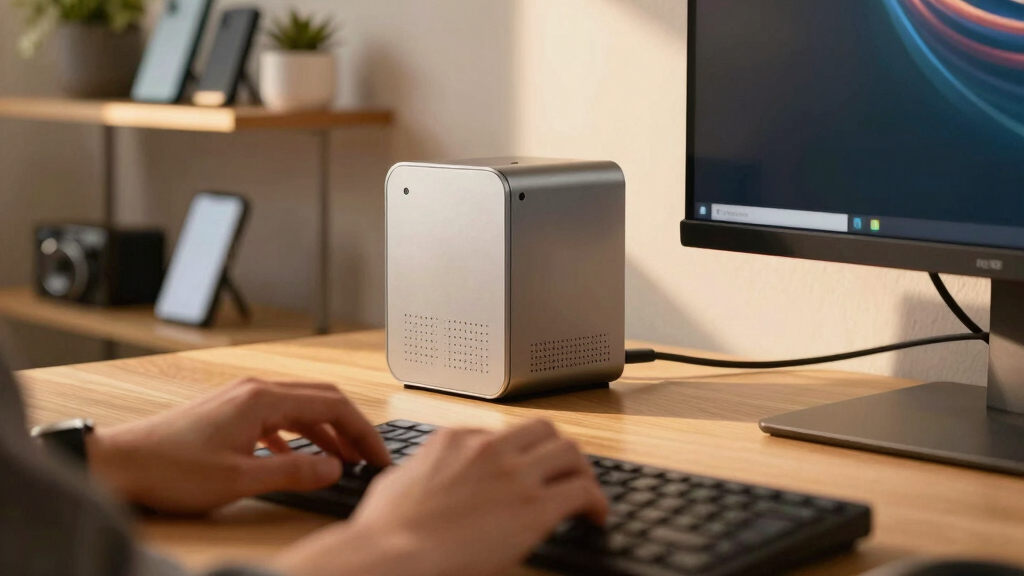
Choosing the right mini PC for automation workflows hinges on performance, expandability, and connectivity. For 2026, top contenders include the Bmax Mini PC B6 Turbo, which offers solid CPU power and great value; the GMKtec Mini PC Workstation, ideal for industrial automation with extensive I/O; and the Bmax B9 Power Mini PC, featuring a high-end i9 processor for demanding tasks. Each balances tradeoffs—whether in size, performance, or expandability—so understanding your workflow needs is key.
Listen free for 30 days with Audible
Thousands of audiobooks and originals — cancel anytime.
Start your free trialAs an affiliate, we earn on qualifying purchases.
Key Takeaways
- The Bmax Mini PC B6 Turbo excels in CPU performance and value, suitable for general automation tasks.
- The GMKtec Mini PC offers extensive ports, perfect for industrial automation and multi-device setups.
- The Bmax B9 Power features a high-end i9 processor, ideal for intensive automation workflows involving heavy data processing.
- Size and expandability vary: compact models like the B6 Turbo prioritize space-saving, while the B9 Power emphasizes raw power with dual M.2 slots.
- Connectivity options such as Wi-Fi 6, multiple USB ports, and HDMI/DisplayPort support are critical for automation environments.
| Bmax Mini PC B6 Turbo, Intel Core i5-8257U |  | Best Overall for Performance and Value | Processor: Intel Core i5-8257U | RAM: 16GB DDR4 | Storage: 512GB NVMe SSD | VIEW LATEST PRICE | See Our Full Breakdown |
| GMKtec Mini PC Workstation, Intel Core i9-13900HK |  | Best for Heavy-Duty Automation and Industrial Use | Processor: Intel Core i9-13900HK | RAM: 32GB DDR5 | Storage: 1TB NVMe SSD | VIEW LATEST PRICE | See Our Full Breakdown |
| Bmax B9 Power Mini PC, Intel Core i9-12900HK |  | Best for High-End Data Processing & Heavy Automation | Processor: Intel Core i9-12900HK | RAM: 24GB LPDDR5 | Storage: 1TB NVMe SSD + dual M.2 slots | VIEW LATEST PRICE | See Our Full Breakdown |
| Bmax Mini PC B6 Turbo, Intel Core i5-8257U |  | Best for Budget-Friendly Performance | Processor: Intel Core i5-8257U | RAM: 16GB DDR4 | Storage: 512GB NVMe SSD | VIEW LATEST PRICE | See Our Full Breakdown |
More Details on Our Top Picks
Bmax Mini PC B6 Turbo, Intel Core i5-8257U
The Bmax Mini PC B6 Turbo stands out for its powerful Intel Core i5-8257U processor, which outperforms many budget options like N100 or N97 chips, making it suitable for complex automation workflows. It offers 16GB RAM and a 512GB NVMe SSD, ensuring fast load times and multitasking. Compared to smaller or less capable alternatives, this model provides a balanced mix of performance and expandability, supporting dual 4K displays with HDMI and DisplayPort. Its size and cooling system make it ideal for minimalist desks or mobile setups. The main tradeoff is that it may be overkill for simple automation tasks, and its larger size could be a concern for very tight spaces.
Pros:- Strong CPU performance with Intel Core i5-8257U
- 16GB DDR4 RAM for demanding multitasking
- Dual 4K output via HDMI and DisplayPort
- Expandable with dual M.2 slots and DDR4 RAM slots
Cons:- Larger footprint than ultra-compact models
- Higher power consumption at 15W
- Overkill for very simple automation tasks
Best for: Power users needing high multitasking and graphics support in automation environments.
Not ideal for: Minimalist setups with strict space constraints or basic automation tasks.
- Processor:Intel Core i5-8257U
- RAM:16GB DDR4
- Storage:512GB NVMe SSD
- Graphics:Intel Iris Plus 655
- Display Outputs:Dual HDMI and DisplayPort
- Size:125x112x33mm
Bottom line: A versatile mini PC offering excellent performance and expandability for complex automation workflows.
GMKtec Mini PC Workstation, Intel Core i9-13900HK
The GMKtec Mini PC is designed for demanding automation tasks requiring maximum processing power. Its Intel Core i9-13900HK with 14 cores and 20 threads delivers exceptional multitasking and data crunching capabilities. Paired with 32GB DDR5 RAM and a 1TB NVMe SSD, it handles large datasets and high-performance applications with ease. Its extensive I/O includes multiple USB ports, HDMI, DisplayPort, and a serial COM port ideal for industrial automation. Its triple 4K support makes it perfect for multi-monitor setups. The main tradeoff is its larger size and higher power draw (45W), making it less suitable for space-constrained or low-power environments.
Pros:- High-end i9-13900HK processor with 14 cores
- 32GB DDR5 RAM for intensive multitasking
- Supports three 4K displays simultaneously
- Multiple USB, HDMI, DP, and serial ports for extensive connectivity
Cons:- Relatively large form factor
- Higher power consumption (45W)
- Premium price point
Best for: Industrial automation, heavy data processing, and multi-device control.
Not ideal for: Simple or space-limited environments where size and power efficiency are priorities.
- Processor:Intel Core i9-13900HK
- RAM:32GB DDR5
- Storage:1TB NVMe SSD
- Graphics:Intel Iris Xe
- Display Outputs:3x HDMI, 1x DisplayPort, USB-C
- Size:Compact but larger than ultra-compact models
Bottom line: The top choice for industrial automation and heavy multitasking workflows, with extensive I/O for device integration.
Bmax B9 Power Mini PC, Intel Core i9-12900HK
The Bmax B9 Power packs a punch with an Intel Core i9-12900HK processor, offering 14 cores and up to 5.0GHz for your most demanding automation workflows. It features 24GB LPDDR5 RAM, ensuring fast data handling and multitasking, plus a 1TB NVMe SSD with dual M.2 slots for future expansion up to 4TB. Its triple 4K display output and advanced cooling system make it suitable for high-resolution, multi-monitor setups. The extensive connectivity includes Wi-Fi 6, Bluetooth 5.2, and multiple USB ports. The tradeoff is its slightly higher power draw and size, which might be less ideal for very tight or low-power environments.
Pros:- Elite i9-12900HK processor with 14 cores/20 threads
- 24GB LPDDR5 RAM for speed and multitasking
- Supports three 4K displays with HDMI, DP, and USB-C
- Upgradeable dual M.2 slots for storage expansion
Cons:- Higher power consumption (~45W)
- Slightly larger size
- Premium price
Best for: High-performance automation, data-intensive workflows, and multi-monitor setups.
Not ideal for: Minimalist or low-power setups where size and energy efficiency matter most.
- Processor:Intel Core i9-12900HK
- RAM:24GB LPDDR5
- Storage:1TB NVMe SSD + dual M.2 slots
- Graphics:Intel Iris Xe
- Display Outputs:3x 4K HDMI, DisplayPort, USB-C
- Size:Compact but larger than ultra-compact
Bottom line: Ideal for users needing top-tier processing power and extensive display options for complex automation workflows.
Bmax Mini PC B6 Turbo, Intel Core i5-8257U
The Bmax Mini PC B6 Turbo is a solid choice for automation workflows that require dependable CPU performance without high power consumption. Its Intel Core i5-8257U, with up to 3.9GHz, handles multitasking and routine automation tasks efficiently. It includes 16GB DDR4 RAM and a 512GB NVMe SSD, supporting dual 4K displays via HDMI and DisplayPort. Its small size and quiet cooling make it ideal for space-constrained environments. However, it may lack the raw power needed for intensive data processing or industrial automation tasks that demand more CPU cores or expandability.
Pros:- Decent CPU with i5-8257U up to 3.9GHz
- 16GB DDR4 RAM for multitasking
- Dual 4K display support
- Compact size and quiet cooling
Cons:- Limited to 16GB RAM
- No dedicated graphics card, relying on integrated graphics
- Less suitable for heavy-duty industrial automation
Best for: Small-scale automation, general office automation, and budget-conscious setups.
Not ideal for: Heavy industrial automation or high-end data processing workflows.
- Processor:Intel Core i5-8257U
- RAM:16GB DDR4
- Storage:512GB NVMe SSD
- Graphics:Intel Iris Plus 655
- Display Outputs:HDMI and DisplayPort
- Size:125x112x33mm
Bottom line: Excellent value for small to medium automation setups with moderate processing needs.
How We Picked
Our selection process focused on mini PCs that deliver reliable performance and flexibility for automation workflows in 2026. We prioritized models with recent processors, ample RAM and storage, and diverse connectivity options. Expandability and size were key considerations—smaller systems for space-constrained setups, high-powered units for data-heavy tasks. We excluded entry-level and overly specialized options, favoring versatile mini PCs that suit a range of automation scenarios.
Factors to Consider When Choosing Best Mini PCs For Automation Workflows
When selecting a mini PC for automation workflows, focus on processing power, expandability, and connectivity. High-core CPUs, ample RAM, and multiple ports enable seamless integration with automation systems, sensors, and displays. Size and cooling are also important—compact models save space, but may limit future upgrades. Consider your specific workflow requirements, such as industrial interfaces or high-resolution displays, to choose the best fit.
Processor Performance
For automation workflows, a multi-core CPU like the Intel i9-13900HK or i5-8257U can handle multitasking and complex data processing. High clock speeds boost performance in real-time control scenarios. Balance CPU power with power consumption and size constraints for your environment.
Memory and Storage
At least 16GB of RAM is recommended for multitasking, data logging, and running multiple automation tools simultaneously. NVMe SSDs provide fast data access and boot times, essential for responsive automation systems. Look for models with upgrade options if future needs grow.
Connectivity and Expandability
Multiple USB ports, HDMI or DisplayPort, and serial interfaces (COM ports) are critical for connecting sensors, industrial devices, and displays. Expandability options like additional M.2 slots support future storage upgrades. Wi-Fi 6 and Ethernet ensure reliable network connectivity.
Size and Cooling
Compact designs are ideal for space-limited setups, but verify cooling solutions to prevent overheating during intensive tasks. Some models feature quiet fans or passive cooling, which can be beneficial in noise-sensitive environments.
Frequently Asked Questions
What processor should I choose for automation workflows?
The processor depends on your workload complexity. For basic automation and multitasking, an Intel i5-8257U or similar quad-core CPU is sufficient. For demanding industrial automation or data processing, consider an i9-13900HK or equivalent with more cores and higher clock speeds.
How much RAM do I need for automation tasks?
A minimum of 16GB RAM is recommended to ensure smooth multitasking, logging, and running multiple automation software simultaneously. For complex or future-proof setups, 32GB or more may be beneficial, especially with high-resolution displays or large datasets.
Are mini PCs expandable for future upgrades?
Many mini PCs offer dual M.2 slots for storage expansion and RAM slots that support upgrades. Industrial models like the GMKtec provide serial ports and additional I/O for device integration. Check each model’s specifications to confirm expandability options relevant to your automation environment.
Which connectivity options are essential in automation mini PCs?
Multiple USB ports, HDMI or DisplayPort, and serial (COM) ports are vital for connecting sensors, controllers, and displays. Wi-Fi 6 and Gigabit Ethernet ensure stable network communication, crucial for remote management and data transfer.
Should I prioritize size or performance?
If space is limited, compact models like the Bmax B6 Turbo or B9 Power are preferable, but verify cooling solutions to maintain performance. For high-end automation requiring extensive processing and multiple displays, larger units with better cooling and expandability like the GMKtec or Bmax B9 Power are better suited.
Conclusion
For users focused on high performance and future expansion, the GMKtec Mini PC stands out. Those with space constraints or moderate needs will find the Bmax B6 Turbo or Bmax B6 Turbo excellent options. Industrial automation setups benefit from the GMKtec for its multiple ports and high-end CPU. Beginners or budget-conscious users should consider the smaller, less expensive models that still provide reliable performance for standard automation tasks. Match your choice to your specific workflow, space, and future growth plans for optimal results.
Flea & tick season Picks
flea and tick prevention
As an affiliate, we earn on qualifying purchases.