
Fast 3D printers can create eye-catching models in record time, but boosting speed often comes with trade-offs. You might notice reduced resolution, rougher surface finishes, or even inconsistent results due to wear and mechanical limitations. While pushing for faster prints may seem tempting, quality can suffer without careful adjustments. If you want to know how to keep your prints both quick and high-quality, keep exploring—there’s plenty more to learn.

Get hardware and tech essentials delivered free with Prime
- Fast, free delivery on millions of items
- Prime Video, Amazon Music and more included
- Member-only deals all year
Key Takeaways
- Increasing print speed can lead to reduced resolution and surface finish quality due to thicker layers and less precise extruder movements.
- Higher speeds often cause layer misalignments, surface roughness, and weaker layer adhesion, impacting print durability.
- Material compatibility issues and mechanical wear become more prominent at faster printing speeds, affecting overall quality.
- Achieving high-quality surfaces at high speeds typically requires slowing down or fine-tuning settings, reducing productivity gains.
- Technological innovations are emerging to balance speed and quality, but rapid printing still risks compromising detailed finish.
As an affiliate, we earn on qualifying purchases.
Why Do People Want Fast 3D Printers?
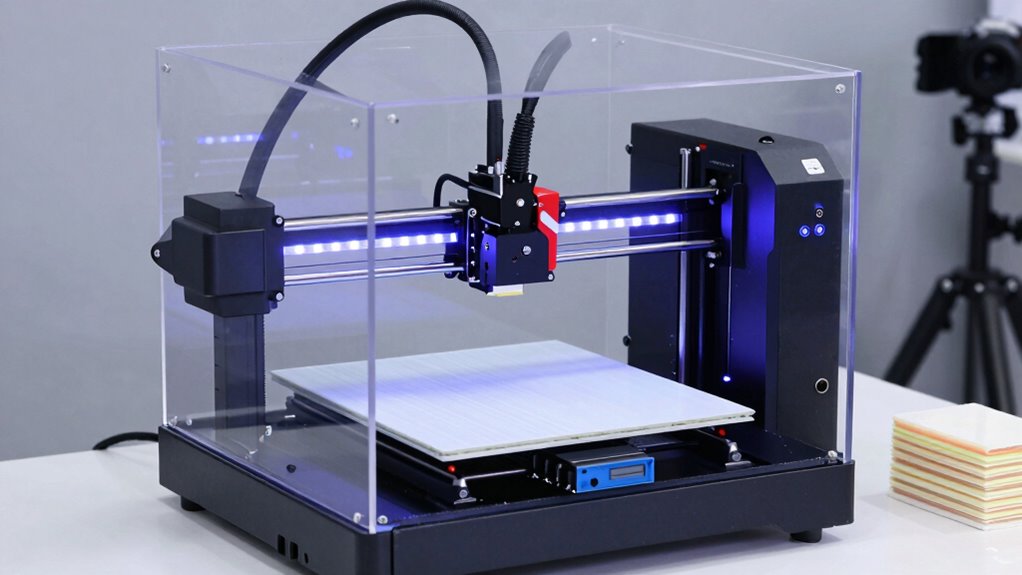
People want fast 3D printers because they can considerably reduce production times, allowing for quicker prototypes and faster project turnaround. This speed is especially valuable for creative applications, where rapid iteration fuels innovation and design experimentation. With faster printing, you can test ideas more frequently and refine your concepts without long delays. Additionally, quick production helps improve cost efficiency, as it minimizes material waste and reduces labor costs. When projects move swiftly, you can take on more clients or produce more prototypes within the same timeframe, boosting your overall productivity. For creators and engineers alike, the ability to print quickly means staying ahead of deadlines and pushing boundaries in design without sacrificing quality. Digital concepts are also evolving alongside printing technology, enabling more complex and innovative designs to be realized rapidly.
fast 3D printer with high quality
As an affiliate, we earn on qualifying purchases.
As an affiliate, we earn on qualifying purchases.
What Are the Main Trade-Offs of Printing Faster?
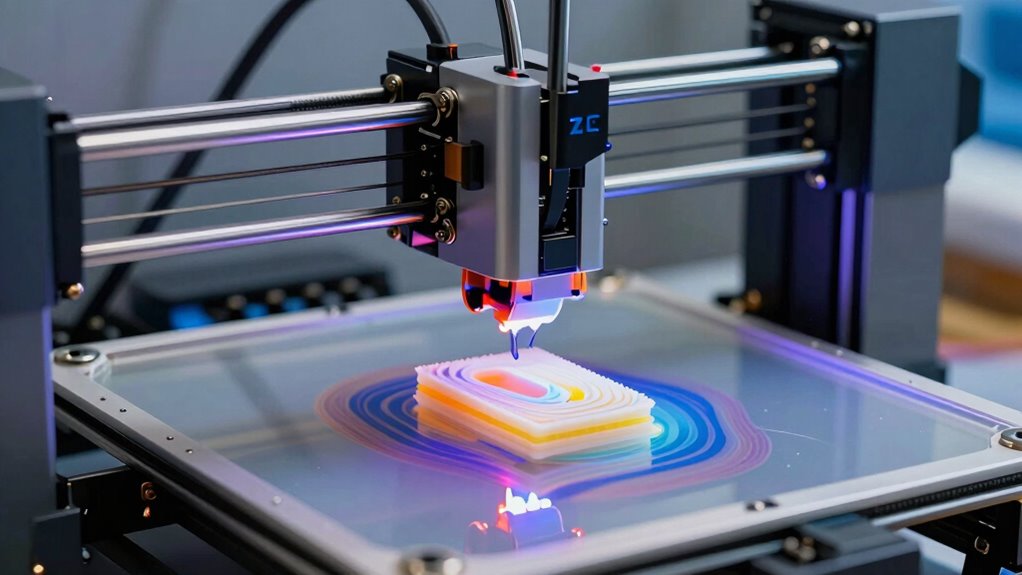
Have you ever wondered what you might sacrifice when choosing to print faster with a 3D printer? Speed often comes with trade-offs. First, material compatibility can become limited, as some filaments may not work well at higher speeds, risking poor adhesion or warping. Second, energy consumption tends to increase because faster printing requires more power to keep the extruder and motors running at higher rates. Third, print quality can suffer, with details becoming less precise and surface finishes rougher. Pushing for speed may save time but often costs you in the form of reduced detail, potential material issues, and higher energy bills. Additionally, print quality deterioration can occur as the rapid extrusion process may lead to less precise layer bonding. Balancing these trade-offs is key to finding the right speed for your projects.
3D printer filament for high detail
As an affiliate, we earn on qualifying purchases.
As an affiliate, we earn on qualifying purchases.
How Does Speed Affect Print Resolution and Detail?
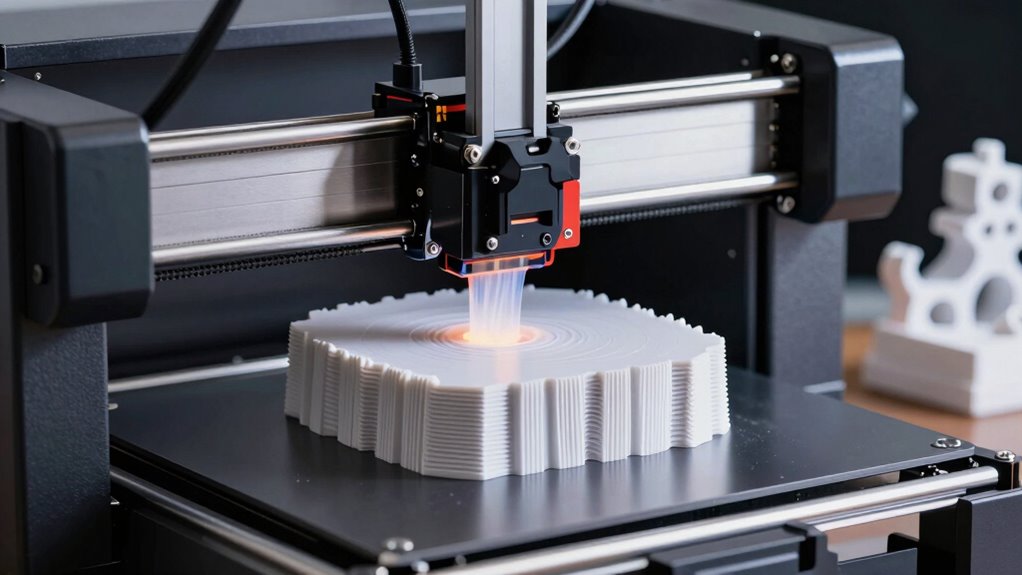
When you increase the printing speed, the ability to capture fine details and achieve high resolution diminishes. Faster prints often require thicker layers, which reduces layer resolution and makes it harder to preserve intricate details. As speed ramps up, the extruder moves quicker, giving less time for precise placement, leading to less smooth surface finishes. This reduction in detail preservation can be particularly noticeable in complex geometries or small features. To compensate, some printers lower layer height, but that also slows down the process. Ultimately, increased speed forces a trade-off: you get faster results, but at the expense of finer resolution and sharp detail. If your goal is high-quality, detailed prints, balancing speed with controlled layer resolution is essential. Understanding the trade-offs in 3D printing can help optimize your settings for the best results.
3D printer fine layer resolution
As an affiliate, we earn on qualifying purchases.
As an affiliate, we earn on qualifying purchases.
What Are the Surface Finish Challenges When Printing Quickly?
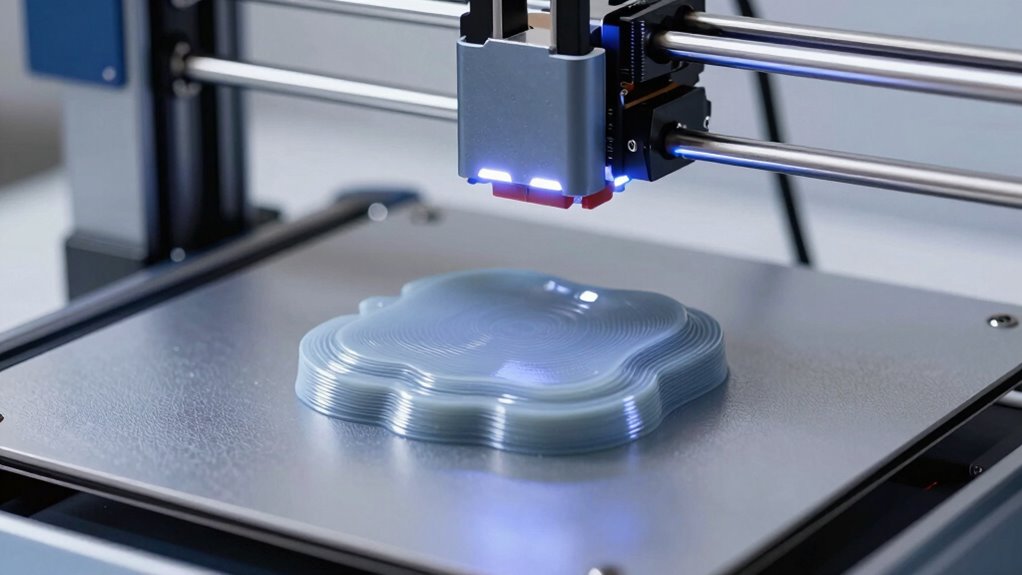
Printing quickly often results in surface finish issues because the extruder moves faster than ideal, leading to less precise material placement. This can cause increased surface roughness, making your prints look uneven and less polished. As speed increases, layer adhesion may weaken, creating gaps or weak spots that compromise strength. You might notice:
- Rough surfaces with visible ridges and inconsistent textures.
- Layer misalignments where layers don’t perfectly stack, producing a jagged appearance.
- Weak spots where insufficient bonding leads to fragile sections.
These issues make your finished piece less smooth and durable. To combat surface roughness and maintain proper layer adhesion at higher speeds, you’ll need to adjust print settings or accept a trade-off between speed and quality. Optimizing print parameters and choosing the right filament type can often help mitigate surface finish challenges, especially when printing at high speeds. Additionally, understanding how layer adhesion is affected by print speed can guide you to better settings that balance quality and efficiency.
Can Speed Compromise Reliability and Consistency?
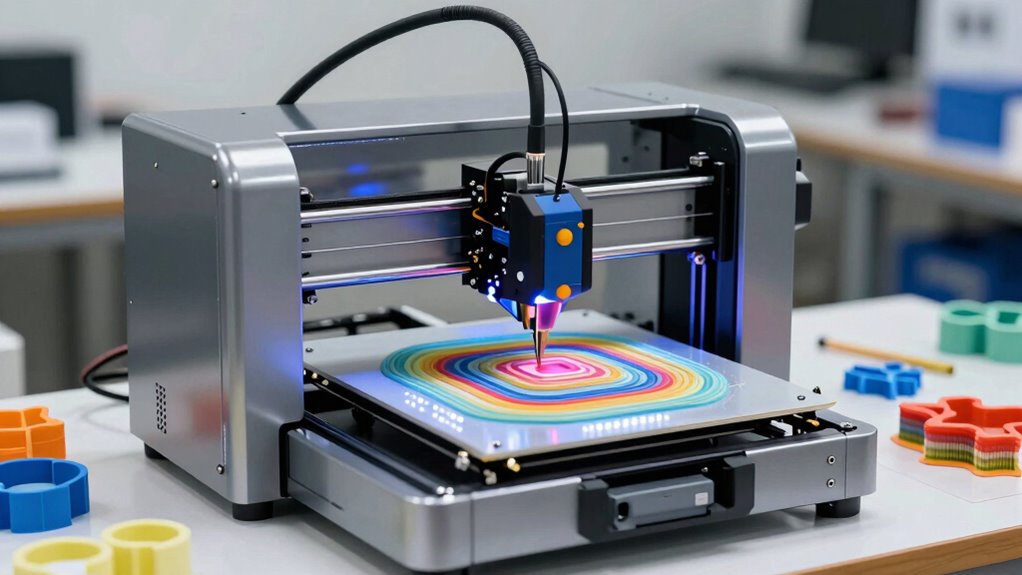
Does increasing print speed threaten the reliability and consistency of your 3D prints? Faster printing can lead to issues like material fatigue, where repeated stress weakens parts, and reduced print stability, causing layer misalignments. When you push speeds higher, your printer’s components endure more strain, risking mechanical wear and inconsistent extrusion. This can result in parts that are fragile or have uneven surfaces. To visualize, consider this table:
| Factor | Effect | Result |
|---|---|---|
| Material fatigue | Weakened filament over time | Reduced part durability |
| Print stability | Less controlled layer placement | Increased defects |
| Mechanical wear | Components degrade faster | Frequent maintenance needed |
| Extrusion consistency | Fluctuations in flow | Surface imperfections |
| Overall reliability | Decreased print success rate | Variability in quality |
Speed can compromise reliability without careful balancing. Additionally, monitoring filter sizing/flow and maintaining equipment can help mitigate some of these issues and improve overall print quality. Being aware of how print speed impacts each of these factors is crucial for optimal results. Regularly checking and adjusting your printer’s components, such as oil for airless sprayers, can also help maintain consistent performance.
How to Pick a Fast 3D Printer That Still Delivers Quality
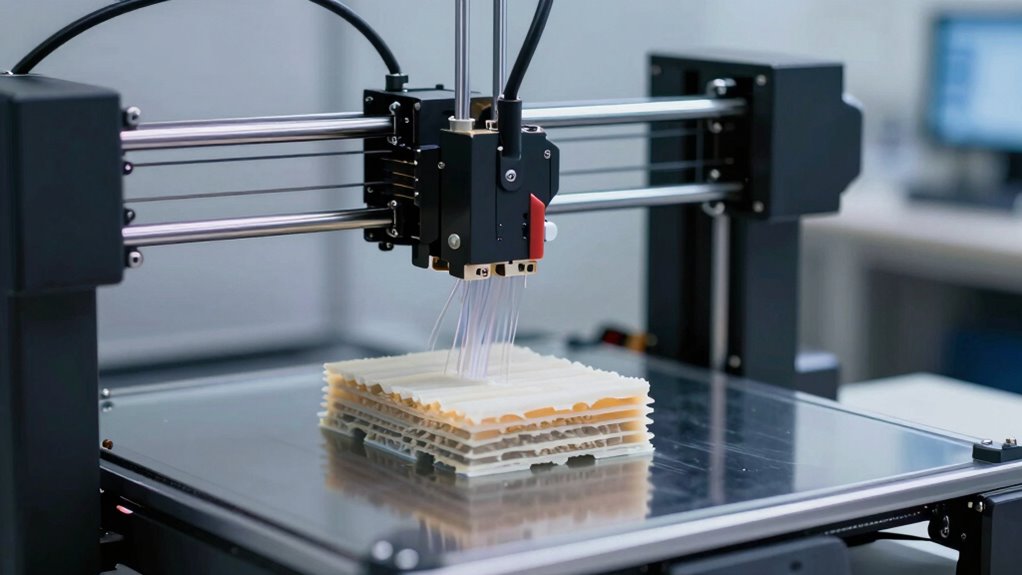
Choosing a fast 3D printer that maintains high-quality results requires balancing speed with precision. To do this, focus on three key factors. First, consider material selection—opt for high-quality filaments suited for fast printing, like advanced composites or specialty resins, to avoid compromises in detail. Second, examine printer ergonomics—look for models with stable frames, easy access to components, and intuitive controls, which help optimize print quality at high speeds. Third, evaluate the printer’s build volume and motion systems—robust axes and precise stepper motors guarantee consistent layer deposition. By prioritizing these aspects, you’ll find a machine that not only races through projects but also delivers the detailed, smooth results you need.
Tips to Improve Quality When Printing Fast
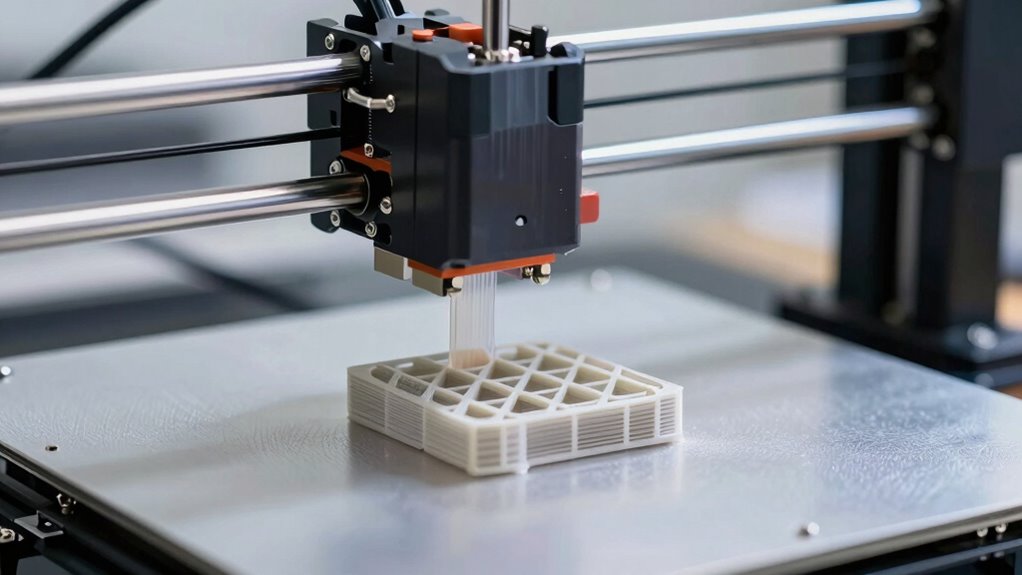
To improve print quality at higher speeds, start by optimizing your speed settings to find a balance between speed and precision. Use proper layer height to guarantee smoother surfaces and better detail, even when printing quickly. Keep your material flow consistent to prevent issues like under-extrusion or gaps that can compromise your final print. Additionally, utilizing tools that help detect and correct passive voice can make your instructions clearer and more direct. Incorporating print quality adjustments specific to your filament type can also enhance the final outcome, especially when printing at faster speeds. Monitoring your watt-hours and capacity can help ensure your printer remains powered reliably during high-speed operations. Paying attention to heat buffering techniques can also minimize issues like warping or stringing during rapid printing.
Optimize Print Speed Settings
When you increase your 3D printer’s speed, it’s essential to fine-tune the print settings to maintain quality. First, adjust your print speed to match your material’s compatibility; some filaments require slower speeds for better layer adhesion. Second, optimize printer ergonomics by ensuring stable mounting and proper bed leveling, which minimizes vibrations and misalignments at high speeds. Third, consider reducing acceleration and jerk settings to prevent sudden movements that can compromise print detail. These adjustments help balance speed and quality, preventing issues like stringing or poor surface finish. Remember, faster printing isn’t just about raw speed—it’s about aligning your settings to work harmoniously with your material and printer setup for consistent, high-quality results.
Use Proper Layer Height
Using the right layer height is key to maintaining quality when printing at higher speeds. A proper layer height guarantees layer consistency, which prevents defects like gaps or rough surfaces. Generally, smaller layer heights give finer detail but slow down prints; larger heights speed things up but can reduce quality. Be mindful of material compatibility—some materials require specific layer heights for ideal bonding and strength.
| Layer Height | Material Compatibility | Effect on Speed |
|---|---|---|
| 0.1 mm | Fine filaments, resin | Slower detail |
| 0.2 mm | Most plastics | Balanced speed and quality |
| 0.3 mm | Faster, less detailed | Highest speed |
Choosing the right layer height keeps your prints consistent and reliable, even when you push for speed.
Maintain Consistent Material Flow
Maintaining a consistent material flow is essential for achieving high-quality prints at faster speeds. Variations in material viscosity or nozzle design can cause uneven extrusion, leading to defects. To keep flow steady, focus on these key points:
- Guarantee your filament’s viscosity remains stable by storing it properly and avoiding moisture absorption.
- Regularly inspect and clean your nozzle to prevent clogs that disrupt flow.
- Optimize your nozzle design for smooth material passage, reducing pressure fluctuations during high-speed printing.
Future Trends: Balancing Speed and Quality in 3D Printing
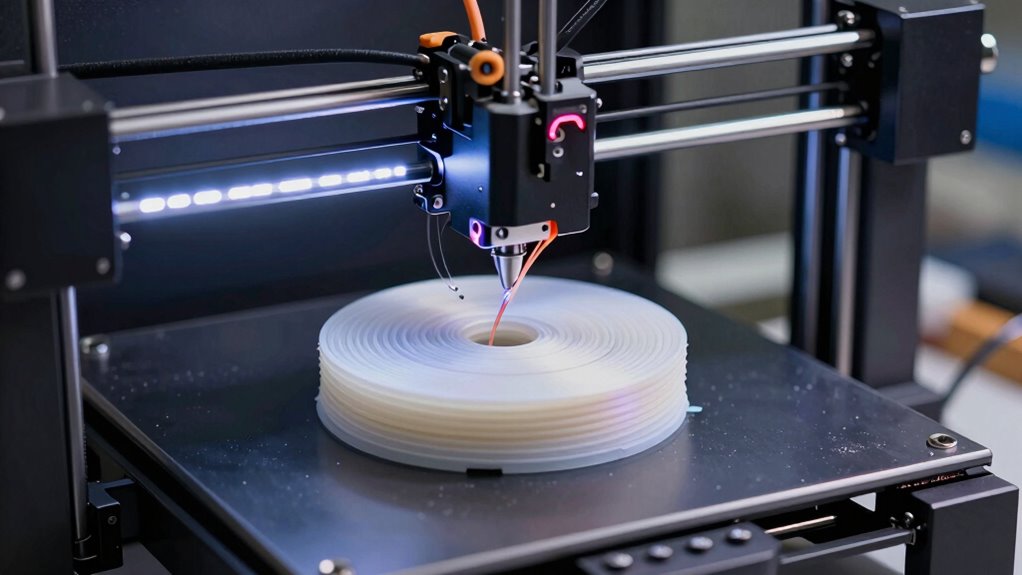
As 3D printing advances, you’ll need to find the right balance between speed and precision to meet your project needs. New technologies are emerging to help optimize this balance, making faster prints with better quality possible. Staying informed about these innovations will help you leverage them effectively for your applications.
Speed vs. Precision Balance
Balancing speed and precision in 3D printing remains one of the industry’s biggest challenges, especially as demand for rapid prototyping grows. When pushing for faster prints, you often face trade-offs that affect quality. For example, you might notice:
- Layer lines becoming more visible, degrading surface finish.
- Material compatibility issues, where certain materials struggle at high speeds.
- Increased energy consumption, raising operational costs and reducing efficiency.
To optimize both, you need to contemplate how faster speeds can compromise material choices and how energy use ramps up with rapid printing. Achieving a balance requires fine-tuning print settings to maintain detail without sacrificing too much speed, all while managing material and energy constraints effectively.
Technological Innovations Ahead
Emerging technological innovations promise to revolutionize the way you balance speed and quality in 3D printing. Advances in material compatibility enable printers to handle a wider range of materials without sacrificing speed or detail. Simultaneously, software optimization accelerates print processes while maintaining precision. These innovations help you produce high-quality prints faster, reducing trade-offs. Additionally, understanding the importance of color accuracy in related imaging technologies can inform better calibration and material choices for improved visual results.
| Innovation | Benefit | Impact |
|---|---|---|
| Material Compatibility | Diverse materials, reliable results | Enhanced versatility |
| Software Optimization | Faster slicing, real-time adjustments | Increased efficiency |
| Hybrid Technologies | Combining speed and detail | Better overall print quality |
Frequently Asked Questions
How Do Different 3D Printing Technologies Impact Speed and Quality?
Different 3D printing technologies influence speed and quality considerably. For example, FDM printers are cost-efficient and fast but may struggle with color consistency and detailed finishes. SLA and resin printers offer high resolution and better color accuracy, but they tend to be slower and more expensive. You should choose based on your priority—speed and cost efficiency or superior print quality with consistent colors.
What Materials Are Best Suited for High-Speed 3D Printing?
For high-speed 3D printing, you’ll want materials that offer good material compatibility and filament flexibility. PETG and ABS are excellent choices because they print quickly while maintaining strength and flexibility. TPU is ideal if you need flexibility, but it requires careful handling. These materials balance speed and quality, reducing the risk of print defects, and ensuring your projects come out precise even at higher printing speeds.
Can Post-Processing Improve Fast-Printed Parts’ Quality?
Yes, post-processing techniques can markedly improve fast-printed parts’ quality. You can use surface finishing methods like sanding, polishing, or chemical smoothing to remove layer lines and enhance the surface quality. These techniques help to refine the print’s appearance and durability, making the parts look more professional. By investing time in post-processing, you guarantee that your fast 3D prints meet your quality expectations and are ready for practical use.
How Does Print Orientation Affect Speed and Detail?
Print orientation is like choosing a dance move—you decide how smoothly it flows. You’ll see faster prints with orientations that minimize filament extrusion and improve print bed adhesion, but they might sacrifice detail. To get the best balance, orient parts to reduce overhangs and layer shifts, enhancing detail without losing speed. Adjusting orientation helps optimize both print quality and efficiency, so you get the best results from your fast 3D printer.
Are There Industry Standards for Balancing Speed and Quality?
You can find industry standards for balancing speed and quality by focusing on material durability and printer calibration. Manufacturers often recommend specific settings to optimize both, ensuring your prints are strong while saving time. Regular calibration helps maintain accuracy, preventing quality drops at higher speeds. While standards vary, following these guidelines helps you achieve the best compromise, giving you durable, precise prints without sacrificing too much speed.
Conclusion
If you’re chasing speed in 3D printing, remember: faster isn’t always better if quality suffers. Like a race car built for speed but lacking control, a quick printer may sacrifice detail or reliability. So, strike a balance—prioritize what truly matters. After all, in the pursuit of rapid results, don’t let your quest for speed turn your prints into fleeting shadows of perfection. Quality endures when you choose wisely and print thoughtfully.
Halloween Picks
halloween
As an affiliate, we earn on qualifying purchases.