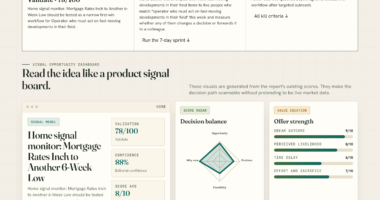

📊 Full opportunity report: Thrymvault: A System Around Your Content on ThorstenMeyerAI.com — validation score, market gap, and execution plan.

Get hardware and tech essentials delivered free with Prime
- Fast, free delivery on millions of items
- Prime Video, Amazon Music and more included
- Member-only deals all year
TL;DR
Thrymvault is launching a self-hosted content management system that combines documents, databases, AI prompts, and client portals. It aims to reduce scattered workflows and improve content collaboration for creators and agencies.
Thrymvault has unveiled a new self-hosted content management platform designed to unify the entire content creation and collaboration process. The system aims to address the common problem of scattered tools and workflows, offering a single workspace where ideas, drafts, assets, and client feedback are interconnected. This development matters because it could significantly streamline content production for creators, agencies, and teams seeking more efficient, organized workflows.
Thrymvault is a private, self-hosted platform that consolidates multiple aspects of content management into one environment. It integrates rich pages, flexible databases, public portals, threaded comments, a file library, and full-text search, all within a workspace that users run on their own servers. The core innovation is its ability to combine the flexibility of documents with the structure of databases, allowing each piece of content to carry its context, status, and next steps without duplication or disjointed tools.
According to the company, this approach turns a collection of notes, drafts, and assets into a “content operating system” where ideas move seamlessly through stages like backlog, research, draft, scheduled, published, and repurposed. The platform also features an AI layer built around saved prompts, enabling users to automate repetitive tasks such as summarizing research, generating titles, or transforming content for different channels. Unlike typical AI integrations that rely on chat boxes, Thrymvault’s prompts are stored and reused, promoting consistency and efficiency.
One of the key features highlighted is the portal system, which allows users to share polished, client-facing views via tokenized links with property-level access controls. This enables agencies and creators to give clients visibility into work-in-progress without exposing internal notes or messy drafts. Feedback remains attached to the relevant content, with threaded comments and role-based permissions ensuring organized collaboration. The platform’s design aims to reduce the friction of managing multiple tools and versions, saving time and reducing errors.
A System Around Your Content
One self-hosted workspace where ideas, drafts, assets, clients, feedback, and reusable AI prompts finally know about each other — instead of scattered across notes, sheets, folders, and chat threads.
Typed properties, relations, and saved views mean the same records become a writing queue, a kanban board, a calendar, or a searchable archive — and each record carries a rich-text body, so the plan and the draft live together.
+ token
+ passphrase
- This is the capability set. Drawn from Thrymvault’s own product documentation — what the workspace is for and how its pieces fit.
- Early-stage, in active build. Some surfaces are more settled than others; treat described capabilities as design, not a finished-product guarantee.
- No deploy-and-verify story yet. Unlike the shipped products in this series, there’s no public-launch writeup attached here — when there is, it gets the same treatment.
- The promise is “lose less.” Not “do more” — less time hunting, copying, asking, and rebuilding, because the pieces share one roof you own.
Independent commentary, produced with AI assistance under human editorial oversight. The views are the author’s own and may change. This is not business, financial, legal, or technical advice. Thrymvault is an early-stage, self-hosted product in active development; described capabilities reflect its design and may change. Product, model, and company names are trademarks of their respective owners; mention does not imply endorsement.
Why Thrymvault Could Reshape Content Workflows
This development is significant because it offers a unified environment that could replace multiple tools used in content creation, project management, and client collaboration. By integrating documents, structured databases, AI workflows, and secure portals, Thrymvault has the potential to streamline workflows, reduce the time spent hunting for assets or feedback, and improve overall productivity. For agencies and individual creators, this could mean faster turnaround times, clearer project tracking, and better client communication. Additionally, the self-hosted nature emphasizes control over data and customization, appealing to teams with strict privacy or security requirements.
However, the impact depends on how widely the platform is adopted and its ease of integration with existing systems. If successful, it could influence how content teams organize their work, shifting away from fragmented toolsets towards a more holistic, connected environment.
self-hosted content management system
As an affiliate, we earn on qualifying purchases.
As an affiliate, we earn on qualifying purchases.
Existing Challenges in Content Management and Workflow Fragmentation
Many content creators and agencies currently rely on a patchwork of tools—Google Docs, spreadsheets, project management apps, file storage services, and client portals—that often do not communicate seamlessly. This fragmentation leads to inefficiencies, version confusion, and difficulty tracking progress across different stages of content development. The problem is compounded by the need to duplicate information or manually sync updates between platforms, which consumes time and increases the risk of errors.
While some platforms have attempted to address these issues, most offer either a document-centric or a database-centric approach, rarely combining both effectively. AI integrations tend to be limited to chat interfaces, requiring re-entry of prompts and inconsistent outputs. Thrymvault’s approach to unify these elements into a single, self-hosted workspace aims to address these longstanding pain points, offering a comprehensive solution tailored for modern content workflows.
“Most tools force a choice: a documents app or a database app. Thrymvault refuses that choice, integrating both into a single environment where content can flow freely.”
— Thorsten Meyer, founder of Thrymvault
As an affiliate, we earn on qualifying purchases.
Unanswered Questions About Adoption and Integration
Details remain unclear about how widely Thrymvault will be adopted, especially among non-technical users or teams accustomed to existing tools. It is not yet confirmed how easy it will be to migrate current workflows into the platform or how it will integrate with other popular tools. Additionally, the platform’s performance, security features, and scalability are still to be demonstrated in real-world environments.
client collaboration portal software
As an affiliate, we earn on qualifying purchases.
As an affiliate, we earn on qualifying purchases.
Next Steps and Expected Developments for Thrymvault
Thrymvault plans to release a beta version later in 2024, inviting early users to test its features and provide feedback. The company aims to refine its AI workflows, portal capabilities, and overall user experience based on real-world use cases. Future updates may include integrations with existing tools, enhanced security features, and expanded collaboration options. Monitoring user adoption and feedback will be crucial to understanding its potential impact on content workflows.
As an affiliate, we earn on qualifying purchases.
Key Questions
What types of content can Thrymvault manage?
Thrymvault can handle a wide range of content including drafts, research, scripts, videos, newsletters, social media posts, and performance notes, all within a unified workspace.
Is Thrymvault a cloud-based platform?
No, Thrymvault is designed as a self-hosted system, allowing users to run it on their own servers for greater control and privacy.
How does the portal feature improve client collaboration?
Portals provide a read-only, branded view of selected content via secure links, enabling clients to see polished work without access to internal notes or drafts, simplifying feedback and review processes.
Will Thrymvault integrate with existing tools?
Details about future integrations are not yet confirmed, but the platform’s development roadmap suggests plans to enhance compatibility with popular tools and workflows.
What are the security features of Thrymvault?
As a self-hosted system, Thrymvault offers server-side authorization, role-based access, and property-level sharing controls, but specific security measures are still being finalized.
Source: ThorstenMeyerAI.com
Halloween Picks
halloween
As an affiliate, we earn on qualifying purchases.