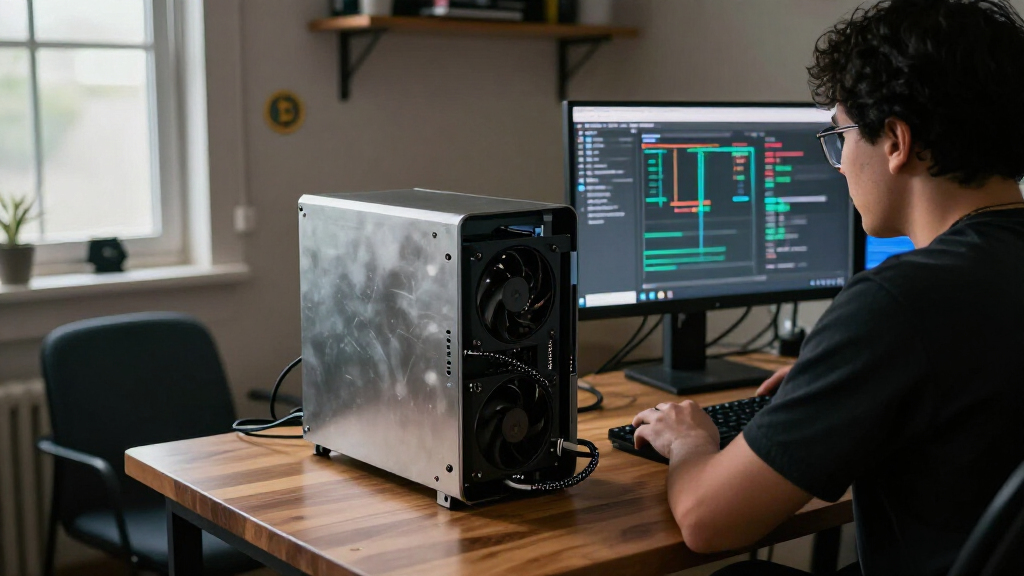

🔍 Read the full analysis: Choosing An External GPU For AI? See The 9 Best For 2027 on ThorstenMeyerAI.com

Get hardware and tech essentials delivered free with Prime
- Fast, free delivery on millions of items
- Prime Video, Amazon Music and more included
- Member-only deals all year
TL;DR
The source describes tradeoffs among Thunderbolt, USB4 V2 and OCuLink eGPU connections, plus the choice between upgradeable enclosures and integrated units. It names the Razer Core X V2, Plugable Thunderbolt 5 AI eGPU Enclosure, NIMO and BOSGAME, but does not provide nine identifiable picks or product-by-product specifications.
A 2027 external-GPU buyer’s guide from ThorstenMeyerAI.com recommends the Razer Core X V2 for broad compatibility and the Plugable Thunderbolt 5 AI eGPU Enclosure for higher connection throughput, but the supplied material does not identify all nine products promised by its title. The guide’s central advice is to weigh connection bandwidth, power needs and cooling against portability and upgradeability before choosing an eGPU for AI or other demanding workloads.
The guide frames the main choice as a tradeoff between Thunderbolt convenience and the potential performance of OCuLink or USB4 V2. It says Thunderbolt 3 and 4 provide 40Gbps, while Thunderbolt 5 and USB4 V2 can provide 80Gbps. Those figures describe interface bandwidth; they do not establish real-world AI performance, which also depends on the GPU, host computer, software and workload.
It distinguishes empty enclosures, which let buyers install a separately purchased graphics card, from integrated eGPU units. The former can permit later GPU upgrades but may need a separate, bulky power supply. Integrated options are presented as simpler and more compact, with the tradeoff that their graphics hardware cannot be replaced. The source cites NIMO and BOSGAME as examples and mentions an RX 7600M XT as an example of a fixed GPU configuration, without tying that specification to a named model.
The guide says it assessed bandwidth potential, compatibility and thermal efficiency, and warns that compact designs may face heat buildup during sustained use. It also advises checking laptop support, power delivery, drivers and setup requirements. These are the source’s selection criteria and general claims; it does not supply test results, prices, model numbers for every option or a complete nine-item comparison.
The 9 picks
- 1
 BOSGAME eGPU Graphic Card Dock Expansion Card with Radeon RX 7600M XT 8GB GDD…View on Amazon →
- 2
 NIMO External GPU Docking Station with AMD Radeon RX 7600M XT 8GB GDDR6View on Amazon →
- 3
 Plugable Thunderbolt 5 AI eGPU Enclosure & Dock: 80Gbps, TAA CompliantView on Amazon →
- 4
 Razer Core X V2 External Graphics Enclosure (eGPU)View on Amazon →
- 5
 MINISFORUM DEG2 USB4 V2 (TBT5 Compatible) & OCuLink eGPU Dock, 80Gbps Dual-Li…View on Amazon →
- 6
 MINISFORUM DEG1 eGPU Dock – External GPU Docking Station for RTX 4090 & AMD R…View on Amazon →
- 7
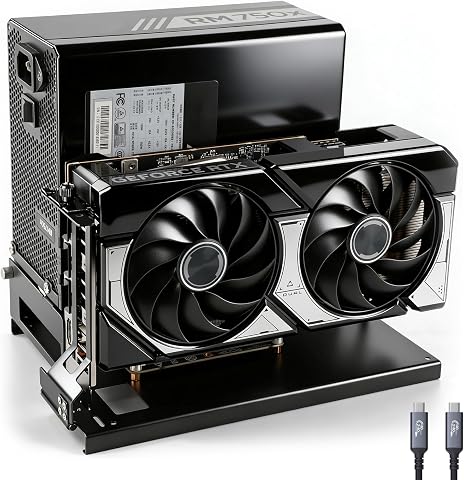 OwlTree Graphics Card eGPU Dock for Thunderbolt 3/4 USB 4, with 60cm CableView on Amazon →
- 8
 OCuLink eGPU Dock – PCIe 4.0 x4 (64 Gbps) ATX External GPU EnclosureView on Amazon →
- 9
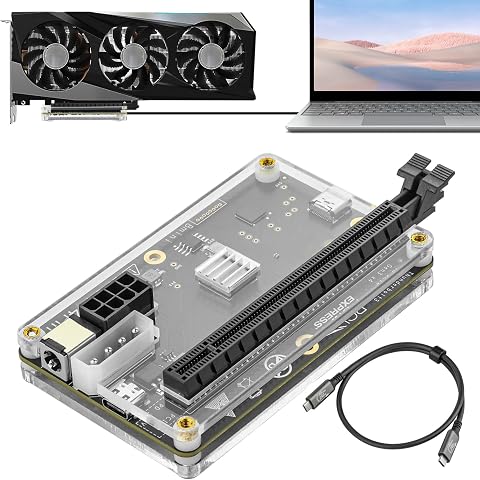 PCIe 3.0 x16 22Gbps eGPU Dock with Thunderbolt 4 Cable (compatible NVIDIA/AMD…View on Amazon →
Bandwidth, Heat and Upgrade Tradeoffs
External GPUs can add graphics processing capacity to compatible computers, including for AI work, without requiring a desktop tower. But the connection between host and GPU can constrain performance: a powerful card connected through a narrower interface may not perform as it would inside a desktop. The guide’s focus on bandwidth and compatibility is relevant to buyers considering a high-end GPU for demanding tasks.
The form factor also affects the practical cost. A separate GPU, enclosure and power supply may offer more choice but add expense, cables and bulk. An integrated unit may simplify setup while limiting future upgrades. For sustained rendering or other long-running workloads, cooling and noise can also shape usable performance. The source offers no benchmark data establishing which option performs best for a particular AI model or workload.
Products Worth Considering

Samsung Odyssey OLED G5 27-Inch QHD Gaming Monitor

Samsung Odyssey G9 QD-OLED 49 Dual QHD Curved Gaming Monitor

Samsung 32 Odyssey G5 (G51F) QHD 180Hz Gaming Monitor
As an affiliate, we earn on qualifying purchases.
How the Guide Frames EGPU Choices
The source describes Thunderbolt 3 and 4 as 40Gbps interfaces and Thunderbolt 5 and USB4 V2 as offering up to 80Gbps. It also characterizes OCuLink as a native PCIe 4.0 x4 connection with 64Gbps theoretical bandwidth and lower latency than Thunderbolt, while noting that compatible laptop ports are less widespread. These are theoretical interface figures, not direct measures of end-to-end application speed.
Its named recommendations are the Razer Core X V2 and Plugable Thunderbolt 5 AI eGPU Enclosure. It also refers to NIMO and BOSGAME integrated units. The supplied text does not establish exact specifications, availability, pricing or test methodology for those products, and ends before completing its discussion of driver compatibility. Readers should treat the ranking language as the publisher’s recommendation rather than an independently verified comparison.
“My top recommendation for most users is the Razer Core X V2 due to its proven reliability and broad compatibility.”
— ThorstenMeyerAI.com guide
Nine Picks Remain Unspecified
The supplied source does not list nine distinct product names, despite the title’s promise. It also lacks a full comparison table, model-specific specifications, prices, availability information and benchmark results. It is not clear which exact NIMO or BOSGAME products are being discussed, or whether all cited products are intended for AI workloads rather than general graphics use.
The material’s claims about reliability, compatibility, bandwidth and thermal behavior are not accompanied by cited test protocols or independent measurements. Compatibility can vary by laptop model, operating system, firmware, drivers and GPU. The source also does not establish that every Thunderbolt 5 or USB4 V2 setup will reach the stated theoretical bandwidth in practice.
Verify Models Before Buying
Before purchasing, readers should confirm the exact enclosure model, supported host ports, GPU dimensions, power supply requirements, laptop charging support and operating-system compatibility using manufacturer documentation. For AI use, they should also check the software’s GPU and memory requirements and seek workload-specific benchmarks rather than relying on interface bandwidth alone.
A complete version of the guide would need to name all nine products and provide comparable specifications, pricing and test conditions to support its ranking. Until that information is available in the supplied material, the two named enclosures and the general selection criteria are the only concrete recommendations readers can assess. External GPU performance and compatibility vary, and hardware purchases carry a risk of poor fit or limited gains.
Key Questions
Which external GPU does the guide recommend for most users?
The guide names the Razer Core X V2, citing reliability and broad compatibility. The supplied material does not include test results or define which computers are compatible.
Which option does it identify for higher bandwidth?
It highlights the Plugable Thunderbolt 5 AI eGPU Enclosure for users seeking throughput. No benchmark figures or full product specifications are provided in the source.
Does the source actually name all nine picks?
No. It names the Razer and Plugable enclosures and refers to NIMO and BOSGAME integrated units, but does not provide a complete list of nine distinct models.
What should buyers check before choosing an eGPU?
Check host-port compatibility, GPU and enclosure dimensions, power requirements, charging support, cooling and driver support. For AI workloads, confirm that the specific software supports the GPU and has enough graphics memory.
Source: ThorstenMeyerAI.com