
📊 Full opportunity report: Use An Empty Trust Tracker To Organize Asset Retitling on IdeaNavigator AI — validation score, market gap, and execution plan.

Get hardware and tech essentials delivered free with Prime
- Fast, free delivery on millions of items
- Prime Video, Amazon Music and more included
- Member-only deals all year
TL;DR
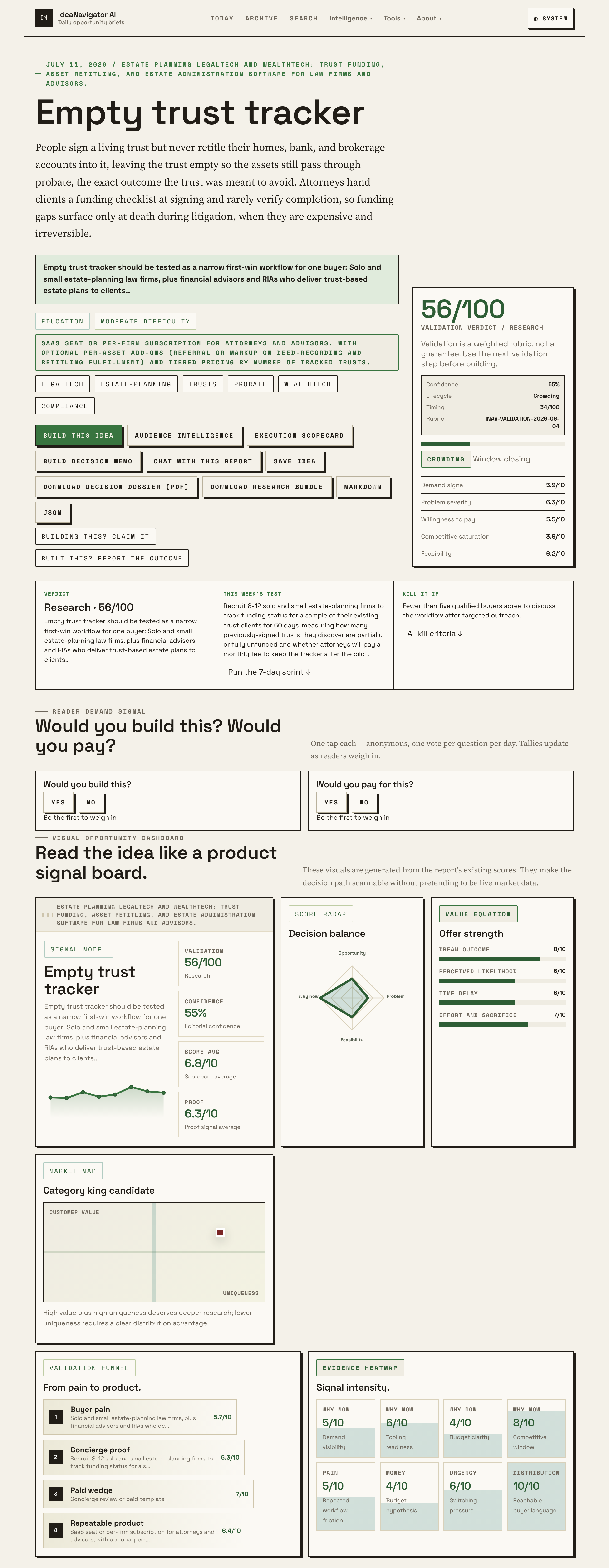
A product concept published by IdeaNavigator AI proposes a trust funding tracker for solo and small estate-planning law firms and advisors. The tool would assign per-asset funding statuses, attach proof such as recorded deeds, and flag trusts that remain unfunded. The idea targets a known gap: signed trusts that never receive retitled assets and therefore still pass through probate.
A new product proposal from IdeaNavigator AI outlines a software tool — an “empty trust tracker” — designed to solve a persistent failure point in estate planning: clients who sign a living trust but never retitle their assets into it. The proposal, aimed at solo and small estate-planning law firms plus financial advisors and RIAs, would give each trust a per-asset funding checklist with verifiable proof, so that dangerously unfunded trusts are flagged before a client dies rather than during litigation afterward.
The core problem the tracker addresses is well documented in estate-planning practice: a revocable living trust only avoids probate for assets that are legally titled in the trust’s name. According to the IdeaNavigator AI analysis, many clients sign the trust documents but leave their homes, bank accounts, and brokerage accounts in their individual names, leaving the trust “empty.” When the client dies, those assets still pass through probate — the exact outcome the trust was created to avoid.
The proposed workflow is straightforward. An attorney or advisor creates a funding checklist per trust covering real estate, bank accounts, brokerage accounts, retirement accounts, business interests, and beneficiary designations. Each asset receives a status — pending, in-progress, or confirmed funded — and the system accepts attached proof, such as a recorded deed or a retitled account statement. Automated reminders go to clients who have not completed their part, and a firm-level dashboard shows the entire book of trusts ranked by percent funded, letting partners spot empty trusts early.
The analysis notes that the current practice in many firms is to hand clients a funding checklist at signing and rarely verify completion. As a result, funding gaps typically surface only at death, during litigation, when they are, in the proposal’s words, “expensive and irreversible.” The revenue model proposed is a per-seat or per-firm SaaS subscription, with optional per-asset add-ons such as referral fees or markups on deed-recording and retitling fulfillment services, and tiered pricing by the number of trusts tracked.
Why Unfunded Trusts Burn Clients and Firms
The stakes are concrete. An unfunded trust provides none of the probate-avoidance benefits the client paid for, and the failure is usually discovered by heirs at the worst possible moment — after the client’s death, when retitling is no longer possible without court involvement. That converts a planning document into a source of malpractice exposure for attorneys and broken promises for advisors who marketed trust-based plans.
The proposal also points to a market shift making this timing relevant. According to the IdeaNavigator AI analysis, estate planning adoption and digital tooling are growing in 2026, yet only about 11% of Americans hold a trust, and trust funding remains a manual, fragmented step that existing document-drafting software does not address. Meanwhile, per-deed funding services priced from $250 have already created a paid fulfillment market — meaning a tracking and verification layer could sit on top of services clients are already paying for. For RIAs racing to bundle fully funded estate plans into client offerings, verification becomes a differentiator rather than administrative overhead.
Products Worth Considering

Logitech MX Mechanical Wireless Illuminated Keyboard, Tactile Quiet, Graphite

Amazon Kindle Scribe Colorsoft 64GB (1st Generation)

Bose SoundLink Flex Bluetooth Speaker (2nd Gen), Portable Waterproof Speaker, Black
As an affiliate, we earn on qualifying purchases.
Estate-Planning Software’s Funding Blind Spot
Estate-planning legaltech has historically concentrated on document generation — drafting trusts, wills, powers of attorney, and healthcare directives. The funding step, in which each asset must be individually retitled or beneficiary-designated into the trust, has stayed largely manual: clients contact banks, record deeds with county offices, and update account registrations themselves. The IdeaNavigator AI analysis states that this gap is not closed by existing drafting software, which typically ends its lifecycle at document execution.
The proposal positions the tracker as a “narrow first-win workflow” — deliberately small in scope rather than a full practice-management platform. It targets firms small enough to lack custom processes but large enough to carry dozens or hundreds of signed trusts whose funding status is unknown. The proposed validation step reflects that narrowness: recruit 8–12 solo and small estate-planning firms to track funding status for a sample of existing trust clients over 60 days, measuring how many previously signed trusts turn out to be partially or fully unfunded, and whether attorneys will pay a monthly fee to keep the tracker after the pilot.
What the Proposal Has Not Yet Proven
It is important to be clear about status: this is a product concept, not a shipped product. No pilot has been run, no firms are confirmed as participants, and no pricing has been finalized. Whether attorneys will actually pay a recurring subscription for verification — rather than treating it as overhead — is untested.
Several practical questions also remain open. It is unclear how the tracker would verify funding claims beyond user-uploaded documents, whether it will integrate with county recorder systems or custodian platforms for automated confirmation, and how it handles assets such as retirement accounts where retitling is generally not appropriate and only beneficiary designations apply. The 11% trust-adoption figure and the $250 per-deed pricing cited in the analysis are presented as market context; the analysis does not name the underlying data sources. The proposed 60-day pilot with 8–12 firms is a plan, not a result.
The 60-Day Pilot Decision Point
The immediate next step, according to the proposal, is recruiting 8–12 solo and small estate-planning firms to run a 60-day tracking pilot on a sample of their existing trust clients. Two metrics will decide whether the idea advances: the share of already-signed trusts discovered to be partially or fully unfunded, and the share of attorneys willing to pay a monthly fee to keep the tracker after the pilot ends.
If validation succeeds, the build path is a minimal product with checklists, statuses, document attachments, automated client reminders, and the firm-wide funding dashboard. Optional revenue extensions — referral arrangements with deed-recording and retitling services — would follow only if the core subscription proves durable. If firms discover few unfunded trusts or decline to pay, the proposal itself suggests the concept should be treated as a failed narrow experiment rather than scaled. Readers who hold a trust should note that this article describes a software proposal, not legal or financial advice; trust funding decisions are specific to each asset and should be reviewed with a qualified professional.
Source: IdeaNavigator AI
Key Questions
What is an ’empty trust’?
A living trust that has been legally signed but whose owner never retitled assets — such as a home, bank accounts, or brokerage accounts — into the trust’s name. Because probate avoidance only applies to assets titled in the trust, an empty trust generally does not keep those assets out of probate.
Is the empty trust tracker an existing product I can buy?
No. It is a product concept published by IdeaNavigator AI. A validation pilot with 8–12 law firms has been proposed but, according to the analysis, has not yet been run, and no pricing or launch date has been confirmed.
Who would use such a tracker?
The proposal targets solo and small estate-planning law firms, plus financial advisors and registered investment advisors (RIAs) who deliver trust-based estate plans and need to verify that clients actually completed asset retitling.
How would the tracker verify that an asset was actually retitled?
According to the proposal, verification relies on attached proof — for example a recorded deed or a retitled account statement — with each asset marked pending, in-progress, or confirmed funded. Automated verification against county or custodian records is not part of the initial concept and remains an open question.
How many Americans currently hold a trust?
The IdeaNavigator AI analysis cites a figure of about 11% of Americans holding a trust as part of its market context. The analysis does not name the underlying data source for that figure.
Source: IdeaNavigator AI