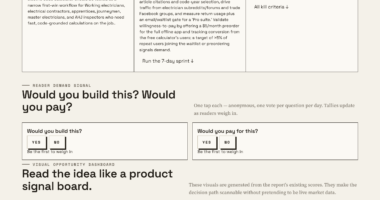

📊 Full opportunity report: Effortless Chrome Extension Creation For Non-Programmers on IdeaNavigator AI — validation score, market gap, and execution plan.

Get hardware and tech essentials delivered free with Prime
- Fast, free delivery on millions of items
- Prime Video, Amazon Music and more included
- Member-only deals all year
TL;DR
A new AI-powered web app allows non-programmers to generate Chrome extensions using simple text descriptions. This development aims to democratize browser automation creation, reducing reliance on coding skills.
A new web app has been launched that enables non-programmers to create Chrome extensions by simply describing desired browser behaviors in natural language. This development aims to lower the technical barrier for building custom browser automations, potentially expanding the creator base and increasing innovation in browser tooling.
The tool is designed for prosumers, indie hackers, marketers, and internal teams who want custom browser automations without writing Manifest V3 code. It generates a complete extension package, including manifest files, content scripts, and UI, based on user prompts. The system offers a one-click local install and a guided process for submitting extensions to the Chrome Web Store.
Built with AI assistance, the platform supports a limited but vetted set of capabilities—such as DOM manipulation, page scraping, and API calls—to ensure safety and reviewability. The service operates on a freemium model, with free tiers for basic use and paid plans ($12-49/month) for advanced features and private distribution. The launch responds to growing demand for no-code/low-code app builders, especially in the browser productivity space.
Potential Impact on Browser Automation Accessibility
This development could significantly democratize browser automation creation, enabling a wider range of users—who lack coding skills—to develop and deploy custom Chrome extensions. It addresses a longstanding barrier in extension development, which traditionally requires understanding complex technical concepts like Manifest V3, service workers, and permissions. By simplifying this process, the tool could lead to increased innovation, more personalized browser experiences, and broader adoption of automation tools.
Moreover, the platform aligns with the rapid growth of no-code and AI-assisted app builders, which are projected to dominate software development by 2026. It also responds to market demand, evidenced by the recent wave of AI extension builders launched in 2025-2026, validating the need for accessible development tools in this space.
Products Worth Considering

Apple iPad Air (4th Generation, 10.9-inch, Wi-Fi, 256GB) – Space Gray

Samsung 27-inch Odyssey OLED G6 QD-OLED QHD Gaming Monitor

Sonos Era 100 Wireless Smart Speaker, Black
As an affiliate, we earn on qualifying purchases.
Rise of No-Code and AI in Extension Development
Building Chrome extensions has traditionally been complex, requiring knowledge of Manifest V3, service workers, and permissions. Despite the Chrome Web Store hosting over 190,000 extensions, most are developed by experienced programmers, leaving non-developers with limited options. Recent advances in AI code generation and no-code platforms have started to change this landscape, with several AI extension builders launching in 2025-2026, indicating a growing market for accessible tools.
This new web app builds on this trend, leveraging AI to translate natural language prompts into valid extension code, thereby lowering the barrier for extension creation. The timing coincides with a broader shift toward democratized software development and automation.
“This tool could significantly expand who can create browser automations, opening new possibilities for customization and productivity.”
— an anonymous researcher
Implementation Details and Adoption Challenges
It is not yet clear how widely the tool will be adopted, how effective the generated extensions will be in complex scenarios, or how it will handle edge cases requiring advanced permissions. User feedback and real-world testing will determine its practical utility and safety.
Next Steps for Launch and User Validation
The team plans to launch a public beta, offering a landing page where users can submit prompts and receive generated extensions. They will monitor prompt-to-install success, user retention, and willingness to pay for premium features. Based on feedback, the platform will evolve to support more capabilities and streamline the publishing process.
Key Questions
Can non-programmers create complex Chrome extensions with this tool?
The current version supports basic automation features like DOM manipulation, page scraping, and API calls. Complex extensions may require more advanced capabilities in future updates.
Is the generated code safe and reviewable?
Yes, the system generates code within a vetted library of capabilities to ensure safety and reviewability, but users should still review generated code before publishing.
How much does the service cost?
The platform offers a free tier with usage caps, with paid plans ranging from $12 to $49 per month for unlimited builds, private distribution, and advanced features.
Will this tool support team collaboration?
Yes, enterprise and team plans are planned to include features for internal management and collaboration, making it suitable for organizational use.
When will the public launch happen?
The platform is currently in development, with a planned public beta rollout scheduled for early 2024.
Source: IdeaNavigator AI