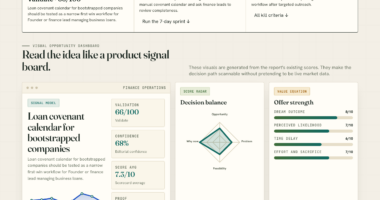

📊 Full opportunity report: Are You Using Blended Billing To Optimize Agency Revenue? on IdeaNavigator AI — validation score, market gap, and execution plan.

Get hardware and tech essentials delivered free with Prime
- Fast, free delivery on millions of items
- Prime Video, Amazon Music and more included
- Member-only deals all year
TL;DR
Agencies are trialing blended billing models combining retainers, usage fees, and fixed projects. Early tests aim to streamline invoicing and reduce revenue leakage. Results are preliminary but promising.
Agencies are testing a new blended billing workflow that consolidates retainer, usage-based, and project charges into a single invoice, aiming to improve accuracy and revenue management. This development is being explored by operations managers at digital and AI services agencies, as a solution to billing complexities caused by mixed billing models.
According to sources familiar with the initiative, the new billing approach involves creating a dedicated workspace where an operations manager can define a single client with multiple billing components: a retainer line, a usage meter, and ad hoc project charges.
Once configured, the system generates a consolidated invoice automatically each month, reducing manual reconciliation and potential errors. This method seeks to address the current challenge where agencies manually stitch together invoices from spreadsheets, risking revenue leakage and billing inaccuracies.
Initial testing involves recruiting eight agencies, each modeling at least one client with hybrid billing needs. The goal is to compare the system-generated invoices against their traditional manual processes and assess willingness to adopt the new workflow.
Potential Impact on Agency Revenue and Operations
This testing could lead to a significant shift in how agencies handle complex billing scenarios, potentially reducing errors and increasing revenue capture. Automating hybrid invoicing aligns with broader trends toward digital transformation in agency operations, offering a scalable solution for managing diverse client billing structures.
blended billing software for agencies
As an affiliate, we earn on qualifying purchases.
As an affiliate, we earn on qualifying purchases.
Growing Need for Flexible Billing Solutions in Agencies
Many digital and AI agencies currently struggle with billing models that combine retainer, usage, and fixed project charges. Existing subscription tools often lack the flexibility to model these hybrid arrangements in a single invoice, leading to manual work and errors.
The push for more integrated billing solutions has gained momentum as agencies increasingly bundle AI usage costs into retainers, complicating traditional invoicing processes. This has prompted developers to create specialized workflows that can handle these hybrid models efficiently.
“The new blended billing approach aims to automate the entire invoicing process for hybrid clients, reducing manual errors and saving time.”
— an anonymous researcher
automated invoicing system for hybrid billing
As an affiliate, we earn on qualifying purchases.
As an affiliate, we earn on qualifying purchases.
Uncertainties About Adoption and Effectiveness
It is not yet clear how widely agencies will adopt this new workflow or whether it will fully replace manual billing practices. The pilot results are still emerging, and long-term effectiveness remains to be seen.
retainer and usage billing management tool
As an affiliate, we earn on qualifying purchases.
As an affiliate, we earn on qualifying purchases.
Next Steps in Validation and Rollout
The ongoing pilot will provide data on invoice accuracy, agency satisfaction, and willingness to switch to the new system. If results are positive, developers plan to refine the platform and expand testing to additional agencies before a broader rollout.
agency billing and invoicing software
As an affiliate, we earn on qualifying purchases.
As an affiliate, we earn on qualifying purchases.
Key Questions
What is blended billing for agencies?
Blended billing combines multiple billing components—such as retainers, usage fees, and fixed projects—into a single invoice, streamlining the billing process.
Why are agencies interested in blended billing?
It reduces manual work, minimizes errors, and helps capture revenue more accurately by consolidating diverse charges into one automated invoice.
When will the new billing system be widely available?
It is currently in pilot testing, with broader availability dependent on successful validation and refinement over the coming months.
What challenges might agencies face in adopting this system?
Potential challenges include adapting existing workflows, training staff, and ensuring the system accurately models complex billing arrangements.
How does this development affect agency revenue management?
If successful, it could significantly improve revenue accuracy and reduce leakage, enabling agencies to better manage hybrid client billing.
Source: IdeaNavigator AI
Halloween Picks
halloween
As an affiliate, we earn on qualifying purchases.