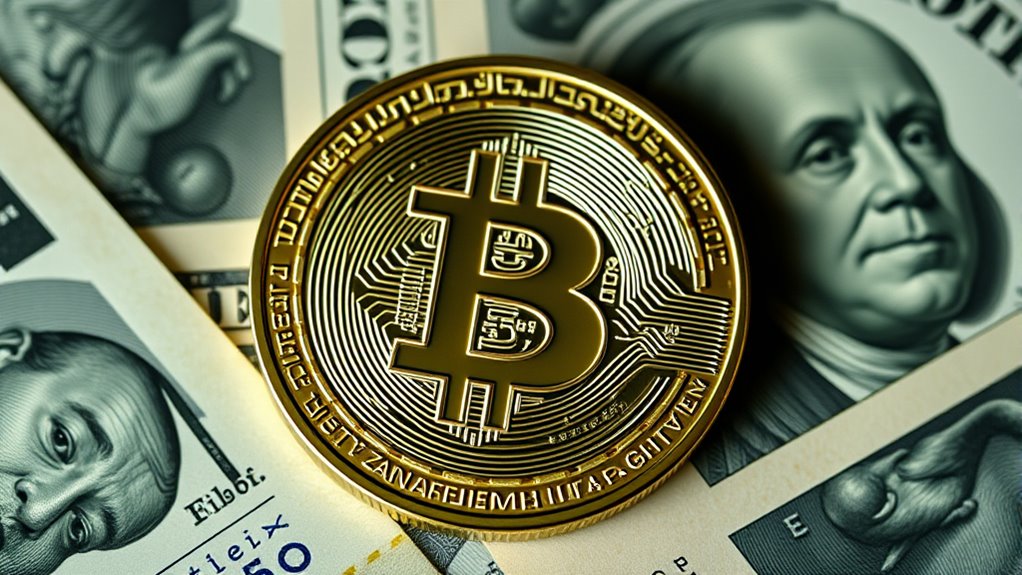

Bitcoin and traditional money are quite different in how they’re created, controlled, and secured. Traditional money is issued and backed by governments or central banks, with physical cash or digital accounts insured and regulated. Bitcoin, on the other hand, is a decentralized digital currency operated on a blockchain, relying on cryptography and network consensus. While traditional money depends on trust in institutions, Bitcoin offers more control and privacy. Keep exploring to understand how these differences can affect your financial choices.
Key Takeaways
- Traditional money is issued and regulated by governments, while Bitcoin is a decentralized digital currency operating on blockchain technology.
- Fiat currency’s value is backed by government trust, whereas Bitcoin’s value is based on cryptography and network consensus.
- Money in banks is protected by security measures and insurance; Bitcoin relies on user-controlled digital wallets and private keys.
- Governments can impose restrictions or bans on traditional money, but Bitcoin’s decentralized nature makes it harder to regulate.
- Traditional currency exists physically or digitally with centralized control, while Bitcoin is purely digital with peer-to-peer transactions.
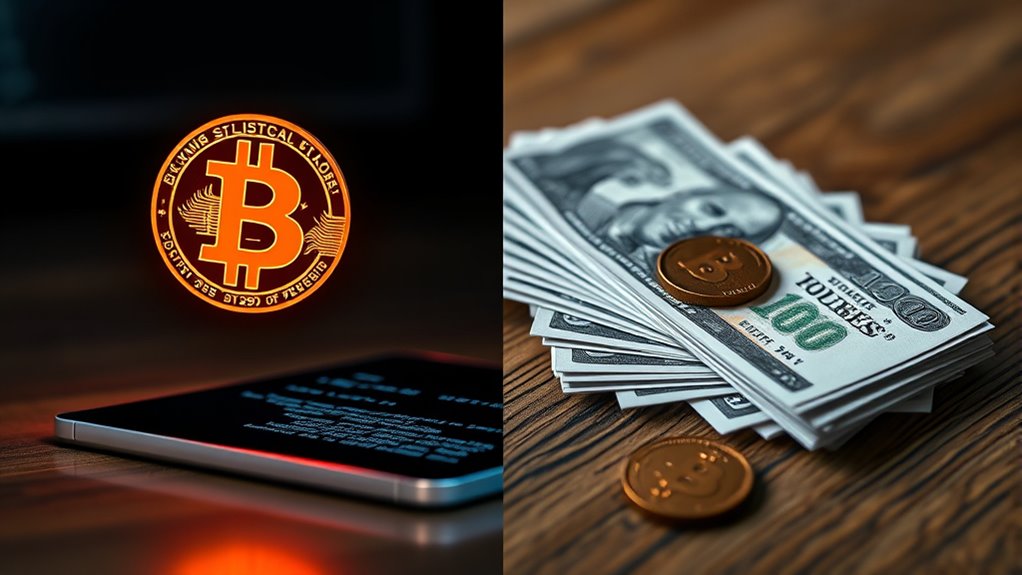
When you compare Bitcoin to traditional money, you’ll notice fundamental differences in how they function and what they represent. Traditional money, like dollars or euros, is issued and regulated by governments and central banks. It exists physically as cash or digitally through bank accounts, and its value is backed by the trust in these institutions. Bitcoin, on the other hand, is a decentralized digital currency that operates on a blockchain—a public ledger maintained by a network of computers worldwide. Unlike traditional currencies, Bitcoin isn’t controlled by any central authority, which can make it appealing for those seeking independence from government policies and banking systems.
Bitcoin is a decentralized digital currency operating on a global blockchain, unlike traditional money controlled by governments.
One significant aspect that sets Bitcoin apart is how it’s affected by cryptocurrency regulation. Governments and regulatory bodies are still figuring out how to classify and control cryptocurrencies. Some countries embrace them, establishing clear rules to protect consumers and prevent illegal activities, while others impose strict bans or restrictions. As a user, you must stay informed about your country’s stance on cryptocurrency regulation because it can influence how easily you can buy, sell, or use Bitcoin. These regulations are evolving rapidly, which can impact the security and legality of your transactions, so understanding the regulatory landscape is essential to avoid potential legal issues or financial losses.
Another critical difference lies in digital wallet security. When you hold traditional money in a bank, the institution takes responsibility for protecting your funds with security measures like encryption, fraud detection, and insurance up to certain limits. With Bitcoin, your digital wallet is your primary tool for storing and managing your coins. Securing your digital wallet is essential because, unlike a bank account, it isn’t insured or protected by government agencies. You need to implement strong security practices, such as using hardware wallets, enabling two-factor authentication, and safeguarding your private keys. A breach or loss of your wallet’s private keys means losing access to your Bitcoin permanently, which underscores the importance of digital wallet security.
While traditional money relies heavily on centralized institutions for stability and security, Bitcoin puts trust in cryptographic principles and the security of the blockchain network. This shift means that, as a user, you bear more responsibility for protecting your assets, but it also offers greater control and privacy. The landscape of cryptocurrency regulation and digital wallet security continues to evolve, shaping how you interact with Bitcoin and determining its role as an alternative or complement to traditional money. Understanding these differences helps you navigate the financial world more confidently, whether you’re investing, trading, or simply exploring new forms of currency.
Frequently Asked Questions
Can Bitcoin Replace Traditional Currencies Entirely?
Bitcoin could replace traditional currencies someday, but it’s unlikely soon. Its role as digital gold and emphasis on decentralization appeal to those seeking a secure, transparent store of value. However, widespread adoption faces hurdles like regulatory issues and price volatility. You’d need to see more stability and acceptance for Bitcoin to fully replace traditional money, but it’s a powerful alternative for those valuing decentralization and digital innovation.
How Does Inflation Impact Bitcoin Versus Traditional Money?
Inflation impacts traditional money more because fiat devaluation occurs when governments use monetary policy to print more currency, reducing its value. Bitcoin, with its capped supply, resists inflation and maintains its purchasing power better over time. You’ll find that during periods of fiat devaluation, Bitcoin often acts as a hedge, helping protect your assets from the adverse effects of inflation caused by expansive monetary policy.
Are Bitcoin Transactions More Private Than Bank Transfers?
Sure, because nothing screams privacy like a digital ledger openly scrutinized by anyone with an internet connection. Bitcoin transactions offer more privacy than bank transfers, but not complete anonymity—your transaction data is traceable on the blockchain. If you’re concerned about privacy, understand that Bitcoin provides pseudonymity, which is better than traditional bank transfers’ detailed records, but it’s still not foolproof for those seeking total transaction anonymity.
What Are the Legal Implications of Using Bitcoin Worldwide?
You should know that using bitcoin worldwide comes with legal risks due to cryptocurrency regulations that vary by country. Some governments accept it, while others ban or heavily regulate it. You might face legal implications if you don’t comply with local laws, including fines or account freezes. Stay informed about the legal landscape in your region to avoid issues, and consider consulting legal experts to understand the specific cryptocurrency regulations that apply to you.
How Scalable Is Bitcoin Compared to Traditional Payment Systems?
Oh, you think Bitcoin’s scalability matches traditional payment systems? Think again. With limited blockchain capacity, it processes fewer transactions per second, making it feel like waiting for a snail to race a cheetah. Its transaction speed lags behind, causing delays during peak times. While innovative, Bitcoin still struggles to handle the volume and speed that seamless, instant payments demand—highlighting its current limits compared to traditional systems.
Conclusion
So, there you have it—your shiny new Bitcoin, the rebellious digital rebel, versus good old traditional money, the reliable old-timer. One promises freedom and privacy, the other offers familiarity and stability. Whether you’re ready to jump into the future or cling to the past, just remember: in the wild world of currency, it’s always a gamble. So go ahead, pick your side—just don’t blame us when the crypto rollercoaster makes you dizzy!