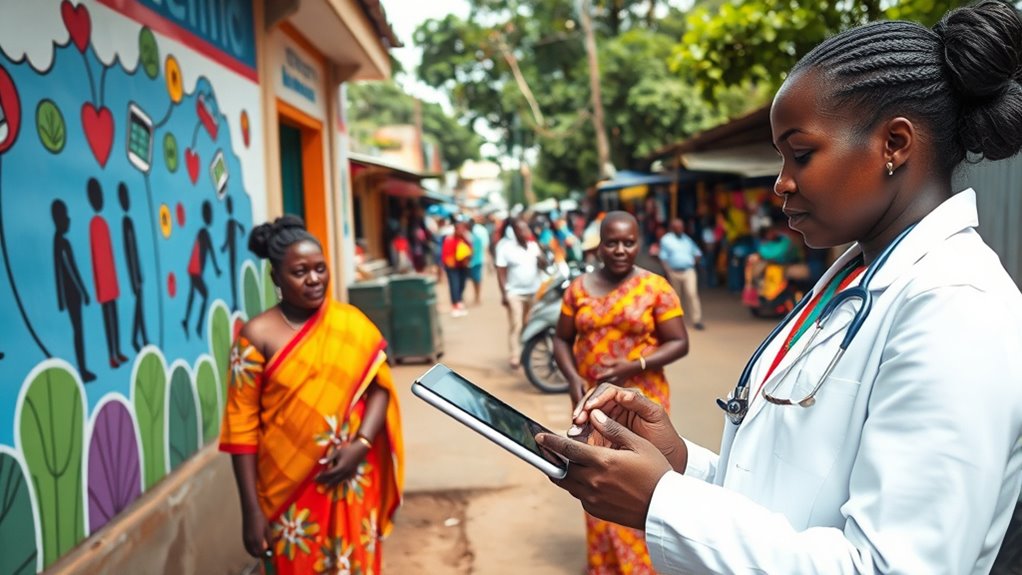

AI is transforming public health in Kenya and Nigeria by enhancing disease diagnosis, outbreak prediction, and health communication. It helps detect illnesses early, track new outbreaks, and support healthcare workers in underserved areas. AI-driven tools also improve treatment plans and promote community engagement through culturally relevant messages. These innovations boost health outcomes and emergency response efforts. Continue to explore how these technologies are shaping sustainable health systems across Africa’s diverse communities.

Get hardware and tech essentials delivered free with Prime
- Fast, free delivery on millions of items
- Prime Video, Amazon Music and more included
- Member-only deals all year
Key Takeaways
- AI predicts infectious disease outbreaks in Nigeria, enabling early intervention and reducing mortality rates.
- In Kenya, AI-driven diagnostic tools improve malaria detection in rural communities.
- AI models analyze hospital data to personalize HIV treatment plans in both countries.
- Community engagement via AI-generated health messages enhances local health awareness and compliance.
- Africa CDC utilizes AI for rapid pathogen tracking and emergency response coordination in Nigeria and Kenya.

Have you ever wondered how artificial intelligence is transforming public health across Africa? AI is making a significant impact in ways that directly benefit you and your community. In Kenya, for example, AI-driven tools are revolutionizing disease diagnosis. Convolutional neural networks are now used to detect malaria more accurately, especially in rural areas where healthcare resources are limited. This means that people living far from hospitals can receive quicker, more precise diagnoses, reducing the risk of complications. Similarly, AI models analyze data from hospitals like Bombo Hospital to predict the health status of HIV patients. These predictions help doctors tailor treatments and improve patient outcomes, making care more personalized and effective.
AI is improving disease diagnosis and treatment in Africa, saving lives and enhancing community health.
Across Nigeria, AI is playing an equally crucial role. It’s used to forecast infectious disease outbreaks, giving health authorities a heads-up before the situation worsens. Expert diagnostic systems supported by AI enhance monitoring efforts, ensuring that health officials can respond swiftly and effectively. These tools also support early-stage disease detection, which is critical for reducing mortality rates. In rural communities, transfer learning and residual neural networks are applied to diseases like urinary tract infections, leading to better health results. These innovations help bridge the gap created by a shortage of healthcare workers, allowing fewer doctors to oversee more patients with the aid of AI.
AI isn’t just improving diagnostics; it’s also transforming health communication. In Kenya and Nigeria, AI-generated health messages are more culturally relevant because they incorporate local metaphors and references. This makes the information easier to understand and accept. Platforms like SARAH.AI and ChatGPT provide accurate medical advice, but they sometimes struggle with linguistic nuances or cultural context. This can limit their effectiveness compared to traditional campaigns led by trusted health authorities. Furthermore, because many AI systems are trained on Western datasets, they risk overlooking local knowledge and gender perspectives. To be truly effective, AI-driven communication needs to involve communities in its design, ensuring it respects cultural sensitivities and medical accuracy. Data diversity plays a critical role in improving AI’s relevance and fairness in health messaging.
AI is also helping to address the severe shortage of healthcare professionals, especially oncologists. In many parts of sub-Saharan Africa, there’s only one oncologist for every 3,000 cancer patients. AI-supported tools help detect cancer early, reducing the burden on limited specialists. They enable more patients to receive timely diagnosis and follow-up care, even in remote locations. Ethical and culturally sensitive deployment is essential to ensure these tools are used responsibly and effectively. Public-private collaborations are working to optimize AI’s role in delivering equitable cancer care.
Finally, AI strengthens Africa’s capacity to prepare for public health emergencies. The Africa CDC uses AI to track pathogens and understand outbreaks, guiding responses to over 160 emergencies annually. It accelerates outbreak detection, helps design vaccines faster, and supports coordinated efforts across sectors. With AI’s help, Africa can respond more swiftly to infectious disease threats, ultimately protecting communities and saving lives.
As an affiliate, we earn on qualifying purchases.
Frequently Asked Questions
How Does AI Improve Healthcare Access in Rural Areas?
AI improves healthcare access in rural areas by enabling virtual consultations that connect you with healthcare professionals anytime, overcoming distance barriers. It supports self-monitoring through wearable sensors and helps diagnose diseases accurately with machine learning tools. AI chatbots and health messages in local dialects improve understanding and trust. Despite challenges like poor connectivity, AI makes healthcare more reachable, affordable, and tailored to your community’s needs.
What Are the Ethical Considerations of AI in Public Health?
You should prioritize fairness, transparency, and patient privacy when using AI in public health. Guarantee your algorithms don’t reinforce biases or widen disparities, especially for marginalized groups. Obtain clear consent and protect sensitive data through anonymization. Be transparent about how AI makes decisions, establish accountability, and prevent misinformation. By addressing these ethical considerations, you help promote equitable, trustworthy, and responsible AI deployment in health systems.
How Does AI Address Disease Surveillance Challenges?
You see how AI tackles disease surveillance challenges by analyzing vast health data quickly, allowing you to identify outbreaks early. It improves detection accuracy, even in remote areas with limited infrastructure, by automating data collection and analysis. AI’s multilingual interfaces help overcome language barriers, and real-time analytics enable you to respond swiftly. This proactive approach helps prevent disease spread, making public health efforts more efficient and targeted in Kenya and Nigeria.
What Role Does AI Play in Health Education Initiatives?
AI plays a crucial role in health education initiatives by delivering personalized, culturally relevant messages through mobile platforms, helping you better understand health risks and preventive measures. It supports community health workers with targeted training and decision-making tools, ensuring local customs are respected. Additionally, AI-driven programs expand access to health information, especially in underserved areas, empowering you and your community to make informed health choices and improve overall wellbeing.
How Is AI Funding Allocated for Public Health Projects?
Funding flows like a carefully choreographed dance, guided by global priorities and local needs. You’ll find resources mainly from international donors, tech giants, and your government, focusing on projects that address disease surveillance, diagnostics, and resource management. They favor initiatives led by local institutions, ensuring the rhythm of AI benefits your community. Short-term grants encourage quick innovation, but you must navigate fluctuating global budgets and shifting policy tides to sustain your efforts.
personalized HIV treatment devices
As an affiliate, we earn on qualifying purchases.
As an affiliate, we earn on qualifying purchases.
Conclusion
So, next time you marvel at AI’s magic in Kenya and Nigeria, remember—it’s not just about saving lives; it’s about how cleverly we can rebrand tech as a miracle worker. Who knew that algorithms and data could replace human touch and intuition? As you marvel at these breakthroughs, just wonder—are we really improving health, or just giving ourselves a fancy new excuse to ignore the messy, imperfect reality of healthcare?
community health communication AI tools
As an affiliate, we earn on qualifying purchases.
As an affiliate, we earn on qualifying purchases.
As an affiliate, we earn on qualifying purchases.
Fall Picks
fall essentials
As an affiliate, we earn on qualifying purchases.