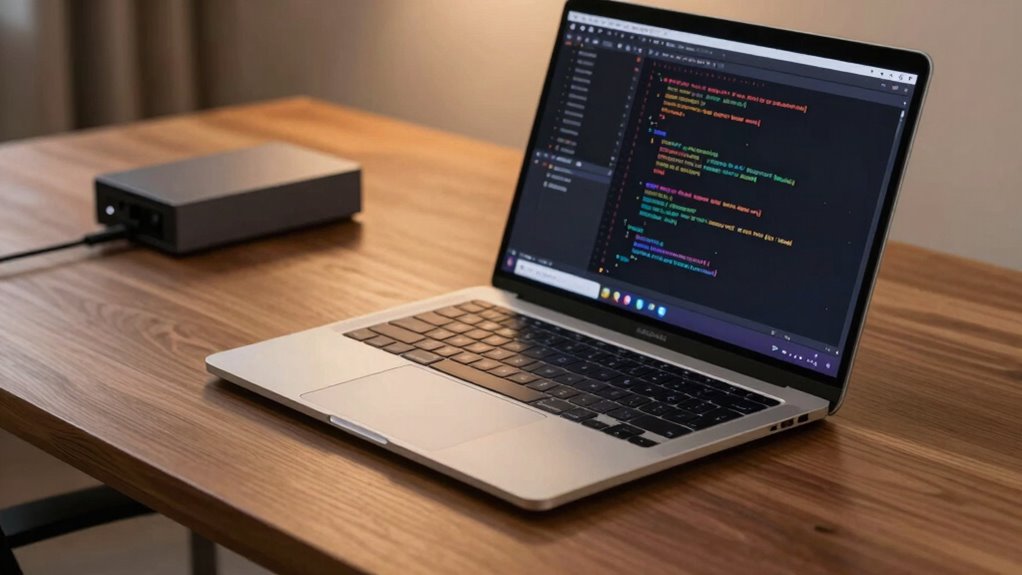

To choose a good AI laptop without overkill, focus on a recent-generation CPU like an Intel Core i7 or AMD Ryzen 7, paired with 16GB or 32GB of RAM for smooth multitasking. A fast SSD helps manage large datasets efficiently, while a mid-range GPU like an RTX 3060 accelerates deep learning tasks without unnecessary costs. Prioritize a good display, portability, and durability for long work sessions. Keep exploring to find the perfect balance for your AI needs.

Get hardware and tech essentials delivered free with Prime
- Fast, free delivery on millions of items
- Prime Video, Amazon Music and more included
- Member-only deals all year
Key Takeaways
- Prioritize a balanced CPU with multiple cores (e.g., Intel Core i7 or AMD Ryzen 7) for efficient processing without excessive power.
- Ensure at least 16GB of RAM for smooth data handling, with options to upgrade for larger workloads.
- Use fast SSD storage (512GB or 1TB) to quickly access large datasets and improve workflow.
- Choose mid-range GPUs like NVIDIA RTX 3060 only if GPU acceleration is essential; integrated graphics may suffice otherwise.
- Opt for portability, good display quality, and durable build to support long AI work sessions without unnecessary extras.
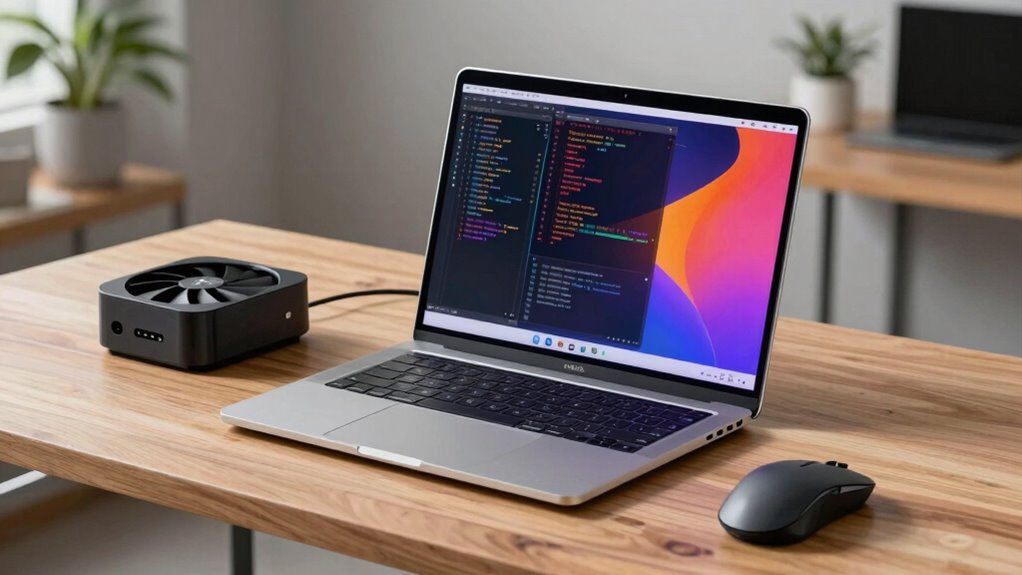
As artificial intelligence continues to advance, having the right laptop becomes essential for anyone working in this field. You need a machine that balances power and portability, enabling you to handle tasks like data preprocessing and cloud computing efficiently without over-investing in unnecessary specs. A good AI laptop isn’t about having the most extreme hardware; it’s about choosing the right components to streamline your workflow and maximize productivity.
When it comes to AI work, especially tasks like data preprocessing, you want a laptop that offers a solid CPU with multiple cores. This allows you to run complex algorithms and manipulate large datasets smoothly. Look for recent-generation processors, such as Intel Core i7 or AMD Ryzen 7, which provide enough horsepower without going overboard. These CPUs help speed up data cleaning, feature extraction, and other preprocessing steps, making your workflow much more efficient. Processing power is crucial for handling compute-intensive tasks efficiently.
Choose a recent-generation CPU with multiple cores for efficient data preprocessing and smooth workflow.
RAM is equally important. For AI applications, 16GB of RAM is often enough for everyday tasks and moderate workloads. If you work with larger datasets or run multiple virtual machines or containers, upgrading to 32GB can prevent slowdowns and improve multitasking. This ensures that your machine can handle intensive processes like training machine learning models or running cloud-based computations without lag. Additionally, choosing a laptop with expandable memory options can be beneficial as your project needs grow. Incorporating memory scalability into your decision can help future-proof your setup.
Storage also matters. A fast SSD (Solid State Drive) offers quick access to your data and reduces load times, which is critical when handling large datasets or booting up multiple applications. A 512GB or 1TB SSD strikes a good balance between capacity and speed, helping you manage data preprocessing tasks more efficiently and keep your workflow fluid.
Graphics hardware can be a lesser concern unless you’re training deep learning models locally or doing GPU-accelerated tasks. A mid-range GPU, such as NVIDIA’s GTX 1660 Ti or RTX 3060, can accelerate specific workloads without adding unnecessary expense. For most AI tasks, especially those involving cloud computing, integrated graphics or a modest GPU will suffice.
Finally, a reliable, high-quality display and good battery life make a huge difference during long work sessions. You want a screen that’s easy on the eyes and can display detailed data visualizations clearly. Choose a laptop that’s portable enough to take with you but also durable enough to withstand daily use.
In essence, a good AI laptop isn’t about the highest-end specs, but rather the right combination of processing power, memory, and storage. It should handle data preprocessing efficiently, support cloud computing workflows, and be versatile enough to grow with your projects—all without breaking the bank or becoming overkill.
As an affiliate, we earn on qualifying purchases.
Frequently Asked Questions
How Much RAM Do I Really Need for AI Tasks?
For AI tasks, you’ll want at least 16GB of RAM, especially when working with large AI models and demanding software. If you’re handling complex models or multitasking, 32GB or more can boost performance and guarantee smooth processing. Adequate RAM helps maintain software compatibility and prevents slowdowns. Keep in mind, the more RAM you have, the better your laptop handles intensive AI workloads without becoming overkill.
Is a High-End GPU Necessary for Beginner AI Projects?
You don’t need a high-end GPU for beginner AI projects. For those just starting out, beginner-friendly hardware with a decent GPU like an entry-level or mid-tier model usually suffices. Focus on GPU requirements that support your projects without overkill, ensuring smooth performance without unnecessary costs. As you progress, you can upgrade to more powerful GPUs, but initial projects don’t demand top-tier hardware.
Can I Upgrade a Laptop’s AI Processing Capabilities Later?
You can upgrade your laptop’s AI hardware later, but it’s like building a house—starting with a solid foundation matters. Focus on software optimization now, which can improve performance without extra hardware. Upgrading internal components like RAM or storage is easier than replacing the GPU, but for major AI processing power, investing in a laptop with a dedicated GPU upfront is wise. Plan ahead to avoid limitations down the line.
What Battery Life Should I Expect When Running AI Workloads?
When running AI workloads, you should expect shorter battery life, typically around 2-4 hours, depending on power consumption and workload intensity. AI tasks demand high processing power, which increases power consumption. To extend battery life, focus on battery optimization features like reducing screen brightness, closing unnecessary apps, and enabling power saver modes. Keep in mind that intensive AI processing will always drain your battery faster than regular use.
Are Gaming Laptops Suitable for AI Development?
Think of gaming laptops as sports cars—they can handle AI development’s high demands, but overheating concerns are real. Their gaming performance is excellent, often equipped with powerful GPUs perfect for AI tasks. However, intense workloads may cause them to heat up quickly, so you’ll need good cooling solutions. If you prioritize speed and processing power, gaming laptops can be suitable, but be prepared for potential thermal challenges during extended AI sessions.
As an affiliate, we earn on qualifying purchases.
Conclusion
In the end, choosing a laptop for AI doesn’t mean overspending on specs you won’t use. Focus on a balanced mix of a decent GPU, enough RAM, and a solid processor. Did you know that 85% of AI developers prefer laptops with dedicated graphics? This shows that you don’t need the most expensive machine, just the right one to boost your projects without breaking the bank. Find what fits your needs, and get coding!
As an affiliate, we earn on qualifying purchases.
As an affiliate, we earn on qualifying purchases.
Halloween Picks
halloween
As an affiliate, we earn on qualifying purchases.