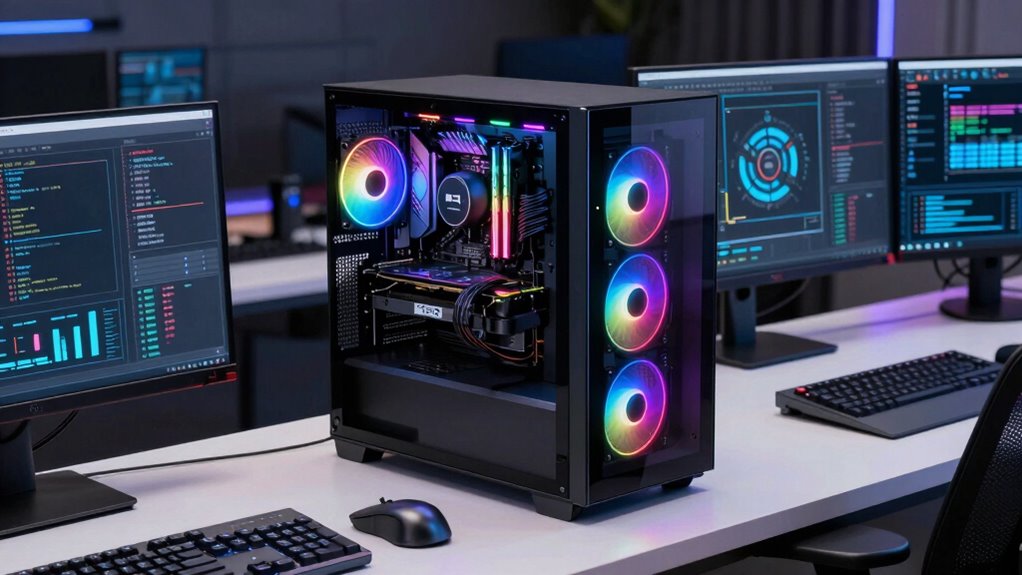
If you’re into AI work, 32GB RAM strikes the perfect balance between performance and cost. It handles complex models, multitasking, and data processing smoothly, reducing delays during training and inference. While higher RAM options exist, 32GB offers enough power to future-proof your setup without breaking the bank. Plus, it’s compatible with current software and hardware, ensuring stability. Keep exploring how to optimize your system, and you’ll see why this capacity is gaining popularity among AI enthusiasts.
Key Takeaways
- 32GB RAM balances performance and affordability, supporting multitasking and complex AI workloads efficiently.
- It handles most machine learning tasks and data processing needs without frequent upgrades.
- Adequate for accelerating AI model training, inference, and system optimization with minimal bottlenecks.
- Cost-effective choice compared to 64GB or higher, offering significant performance gains for most users.
- Future-proof for emerging AI developments, large datasets, and integration with cloud computing platforms.
Why 32GB RAM Is the Sweet Spot for Most AI Workloads
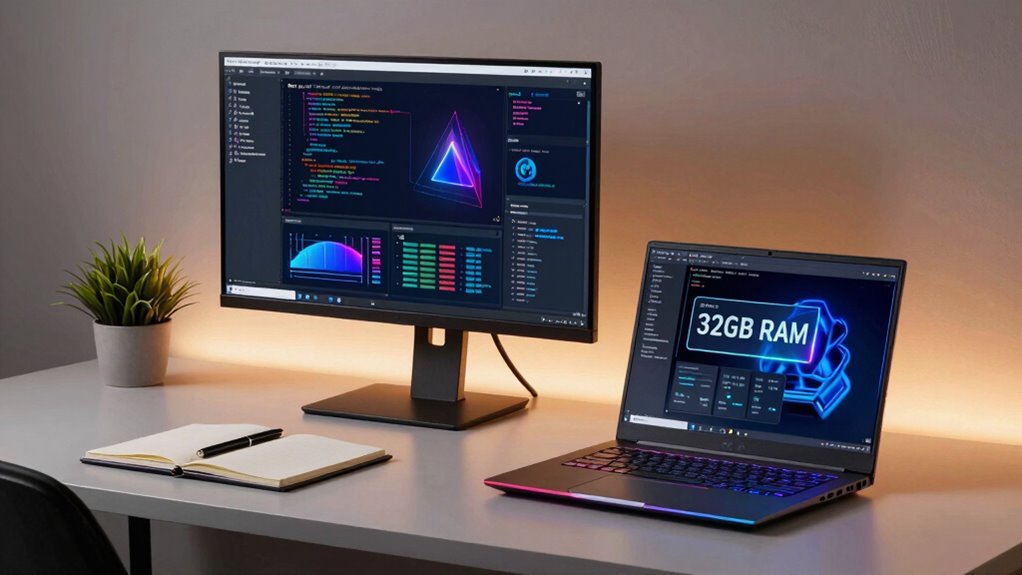
For most AI workloads, 32GB of RAM strikes the perfect balance between performance and affordability. This amount guarantees smooth handling of complex models while maintaining hardware compatibility with a wide range of systems. With 32GB, your setup supports software optimization, allowing AI frameworks and data processing tools to run efficiently without frequent bottlenecks. You won’t need to upgrade prematurely, saving both time and money. This RAM capacity provides enough headroom for multitasking and running multiple AI applications simultaneously. It also enables faster data access, minimizing delays during training and inference. Additionally, exploring new content formats can help optimize how your AI workflows adapt to emerging digital concepts. Understanding hardware specifications is crucial for ensuring compatibility and maximizing performance, especially when working with demanding AI tasks. Having sufficient RAM also helps prevent system slowdowns during intense processing sessions, ensuring a smoother workflow. Overall, 32GB of RAM offers the stability and flexibility you need to optimize your AI workflows without overinvesting in hardware that may become outdated quickly.
Can 32GB RAM Handle Heavy Machine Learning and Data Processing?
While 32GB of RAM can handle many machine learning and data processing tasks, there are limits when it comes to extremely heavy workloads. Heavy computations demand high memory bandwidth to transfer data quickly and prevent bottlenecks. Storage speed also plays a vital role in loading large datasets efficiently, avoiding delays that slow down workflows. Additionally, safety tips for portable oil radiators are essential when working in environments where heat sources are used for extended periods, ensuring both equipment and user safety. However, when working with massive datasets or complex models, you might experience:
- Slower training times, feeling frustrating
- Memory swapping, causing performance drops
- Bottlenecks in data transfer, limiting productivity
- Longer inference times, reducing responsiveness
- Potential crashes or freezes during intense tasks
These issues highlight that, while 32GB is powerful, pushing the limits of heavy machine learning and data processing can require more advanced memory solutions.
How 32GB RAM Boosts AI Model Training and Inference
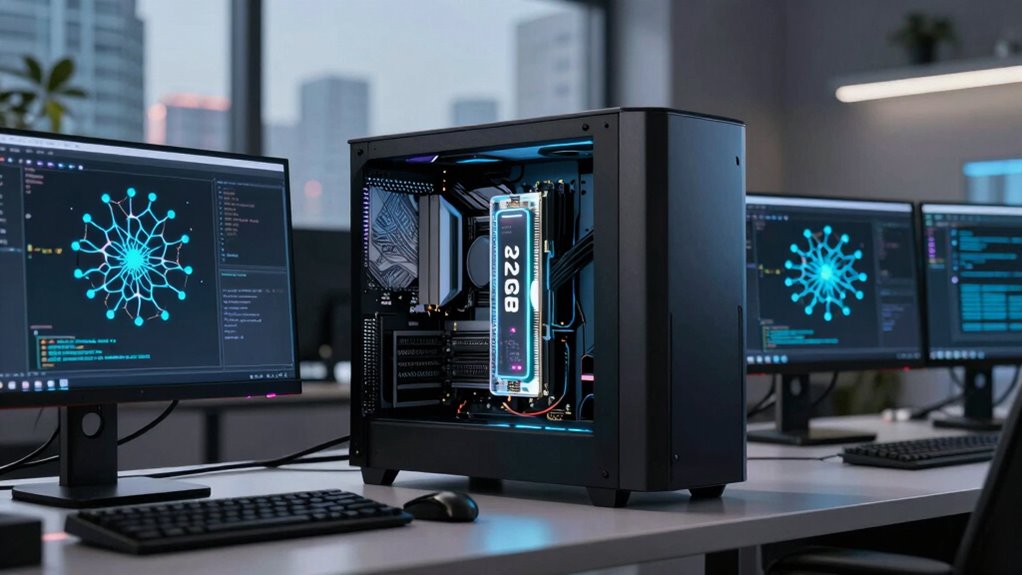
Having 32GB of RAM considerably accelerates AI model training and inference by providing ample memory to handle large datasets and complex models simultaneously. This capacity allows you to process data more efficiently, reducing bottlenecks caused by insufficient memory. Increased memory bandwidth ensures faster data transfer between RAM and the CPU, boosting overall performance during intensive tasks. Additionally, with more RAM, your system can maintain higher workloads without frequent swapping, leading to smoother training sessions. Proper cooling solutions are crucial, as intensive computations generate heat that can degrade performance or cause instability. Efficient cooling maintains ideal operating temperatures, preserving hardware longevity and ensuring consistent training speeds. Moreover, efficient cooling solutions can help prevent thermal throttling, which can significantly hinder performance during prolonged AI training sessions. Furthermore, using electric bikes as a sustainable transportation option can reduce your carbon footprint during long training sessions or commutes. Implementing adequate system cooling is essential for maintaining optimal hardware performance during extended AI workflows. To maximize performance, it’s also vital to consider hardware durability to ensure your system withstands intensive workloads over time. Together, these factors make 32GB RAM a necessary component for robust AI workflows.
Is 32GB RAM Enough? Comparing It to Other Memory Options for AI
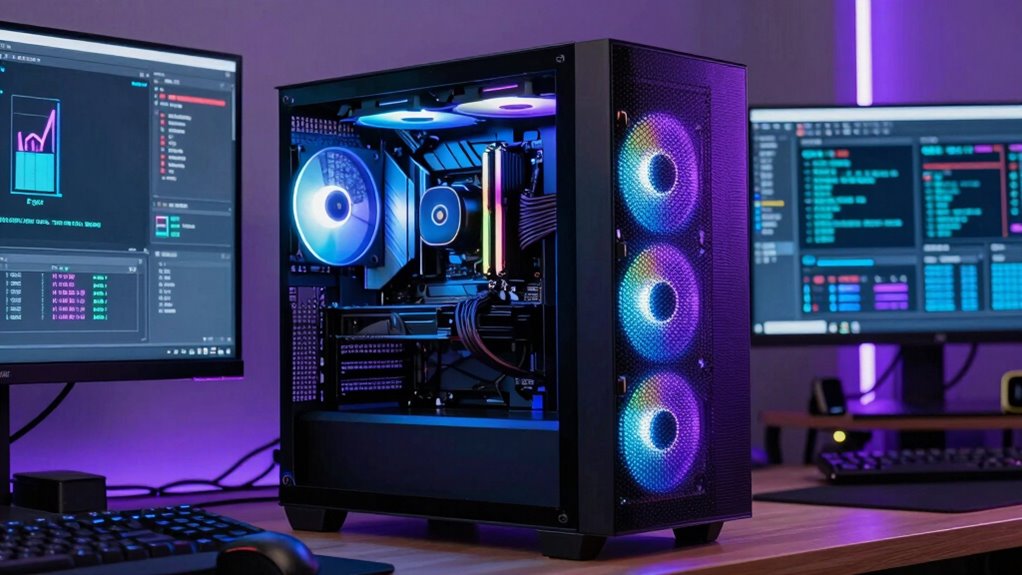
When considering whether 32GB of RAM suffices for AI tasks, it’s important to compare it to other memory options. While 64GB or more can handle larger datasets, 32GB strikes a balance between cost and performance. Key factors include memory bandwidth and RAM latency: higher bandwidth speeds up data transfer, and lower latency reduces delays. Here’s what to keep in mind:
- More RAM means smoother multitasking during complex training.
- Higher memory bandwidth accelerates data movement, boosting performance.
- Lower RAM latency reduces wait times, improving responsiveness.
- Beyond 32GB, diminishing returns may not justify the cost for most AI tasks.
- Compatibility and system limitations can influence real-world gains.
- Incorporating landscaping and outdoor amenities can optimize your workspace environment for better focus and productivity.
Ultimately, 32GB offers a practical sweet spot, but evaluating your specific AI workload helps determine if it’s enough.
Why 32GB RAM Is a Cost-Effective Choice for AI Enthusiasts
With 32GB of RAM, you get a solid performance boost without breaking the bank. It’s enough for most AI tasks, so you won’t need to upgrade frequently or overspend. This makes 32GB a smart, cost-effective choice for AI enthusiasts looking for reliable power. Additionally, it provides sufficient memory for AI training jobs, ensuring smooth operation during complex model development. The right amount of RAM can also support home theatre projectors and other multimedia setups, enhancing your overall experience. Incorporating optimal essential oils can further improve your workspace environment, boosting focus and reducing stress during intense AI development sessions.
Budget-Friendly Performance Boost
While upgrading to 32GB of RAM might seem like a substantial investment, it actually offers a cost-effective way to boost your AI performance without breaking the bank. With increased memory bandwidth, you’ll experience faster data processing and smoother multitasking. Plus, 32GB guarantees better software compatibility, reducing crashes and lag during intensive tasks. This upgrade provides a noticeable performance uplift for AI workloads at a reasonable price point. You’ll feel confident tackling larger datasets and complex models without constantly upgrading again. It’s a smart investment that maximizes your current setup’s potential. Imagine seamless workflows, fewer delays, and more time focusing on your AI projects rather than troubleshooting hardware issues. Incorporating best vacuums for dust removal in 2024 ensures your environment remains clean and allergen-free, which can contribute to better overall productivity and focus. Additionally, having sufficient RAM can help mitigate hardware bottlenecks that often hinder AI development and testing. It’s a budget-friendly way to open significant performance gains and future-proof your system.
Sufficient for Most Tasks
Upgrading to 32GB of RAM already delivers noticeable improvements, but it also proves to be more than enough for most AI tasks you’ll encounter day-to-day. With 32GB, you can handle large datasets, run multiple applications, and train complex models without significant lag. This amount balances hardware compatibility and software optimization, ensuring smooth performance across various setups. Most AI enthusiasts won’t need to jump to higher capacities unless working on specialized projects. Here’s a quick overview:
| Task Type | RAM Requirement | Recommended for |
|---|---|---|
| Data preprocessing | 16-32GB | Most users |
| Model training | 32GB or more | Heavy workloads |
| Software testing | 16-32GB | Routine experimentation |
| Simulations | 32GB+ | Advanced research |
| Multi-tasking | 32GB | Efficient workflow |
Additionally, understanding RAM requirements can help you make more informed decisions when upgrading your system for AI tasks. Recognizing the importance of software optimization can further enhance your system’s performance and efficiency. For example, considering hardware compatibility can ensure that your system supports the desired RAM capacity effectively. Developing a curiosity about system architecture can also assist in optimizing your setup for various AI applications.
How to Optimize Your System Settings for Maximum 32GB RAM Performance
To get the most out of your 32GB RAM, you need to fine-tune your system settings for peak performance. A proper Memory Upgrade and System Optimization can unlock your setup’s full potential. Start by adjusting your virtual memory to match your workload, ensuring smooth multitasking. Disable unnecessary startup programs that drain resources. Enable XMP profiles in BIOS for faster RAM speeds. Keep your drivers and OS updated for compatibility and stability. Finally, monitor your system’s performance regularly to spot bottlenecks.
Boost your confidence in your setup with these steps:
- Maximize RAM speed with BIOS tweaks
- Close background apps during intensive tasks
- Enable high-performance power plans
- Regularly clean and defragment drives
- Use system monitoring tools to fine-tune performance
Future-Proof Your AI Setup With 32GB RAM
Optimizing your system settings sets the stage for a longer-lasting AI setup, but thinking ahead guarantees you stay ahead of evolving technology. With 32GB RAM, you’re better prepared for advancements like cloud computing and quantum computing, which demand substantial memory resources. As AI workloads grow more complex, having ample RAM ensures smooth integration with cloud platforms, allowing seamless data transfer and processing. Quantum computing’s potential to revolutionize AI requires systems that can handle massive datasets and intensive computations. Investing in 32GB RAM now future-proofs your setup against these shifts, enabling you to leverage emerging technologies without hardware bottlenecks. Staying adaptable means your AI environment remains efficient, scalable, and ready for the next wave of innovation. Additionally, understanding animated movies that touch hearts and their emotional depth can inspire more human-centered AI interactions, making your setups more engaging and relatable. Recognizing the importance of impactful storytelling in media can also guide the development of AI systems that better understand and generate emotionally resonant content. Preparing your hardware with ample memory ensures your AI tools can effectively process and analyze emotionally rich media, further enhancing their ability to connect with users on a deeper level. Developing a comprehensive understanding of media can help tailor AI responses to better align with human emotional experiences.
Frequently Asked Questions
How Does RAM Speed Affect AI Performance Beyond Capacity?
RAM speed impacts AI performance by influencing memory latency and bandwidth optimization. Faster RAM reduces memory latency, allowing your system to access data more quickly, which speeds up training and inference tasks. Higher RAM speed also boosts bandwidth, enabling more data to flow efficiently between the memory and CPU or GPU. This improved data flow minimizes bottlenecks, making your AI workflows smoother and more responsive, especially during intensive computations.
Can 32GB RAM Support Multiple AI Applications Simultaneously?
Yes, 32GB RAM can support multiple AI applications simultaneously. With an average memory latency of around 70 nanoseconds, your system can efficiently access data across applications. Proper cache optimization guarantees quick data retrieval, minimizing delays. This setup allows you to run several models or tools at once without significant slowdowns, making 32GB a practical choice for AI enthusiasts who need multitasking power and smooth performance.
What Are the Potential Bottlenecks When Using 32GB RAM for AI?
When using 32GB RAM for AI, potential bottlenecks include memory latency, which can slow data access, and thermal management issues that might cause overheating and throttling. If your system isn’t optimized, high memory usage can lead to delays in processing. You need good cooling solutions and fast memory modules to minimize latency. Without these, performance could suffer, limiting your ability to run multiple AI applications smoothly.
How Does RAM Upgradability Impact Long-Term AI Project Planning?
Imagine the power of future-proofing your AI projects—upgrading RAM can be a game-changer. When you prioritize RAM upgradability, you guarantee hardware compatibility with evolving needs, avoiding costly replacements. Plus, it seamlessly integrates with cloud solutions, giving you flexibility in resource management. This foresight lets you plan long-term, confidently handling larger datasets and more complex models, keeping your AI projects ahead of the curve without unexpected bottlenecks.
Are There Specific AI Workloads That Require More Than 32GB RAM?
Certain AI workloads, like training large deep learning models or working with massive datasets, demand more than 32GB RAM. Your AI hardware needs to support these intensive tasks, and memory optimization becomes essential to prevent bottlenecks. When planning your setup, consider future scalability and the possibility of higher memory requirements, ensuring your system can handle evolving AI workloads efficiently without frequent upgrades.
Conclusion
So, if you thought skimping on RAM was a good idea, think again. 32GB is basically the goldilocks zone for AI enthusiasts—just enough to handle heavy workloads without draining your wallet or turning your PC into a hot mess. Upgrade now, and you’ll thank yourself when your models train faster and your system stays cool. Because, let’s face it, nobody wants their AI dreams crushed by a measly little RAM shortage.