
Computer vision allows machines to see and understand images like humans by recognizing objects, shapes, textures, and colors. It uses deep learning models, especially convolutional neural networks, to analyze visual data and identify key features. These systems can locate objects with bounding boxes and assign labels with confidence scores. As technology improves, machines become better at interpreting complex scenes. Keep exploring to discover how this exciting field is transforming various industries and daily life.
Key Takeaways
- Computer vision enables machines to interpret and understand visual data by recognizing objects, shapes, colors, and textures in images.
- It uses deep learning models, especially convolutional neural networks (CNNs), trained on large labeled datasets for accurate recognition.
- Image processing workflows involve preprocessing, feature extraction, and analyzing images to generate labels or bounding boxes.
- Applications include facial recognition, medical imaging, autonomous vehicles, security, and retail inventory management.
- Continuous advancements improve speed, accuracy, and scene interpretation, making machines better at “seeing” and understanding the world.
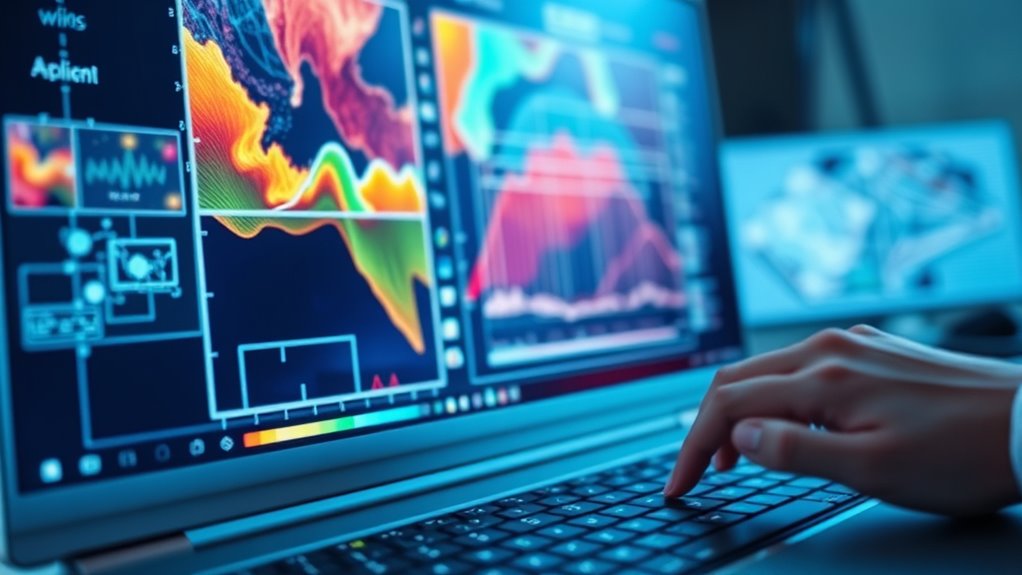
Have you ever wondered how computers can interpret and understand images the way humans do? It’s a fascinating process that involves complex algorithms and advanced techniques, all aimed at enabling machines to make sense of visual data. At the core of this capability is image recognition, which allows computers to identify and categorize objects within an image. When you upload a photo, the system analyzes the visual elements—shapes, colors, textures—and compares them to vast databases to determine what’s present. This process is essential for applications like facial recognition, medical imaging, and even social media tagging. But beyond just recognizing objects, computers are also equipped for object detection, which goes a step further by not only identifying what’s in an image but also pinpointing where those objects are located. Instead of simply labeling an image as “cat,” object detection draws bounding boxes around each cat, helping machines understand the spatial relationship between objects. This distinction is critical when machines need to interpret complex scenes, like autonomous vehicles steering busy streets or security systems monitoring for suspicious activity.
To perform image recognition and object detection, computers rely on machine learning models, especially deep learning algorithms. These models are trained on massive datasets containing labeled images, where each object is annotated with its location. Over time, the models learn to recognize patterns and features that distinguish different objects. Convolutional neural networks (CNNs) are particularly effective because they mimic the way our visual cortex processes information, allowing computers to automatically learn relevant features without manual feature extraction. When you feed an image into such a system, the CNN extracts multiple layers of features—from simple edges to complex textures—building a detailed understanding of the scene. Moreover, ongoing research in AI security emphasizes the importance of safeguarding these systems against vulnerabilities like adversarial attacks, ensuring their robustness in real-world applications.
The process begins with preprocessing the image, which might involve resizing, normalizing, or filtering to enhance relevant features. Then, the trained model analyzes the image through its layers, generating predictions about the presence and location of objects. The final output could be a set of labels with confidence scores, or bounding boxes highlighting detected objects. This capability is transforming numerous industries, from retail—where it helps with inventory management—to healthcare, improving diagnostic accuracy. As technology advances, these systems are becoming faster and more precise, making it easier for machines to see and interpret the world around them with increasing accuracy.
Frequently Asked Questions
How Do Computers Interpret Color Differences in Images?
You can think of computers interpreting color differences through chromatic analysis, where they analyze the RGB or HSV values in an image. They compare the color perception by measuring variations in these values, allowing them to identify distinct hues, shades, and contrasts. This process helps machines distinguish objects and textures based on color differences, enabling tasks like image recognition, segmentation, and even color correction with high precision.
What Are Common Challenges in Real-Time Computer Vision Applications?
In real-time computer vision applications, you face challenges like variable lighting conditions that affect image clarity and accuracy. Occlusion challenges occur when objects block each other, making it hard for the system to identify or track items correctly. To overcome these issues, you need robust algorithms and adaptive techniques that can handle changing environments and partial views, ensuring reliable performance even under difficult conditions.
How Does Machine Learning Improve Image Recognition Accuracy?
Machine learning improves image recognition accuracy by enabling your system to learn from vast datasets. For example, using deep learning models, your system automatically performs feature extraction, identifying key patterns in images. This process helps the model distinguish objects more precisely, even in complex scenes. Over time, the model refines its understanding, reducing errors and making recognition faster and more reliable, ultimately enhancing your application’s performance.
Can Computer Vision Detect Emotions From Facial Expressions?
Yes, computer vision can detect emotions from facial expressions through expression analysis. You can use specialized algorithms to analyze facial features like eyes, mouth, and eyebrows to identify facial emotion. This technology enables machines to interpret feelings accurately, enhancing applications like customer service, security, and mental health assessments. By training on diverse datasets, these systems become more precise in recognizing subtle emotional cues, improving their overall effectiveness.
What Hardware Is Essential for Advanced Computer Vision Tasks?
You need powerful hardware like high-resolution cameras, GPUs, and specialized sensors for advanced computer vision tasks. Guarantee sensor calibration is precise to improve accuracy, while data augmentation techniques help your system learn better with diverse inputs. Using high-performance processors allows real-time analysis, and robust storage manages large datasets. Combining these hardware elements with proper calibration and data augmentation builds a reliable foundation for complex computer vision applications.
Conclusion
Now that you understand how machines see images, it’s like giving them eyes that never tire. You can imagine how computer vision transforms everyday devices into intelligent helpers, analyzing and interpreting the world around them. Just as your eyes process what you see, algorithms break down images into details you might miss. With this technology, the future feels brighter and clearer—like stepping into a world where machines truly understand what they see.