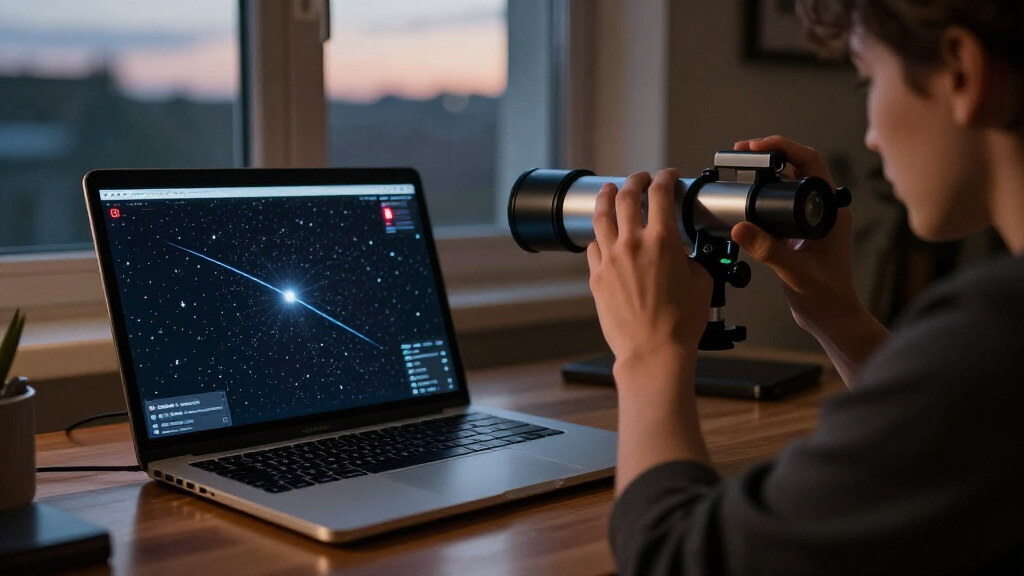

🔍 Read the full analysis: A Guide To The Held-Light Technique In “OORT — Comet Vigil For P/2043 K1 Vesper” on ThorstenMeyerAI.com

Get hardware and tech essentials delivered free with Prime
- Fast, free delivery on millions of items
- Prime Video, Amazon Music and more included
- Member-only deals all year
TL;DR
OORT — Comet Vigil for P/2043 K1 Vesper is an AI-built web artwork centered on a fictional comet and observatory. Its held-light technique gradually extends seeded star trails during a visit, while local storage preserves elapsed time on the same device. The comet, its history and its observations are fictional; the site presents waiting itself as the artwork.
OORT — Comet Vigil for P/2043 K1 Vesper, an AI-built web exhibition, uses time spent on a page as part of its artwork: a seeded field of stars gradually draws longer trails, and the same local sky can resume when a visitor returns on that device. The exhibition depicts an observatory watching a fictional comet. Its central device, described as held light, makes elapsed time visible within the artwork.
The artwork’s canvas places stars around a point below the visible frame and extends their curved paths as time passes. The guide says the trails follow a logarithmic growth curve, making changes apparent early while leaving room for a longer visit. A repeatable seed keeps the sky consistent on a device, and local storage preserves elapsed time there. The source does not describe this as a shared record across visitors or devices.
A second instrument connects scrolling to an inline SVG depiction of the comet’s imagined motion. The ion tail points away from the sun, while the dust tail curves along the fictional orbit. Both respond to the same progress value, which also coordinates displayed geometry, distance and year. A range control changes a defocused view and its related brightness estimate.
Visitors can briefly hold a control to open a simulated shutter. The site records a timestamp, but does not present the gesture as a sighting: the comet remains unseen and in transit within the fiction. The accompanying design brief also calls for a reduced-motion still version and for the animation loop to stop when the browser tab is hidden.
How OORT Makes Waiting Visible
The exhibition uses elapsed time as an input: a visitor’s time on the page changes its visual record, and returning on the same device can continue that exposure. The interaction gives duration a visible effect without suggesting that a visitor has detected a comet.
The piece uses visual elements associated with observation, including coordinates, readings, orbital paths and a shutter, while identifying its subject as fictional. The timestamp records an interaction with the artwork, not an astronomical measurement. The source describes participation as attention to the work rather than as a discovery.
The project also combines several time-based displays. Canvas trails, scrolling, SVG geometry and a brightness control are described as linked parts of one interface. The source presents the site as both an exhibition and a demonstration of code used to represent patient observation.
As an affiliate, we earn on qualifying purchases.
A Fictional Observatory in Room 170
The source identifies OORT as room 170 of 175 in an exhibition series of AI-built web pieces. Its imagined setting is a community keeping a decades-long vigil for P/2043 K1 Vesper, described as a fictional comet. References in the design brief to a long wait, frost on an eyepiece and a last sighting in 1608 belong to the invented world, not to verified astronomical history.
The room’s visual system supports that setting. It uses a near-black field, cyan for the ion tail and readings, and warm red-orange for instructions and actions. Dust-toned text carries longer passages; display lettering gives headings and measurements an instrument-like quality, while monospaced text is used for coordinates and field notes. The stated aim is a dark-adapted observatory atmosphere, not a conventional marketing-page layout.
The supplied brief says the piece was produced through a three-pass workflow: initial construction, a critique focused on legibility and behavior, and a final art-direction review. It calls for pure HTML, CSS and JavaScript, code-generated visuals, responsive layouts, keyboard focus styles and reduced-motion support. The source says the room’s footer links to the original brief and that fuller build notes are available in a design guide.
“The page makes duration part of the artwork instead of treating it as time spent before the content.”
— ThorstenMeyerAI.com source description
interactive astronomy simulation software
As an affiliate, we earn on qualifying purchases.
As an affiliate, we earn on qualifying purchases.
Limits of the Observation Record
The source describes the design and intended behavior of the live room, but does not provide independent testing results, usage figures or a technical audit. It does not establish how the experience performs across every browser or device. Although the brief specifies accessibility and performance goals, the supplied material does not report measured compliance or frame rates.
The comet, observatory, amateur logs and historical provenance are part of the fictional setting. The source provides no evidence that P/2043 K1 Vesper is a real astronomical object. It also does not explain how long the timestamp is retained, whether visitors can clear it, or whether any information is transmitted beyond local storage. Those details should not be inferred from the description of a locally persistent sky.
As an affiliate, we earn on qualifying purchases.
Explore the Room and Its Guide
The source directs readers to the live OORT room and its design guide, which describes the seeded exposure, SVG orbit and visual system. Visitors can test the experience by spending time on the page, leaving and returning on the same device, and trying the simulated shutter. The source also points to the wider collection of 175 rooms. It does not announce a release date, future feature or additional development milestone.
As an affiliate, we earn on qualifying purchases.
Key Questions
Is P/2043 K1 Vesper a real comet?
No. The source describes the comet and its observatory as fictional. The orbital graphics and observation details are elements of the artwork, not verified astronomical data.
What does “held light” mean in OORT?
It refers to star trails that lengthen as time passes on the page. The guide says a repeatable seed and local storage let the sky resume on the same device.
Does using the shutter confirm a comet sighting?
No. Holding the control opens a simulated shutter and records a timestamp as part of the artwork. The source says the comet remains unseen and in transit.
What makes the two tails move differently?
The illustrated ion tail points away from the sun, while the dust tail bends along the imagined orbit. Both respond to the page’s progress value.
Does the source confirm that the site meets its accessibility goals?
No testing results are provided. The design brief calls for reduced-motion support, keyboard focus styles and responsive layouts, but the source does not document an independent audit or measured compliance.
Source: ThorstenMeyerAI.com
Fall Picks
fall essentials
As an affiliate, we earn on qualifying purchases.