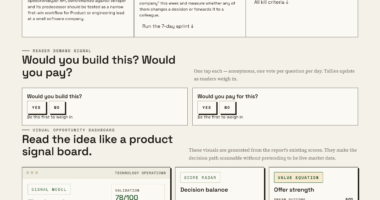

📊 Full opportunity report: The Pros And Cons Of Mistral Forge AI Solutions on ThorstenMeyerAI.com — validation score, market gap, and execution plan.

Get hardware and tech essentials delivered free with Prime
- Fast, free delivery on millions of items
- Prime Video, Amazon Music and more included
- Member-only deals all year
TL;DR
Mistral Forge offers a powerful, sovereign AI platform suited for high-stakes, specialized applications. However, it is not ideal for most organizations due to its complexity and specific requirements. This analysis explores its strengths, limitations, and who should consider using it.
Mistral Forge is a full-lifecycle, sovereign AI platform designed for high-consequence applications, but its suitability depends on specific organizational needs. While it is a capable and flexible tool, most organizations should not adopt Forge unless they meet strict criteria, due to its complexity and cost.
Developed by Mistral, Forge provides a comprehensive platform for building, training, and managing AI models with a focus on sovereignty and control. It is particularly aimed at government agencies, regulated financial institutions, and industrial firms with high data sensitivity and strict compliance needs.
According to industry experts, Forge excels when organizations have highly specialized, well-structured data, and the technical maturity to operate advanced AI infrastructure. It is not recommended for companies seeking quick, simple solutions like prompt engineering or document retrieval, which can be handled more efficiently with cheaper tools.
Key conditions for Forge’s suitability include data sovereignty requirements, proprietary knowledge that must influence model reasoning, and in-house AI operational capacity. If any of these are missing, organizations risk investing in an unnecessarily complex and costly solution.
Should you use Mistral Forge? A buyer’s decision guide
Forge isn’t overrated — it’s over-reached-for. A scalpel for a specific, high-value incision, wrong for most jobs. Here’s the honest filter: who it fits, what to use instead, and the red flags that mean “not this, not now.”
- Gov / defense — language, law, process; air-gapped
- Regulated finance — compliance internalized
- Industrial / mfg — specialist constraints & data
- Telecom · deep-code tech — proprietary specs / codebase
- …but only the data-mature, high-consequence, sovereign ones
- You want an assistant / doc-search / support bot → RAG
- Knowledge changes often or must be cited/deleted → RAG
- Low data maturity — fix the data first
- You need cheap, fast, easily updatable
- Small org · no ML capacity · no sovereignty need
- Can’t answer IP / portability / lock-in questions
- No PoC beating a RAG + fine-tune baseline
Forge is a precise instrument for deep domain reasoning + sovereignty + lifecycle control, for orgs mature enough to wield it. For the vast majority the honest answer is not Forge, not yet, maybe never — and that’s fit, not failure. Even the sovereignty-driven buyer has a lighter, reversible choice in self-hosted open weights. The discipline isn’t picking the most powerful tool — it’s matching the tool to the job, the data, and the maturity you actually have, and demanding proof before you commit. Sequence for almost everyone: 1 prompt + RAG → 2 targeted fine-tune → 3 Forge only if a measured gap remains. Climb, don’t leap.
Why Forge’s Niche Focus Shapes Its Market Role
The primary importance of Forge lies in its ability to meet strict sovereignty, compliance, and customization needs that off-the-shelf solutions cannot address. For entities like government agencies or critical infrastructure providers, Forge offers a controlled environment for deploying AI with high security and legal adherence. However, for most enterprises, simpler, more flexible options tend to be more practical and cost-effective.
enterprise AI model training platform
As an affiliate, we earn on qualifying purchases.
As an affiliate, we earn on qualifying purchases.
High-Impact Use Cases and Deployment Conditions
Mistral Forge is positioned within a niche of high-stakes environments where data sensitivity, legal constraints, and operational control are paramount. Its adopters include governments, defense agencies, and regulated sectors such as finance and aerospace, often operating air-gapped or on-premises environments.
Industry analysts note that the platform’s complexity and operational demands mean that many organizations lack the data maturity or technical capacity to fully leverage its capabilities. This limits its broader market penetration, confining it to specialized use cases where its benefits outweigh the costs.
“Forge is a scalpel, not a hammer. It’s ideal when precision, control, and sovereignty are non-negotiable.”
— Industry expert
on-premise AI infrastructure solutions
As an affiliate, we earn on qualifying purchases.
As an affiliate, we earn on qualifying purchases.
Unclear Adoption Rates and Long-term Cost Effectiveness
It is still unclear how widely Forge is being adopted across different sectors and whether its high costs and operational complexity will be justified long-term. Industry feedback suggests that many organizations are hesitant due to the steep learning curve and resource requirements, but comprehensive data on adoption and ROI are not yet available.
As an affiliate, we earn on qualifying purchases.
Future Developments and Market Positioning
Moving forward, Mistral is expected to refine Forge’s deployment options, potentially offering more streamlined versions for less demanding use cases. Additionally, organizations will likely evaluate open-weight, self-hosted alternatives that could provide similar sovereignty benefits at lower costs. The platform’s evolution will depend on how well it can balance sophistication with accessibility.
high-security AI deployment hardware
As an affiliate, we earn on qualifying purchases.
As an affiliate, we earn on qualifying purchases.
Key Questions
Who should consider using Mistral Forge?
Organizations with strict data sovereignty needs, proprietary knowledge that influences model reasoning, and the technical capacity to manage complex AI infrastructure, such as government agencies, regulated financial firms, or industrial companies.
What are the main limitations of Forge?
It is complex and costly to operate, requires high data maturity, and is not suitable for simple AI tasks like document retrieval or prompt engineering. It also demands significant in-house expertise and long-term operational commitment.
Are there cheaper alternatives to Forge?
Yes. Open-weight models run on self-hosted infrastructure, combined with retrieval-augmented generation (RAG) and light fine-tuning, can often meet sovereignty needs at a lower cost and with more flexibility.
Will Forge become more accessible in the future?
Potentially, as Mistral may develop more streamlined or modular versions. However, its core focus on high-consequence, high-control environments suggests it will remain specialized and not broadly targeted at general enterprise use.
Source: ThorstenMeyerAI.com
Evergreen bestsellers Picks
bestsellers
As an affiliate, we earn on qualifying purchases.