
📊 Full opportunity report: Retirement Care Planner on IdeaNavigator AI — validation score, market gap, and execution plan.

Get hardware and tech essentials delivered free — and shop member deals
- Fast, free delivery on millions of items
- Access to Prime Big Deal Days deals on October 6–7
- Prime Video, Amazon Music and more included
TL;DR
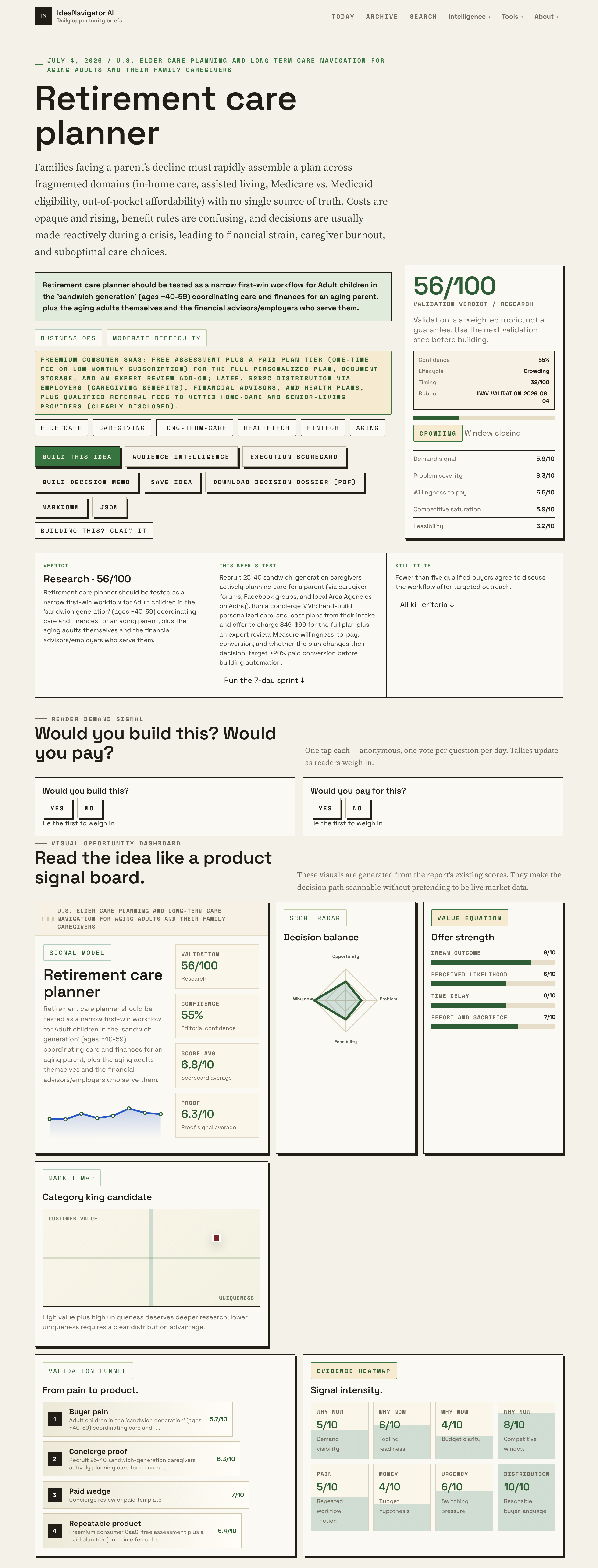
A retirement care planner web app is being tested to assist adult children in the ‘sandwich generation’ with care and financial planning for aging parents. The pilot aims to provide personalized, localized care options and cost estimates. This development responds to increasing demand amid rising elder care costs and complexity, similar to the need for when-to-replace planning for data center equipment.
A new retirement care planning web app is being tested as a targeted solution for adult children in the ‘sandwich generation’ who are coordinating care and finances for aging parents. The pilot aims to streamline decision-making amid rising elder care costs and fragmented information, marking a significant step toward structured guidance in this complex market.
The web app, currently in a prototype phase, will offer personalized care and cost plans after a brief intake process covering the parent’s health, location, and finances. It will generate localized cost comparisons between in-home care, assisted living, and nursing homes, along with explanations of Medicare and Medicaid eligibility. The tool also provides affordability projections and a prioritized action checklist with vetted local provider links.
This initiative is targeted at families in high-cost states initially, to keep data manageable and refine the model. The goal is to deliver a clear, actionable plan that helps families avoid reactive crisis decisions, reduce financial strain, and prevent caregiver burnout. The pilot involves recruiting 25-40 caregivers through forums, Facebook groups, and local agencies, offering a concierge service with plans priced at $49-$99. The focus is on measuring willingness-to-pay, plan impact, and decision changes before automation expands.
Why a Retirement Care Planner Matters Now
This development addresses a pressing need as the U.S. approaches a demographic peak, with approximately 73 million Americans aged 65+ by 2030. The likelihood of needing long-term care is high, and costs have surged — with median assisted living costs reaching $6,200 per month and nursing home expenses around $115,000 annually. Families face complex decisions with opaque costs and confusing benefit rules, often making reactive choices that strain finances and emotional well-being.
By providing structured, personalized guidance, the retirement care planner could improve decision quality, reduce financial surprises, and ease caregiver burden. It also opens new revenue opportunities for service providers and insurers, aligning with a broader shift toward digital, consumer-centric elder care solutions.
As an affiliate, we earn on qualifying purchases.
Background on Elder Care Planning Challenges
Current elder care planning in the U.S. is fragmented, involving multiple providers and benefits programs that are difficult to navigate. Families often rely on reactive decision-making during crises, leading to suboptimal outcomes and financial hardship. Costs have been rising sharply over recent years, and the complexity of eligibility rules for Medicare and Medicaid complicates planning further. The ‘sandwich generation’ — adults aged 40-59 caring for aging parents while managing their own families — faces mounting emotional and financial pressure, increasing demand for accessible, structured planning tools.
Previous efforts to digitize elder care planning have been limited, often focusing on specific services rather than comprehensive, personalized solutions. The new web app aims to fill this gap by offering a unified, user-friendly platform tailored to family caregivers’ needs.
“Families need a clear, personalized roadmap to navigate the complexities of elder care costs and benefits, especially as expenses continue to rise.”
— an anonymous researcher
As an affiliate, we earn on qualifying purchases.
Uncertainties About Deployment and Effectiveness
It is not yet clear how well the prototype will perform in real-world settings or whether families will adopt and pay for the full service at scale. The pilot’s success depends on user engagement, willingness to pay, and the accuracy of cost and eligibility data. Additionally, the impact on decision quality and caregiver stress remains to be empirically validated through ongoing testing.
Medicare Medicaid eligibility guide
As an affiliate, we earn on qualifying purchases.
As an affiliate, we earn on qualifying purchases.
Next Steps for Validation and Expansion
The team plans to complete initial testing with recruited caregivers over the coming months, analyzing willingness-to-pay and decision impacts. If results are favorable, they will refine the platform, expand the pilot to additional states, and explore partnerships with employers, financial advisors, and elder care providers. A broader rollout could follow within the next year, contingent on pilot outcomes and funding.
As an affiliate, we earn on qualifying purchases.
Key Questions
How does the retirement care planner generate personalized plans?
The app uses an intake questionnaire covering health, location, and finances to produce localized cost comparisons, eligibility explanations, and a prioritized action checklist with vetted provider links.
Will families have to pay for the full service?
The pilot offers a free assessment with optional paid plans at $49-$99 for comprehensive personalized plans and expert reviews. Future pricing models are under consideration.
What are the main benefits of using this tool?
It aims to reduce reactive decision-making, clarify costs and benefits, and ease caregiver stress by providing structured, actionable guidance tailored to each family’s situation.
When will the full version be available?
The current phase is testing, with potential broader rollout within the next year if pilot results are positive. No official launch date has been announced yet.
How does this fit into the elder care market?
The platform targets the growing need for comprehensive, user-friendly elder care planning solutions amid rising costs and complex benefit rules, addressing a significant gap in current services.
Source: IdeaNavigator AI
Halloween Picks
halloween
As an affiliate, we earn on qualifying purchases.