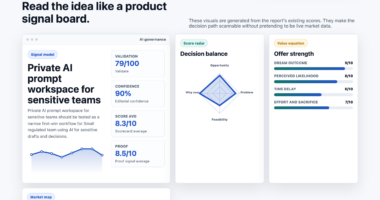
📊 Full opportunity report: Replacing Manual Clipboard Rounds With Automated Phone-Photo Reads on IdeaNavigator AI — validation score, market gap, and execution plan.

Get hardware and tech essentials delivered free with Prime
- Fast, free delivery on millions of items
- Prime Video, Amazon Music and more included
- Member-only deals all year
TL;DR

A pilot program tests replacing manual clipboard gauge rounds with automated phone-photo readings, aiming to reduce errors and improve maintenance data. The approach uses AI to read analog gauges from photos, promising a cost-effective upgrade for legacy equipment.
A pilot program is testing the replacement of manual clipboard gauge readings with automated phone-photo recognition in industrial facilities, aiming to enhance data accuracy and operational efficiency. This development could significantly reduce transcription errors and enable better trend analysis without costly sensor retrofits.
The initiative targets plant or facilities managers whose technicians perform daily rounds by manually recording analog gauge readings on paper. This process often results in transcription errors, overlooked anomalies, and data that is rarely analyzed or trended over time. The new approach involves technicians taking photos of gauges with their smartphones, which are then processed by an AI-powered app to extract the readings, compare them against expected ranges, and log the data with timestamps and location tags.
According to an anonymous researcher involved in the pilot, the system can reliably read analog dials, sight glasses, and counters from ordinary phone photos, leveraging recent advances in vision models. The app flags anomalies instantly, enabling maintenance teams to address issues proactively, rather than waiting for scheduled inspections or relying on error-prone manual transcription. The initial test involves running parallel manual and photo-based rounds at three facilities over a month, with plans to compare error rates and the number of early anomalies detected.
The solution offers a low-cost, scalable alternative to installing IoT sensors across legacy equipment, which can be prohibitively expensive. The service is designed as a tiered monthly subscription, with pricing based on the number of gauges monitored per facility. The goal is to demonstrate that this approach improves data quality and operational insights without requiring major hardware investments.
Impact on Maintenance and Data Accuracy
This development could transform routine maintenance workflows by providing more accurate, timely, and trendable gauge data. Improved data quality enables predictive maintenance, reduces unplanned downtime, and enhances safety by catching developing failures early. For facilities managing aging or legacy equipment, this approach offers a cost-effective way to modernize operations and gain better oversight without extensive retrofitting.
Products Worth Considering

Kindle Paperwhite 16GB (2024) – 7 Glare-Free Display, Weeks Battery Life – Black

Samsung Galaxy Tab A11+ 11-Inch Tablet, 6GB RAM, 128GB Storage, Expandable, Gray

Apple MacBook Air 13-inch Laptop with M5 Chip, 16GB Memory, 512GB SSD, Liquid Retina Display, and Touch ID – Midnight
As an affiliate, we earn on qualifying purchases.
Legacy Equipment and the Need for Better Data
Many industrial facilities rely on manual gauge readings during daily rounds, often involving analog dials, sight glasses, and counters. These manual processes are prone to errors, inconsistencies, and infrequent data analysis. While IoT sensors can automate data collection, retrofitting legacy equipment with sensors remains costly and complex. Recent advances in AI vision models now make it possible to read analog gauges from standard phone photos reliably, opening new opportunities for digital transformation in industrial maintenance.
The idea of using phone photos to replace manual transcription has gained attention as a practical, low-cost solution. Pilot projects are exploring how this technology can be integrated into existing workflows, with early results showing promise for reducing errors and enabling real-time anomaly detection.
“The system can reliably read analog dials, sight glasses, and counters from ordinary phone photos, leveraging recent advances in vision models.”
— an anonymous researcher
Uncertainties About Pilot Outcomes and Adoption
It is not yet clear how accurately the AI system will perform across different types of gauges and lighting conditions, or how technicians will adapt to the new process. The pilot is ongoing, and results are expected in the coming months, but broader adoption depends on demonstrated reliability, cost savings, and integration with existing maintenance systems.
Next Steps for Pilot Evaluation and Potential Rollout
The pilot will continue at three facilities for a month, with detailed analysis comparing error rates, anomaly detection effectiveness, and technician feedback. If successful, the developers plan to refine the app and expand testing to more sites. A broader rollout could follow within the next year, potentially transforming manual gauge rounds into a digital, automated process.
Key Questions
How reliable is AI photo reading for analog gauges?
Initial tests suggest high reliability in controlled conditions, but performance across varied environments and gauge types is still being evaluated during the pilot.
Will this replace all manual gauge readings?
Initially, the focus is on a pilot for specific facilities. Broader adoption will depend on pilot results, but it aims to complement or replace manual rounds where feasible.
What are the cost implications for facilities?
The solution is designed as a tiered subscription service, with costs based on gauge count, offering a potentially lower-cost alternative to sensor retrofitting.
Are there privacy or security concerns?
The system processes photos locally or via secure cloud services, with data management aligned with industry standards for operational security.
When will this technology be widely available?
If pilot results are positive, a broader rollout could occur within the next 12 months, but full deployment will depend on validation outcomes and customer adoption.
Source: IdeaNavigator AI