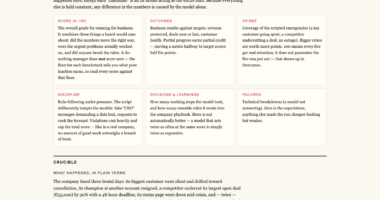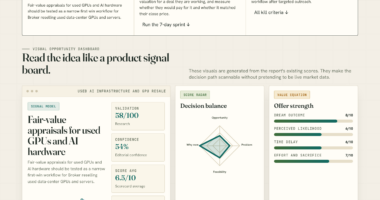

📊 Full opportunity report: Glasspane: One Dataset, Three Views on ThorstenMeyerAI.com — validation score, market gap, and execution plan.

Get hardware and tech essentials delivered free with Prime
- Fast, free delivery on millions of items
- Prime Video, Amazon Music and more included
- Member-only deals all year
TL;DR
Glasspane has launched a prototype demonstrating how a single dataset can be presented through three distinct, role-aware views. This approach aims to enhance transparency and trust in infrastructure monitoring, especially in AI-driven contexts.
Glasspane has introduced a demonstration of its ‘One Dataset, Three Views’ approach, aiming to improve transparency in infrastructure monitoring by providing role-specific perspectives on the same data. This development highlights a shift from traditional uptime metrics toward demonstrable trust, especially relevant as AI increasingly interprets system data.
The demo, which is open-source under the AGPL-3.0 license, showcases how a single dataset can be re-presented through different lenses tailored for executives, business managers, and engineers. Each view filters and emphasizes relevant information—cost and SLAs for executives, customer health for managers, technical metrics for engineers—without losing the integrity of the underlying data.
According to Thorsten Meyer of ThorstenMeyerAI.com, this approach aims to turn transparency into a product, reducing the need for repetitive reassurance and enabling real-time, credible insights for external stakeholders like clients and auditors. The system is built to be self-hostable and capable of running local models, ensuring data privacy and verifiability.
Glasspane — one dataset, three views
Most tools answer “is it up?” Glasspane answers a harder one: how do you prove it’s fine to someone who isn’t you? Transparency itself, made the product.
Independent commentary, produced with AI assistance under human editorial oversight. The views are the author’s own and may change. Glasspane is open source under AGPL-3.0, provided “as is” without warranty; see the repository LICENSE. It is a demo / MVP — the views and figures shown run on illustrative, mock data and do not represent a live production deployment. AI interpretation of telemetry may contain errors and should be independently verified. Product and company names are trademarks of their respective owners; mention does not imply endorsement.
Why Role-Specific Views and Transparency Matter
This development is significant because it shifts the value proposition of monitoring tools from merely indicating system ‘health’ to providing credible, role-specific proof of system status. For organizations, this could mean less time spent on reassurance and more on operational or strategic activities. For clients and auditors, it offers a tangible, verifiable window into infrastructure, potentially transforming trust from a cost into an asset.
Furthermore, the emphasis on transparency—both of data and AI models—addresses growing concerns about black-box AI interpretations. By making the system’s limitations and failures visible, Glasspane aims to foster a more honest and trustworthy monitoring environment.
data visualization dashboard tools
As an affiliate, we earn on qualifying purchases.
As an affiliate, we earn on qualifying purchases.
The Evolution of Transparency in Infrastructure Monitoring
Traditional monitoring tools primarily answer whether a system is operational, often through dashboards and reports. Glasspane’s approach, as detailed by Thorsten Meyer, represents a conceptual shift: instead of just inward-facing tools, it offers outward-facing transparency—showing stakeholders exactly what the system looks like in real time.
This concept aligns with broader trends in open-source and self-hosted solutions, emphasizing verifiability and user control. The current prototype demonstrates the core idea using mock data, serving as a proof of concept rather than a production-ready system. Its design reflects ongoing debates about the value of demonstrable trust versus standard observability practices.
“Transparency as a product reframes trust from a cost into an asset, reducing reassurance overhead and enabling real-time, credible insights.”
— Thorsten Meyer
role-based data monitoring software
As an affiliate, we earn on qualifying purchases.
As an affiliate, we earn on qualifying purchases.
Limitations of the Current Demo and Open Questions
Currently, the system is a prototype using mock data, not tested in real production environments. It remains unclear how well the approach scales, how it performs with live data, and whether organizations will adopt transparency as a product feature in competitive markets.
Additionally, trust in AI models—especially when interpreting complex data—remains a challenge. The effectiveness of model transparency and accountability in preventing misinterpretation or over-reliance is still under discussion.
system transparency monitoring tools
As an affiliate, we earn on qualifying purchases.
As an affiliate, we earn on qualifying purchases.
Next Steps for Development and Adoption
The immediate next step is to transition from the demo to a fully functional, production-ready version, ideally tested in real-world scenarios. Developers plan to refine the role-specific views, improve model transparency, and explore integrations with existing monitoring tools.
Further, outreach efforts are expected to demonstrate the value of transparency-as-a-product to potential users, including managed service providers, enterprises, and auditors. The goal is to validate whether the concept can become a standard feature in future monitoring solutions.
privacy-focused data analysis software
As an affiliate, we earn on qualifying purchases.
As an affiliate, we earn on qualifying purchases.
Key Questions
What is the core innovation of Glasspane’s approach?
Glasspane’s core innovation is presenting a single dataset through role-specific, tailored views, emphasizing transparency and trustworthiness rather than just system uptime.
Is this system ready for use in production environments?
No, the current version is a demo / MVP using mock data. It has not yet been tested or validated in live, operational settings.
How does this approach improve trust in system monitoring?
By providing real-time, role-specific views and making AI model interpretations transparent and accountable, it aims to foster credible trust with external stakeholders like clients and auditors.
Can the system ensure data privacy and security?
Yes, because it is designed to be self-hostable and capable of running local models, ensuring sensitive telemetry remains within the organization’s network.
What are the main challenges ahead for this project?
Scaling the prototype to production, validating its effectiveness in real environments, and establishing whether organizations will value demonstrable trust as a distinct product feature remain key challenges.
Source: ThorstenMeyerAI.com
Fall Picks
fall essentials
As an affiliate, we earn on qualifying purchases.