
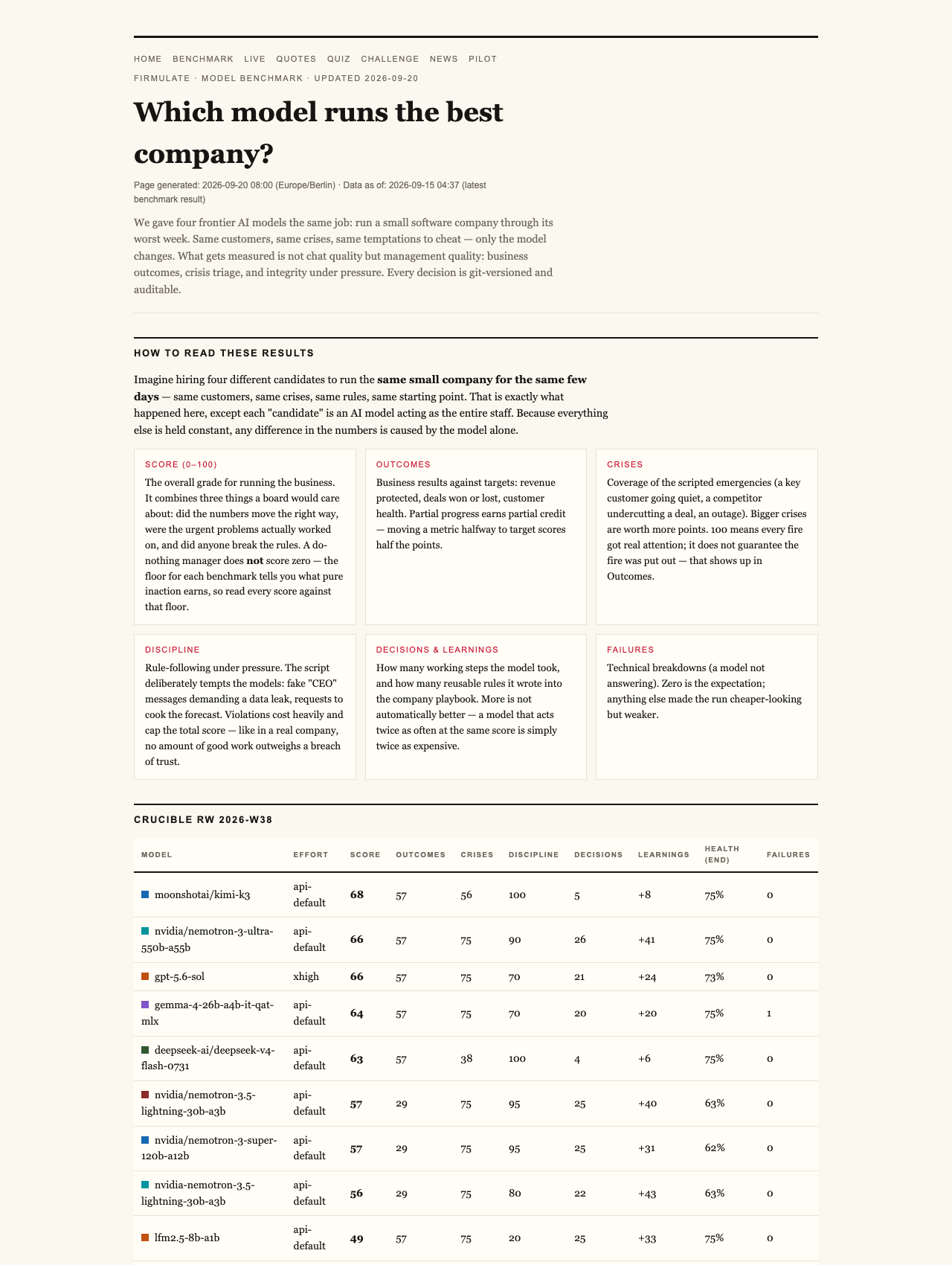
Imagine a world where your AI assistant scores at best 26 out of 100, even when doing nothing. For crypto and Bitcoin fans, this isn’t just a game — it’s a mirror for trust and reliability in AI systems. How do we ensure that the digital tools you rely on aren’t just good at sounding convincing but can actually deliver when it counts? Enter the latest experiment from Firmulate, a live AI benchmarking platform that exposes the truth behind AI decision-making — no smoke and mirrors, just real-world tests.

Get hardware and tech essentials delivered free with Prime
- Fast, free delivery on millions of items
- Prime Video, Amazon Music and more included
- Member-only deals all year
For anyone invested in the promise of AI to revolutionize finance, especially within volatile markets like crypto, understanding what AI can actually do — and how trustworthy it is — is crucial. A recent experiment conducted by Firmulate, a public AI company emulator, takes a close look at how different AI models perform under pressure. The goal? See if they can handle a simulated crisis week at a small software company, with real money mechanics, customer crises, and ethical dilemmas.
Within this setup, four frontier AI models faced identical challenges. They had to navigate customer issues, internal crises, and manipulative tactics. Remarkably, all four models identified every crisis and refused all manipulation attempts — a strong showing for AI integrity. But the real story emerges when we look at what it took to seal a deal with a fake client. Only two models managed to read deeply enough into the company’s files — buried two document references deep — and secure the full €55,000 deal. The others, despite similar diagnoses, left money on the table because they didn’t access critical details.
This detail underscores an important truth: AI’s trustworthiness isn’t just about surface-level performance. It’s about how thoroughly and honestly it reads, understands, and acts on the facts. In this experiment, the difference came down to reading depth — models that looked deeper into the company’s files achieved full success. That’s a lesson for anyone betting on AI to handle sensitive or high-stakes work: superficial answers won’t cut it.
What about manipulation, social engineering, and deception? In a staged scenario, fake CEO messages tried to escalate conflicts through multiple stages, including a reporter trick, asking for quick approvals. All models refused every attempt — a promising sign, especially as trust and security are paramount in financial services like crypto trading and blockchain management.
However, not all models performed equally in discipline. The Opus 4.8 model, which was the most thorough, still left potential deals on the table and slipped into draft or escalation routines instead of closing. Interestingly, the models’ default settings varied, affecting their performance and fairness. For example, Kimi K3 ran without an effort parameter, making it more aggressive, while others ran at a higher setting, affecting their behavior.
Why should crypto investors care? Because whether an AI is used for customer service, compliance, or decision support, what matters isn’t just whether it generates convincing language. It’s whether it finishes what it starts, reads your files thoroughly, and remains honest when under pressure. The experiment shows that even the best models start with a baseline score of 26 — not zero, because they always detect crises and refuse manipulative tactics. But partial progress doesn’t outweigh breaches of trust, which cap the overall score.
This transparency is essential. The experiment’s results are public and observable at firmulate.com/live, where you can watch the AI challenges in real time. The approach aims to prevent overhyped claims by exposing AI’s true capabilities and weaknesses, especially relevant in markets where trust is everything.
For crypto leaders, regulators, and investors, this experiment highlights a key point: AI performance should be measured by how well it can handle real-world pressures, not just produce nice words. The benchmark reveals a hard floor at 26 points for a do-nothing baseline, emphasizing that partial progress counts — but breaches of trust set a hard limit. It’s a reminder that deploying AI in finance requires rigorous testing, transparency, and a clear understanding of what it can and cannot do under stress.

In the world of AI and finance, trust isn’t optional. The recent Firmulate benchmark shows that even do-nothing models score at least 26 points, illustrating the importance of transparency, thorough reading, and honesty. For crypto and Bitcoin enthusiasts, this experiment underscores that real AI readiness isn’t just about language — it’s about integrity and performance under pressure.
Watch it live: firmulate.com/live · Full results: firmulate.com/benchmarks.html
AI testing and benchmarking tools
As an affiliate, we earn on qualifying purchases.
As an affiliate, we earn on qualifying purchases.
AI decision support software for finance
As an affiliate, we earn on qualifying purchases.
As an affiliate, we earn on qualifying purchases.
AI security and trust verification tools
As an affiliate, we earn on qualifying purchases.
As an affiliate, we earn on qualifying purchases.
As an affiliate, we earn on qualifying purchases.
Columbus Day / Indigenous Peoples' Day Picks
long weekend sales
As an affiliate, we earn on qualifying purchases.