🔍 Read the full analysis: 14 AI Workflow Automation Software Choices For Different Needs on ThorstenMeyerAI.com

Get hardware and tech essentials delivered free with Prime
- Fast, free delivery on millions of items
- Prime Video, Amazon Music and more included
- Member-only deals all year
TL;DR
ThorstenMeyerAI.com presents 14 AI workflow automation resources for different users, from nontechnical business owners to developers and enterprise teams. The list describes audience and approach, but the supplied material does not name all 14 options or provide comparative test results.
ThorstenMeyerAI.com has published a guide to 14 AI workflow automation options, grouping resources by audience and technical demands, from no-code business users to developers and enterprise teams. The material frames the central choice as speed and simplicity versus flexibility and scale, but the source provided for this article does not identify every item in the 14-option list.
The guide recommends The No-Code AI Automation Playbook as its best overall choice for business users seeking to automate tasks without writing code. It says the resource connects concepts and tools associated with Zapier, Make and n8n. For developers seeking more control over custom agents, the guide points to n8n AI Automation and its Python integration. For more guidance on AI automation software for workflow building, readers can explore additional guides.
Other named resources include Agentic Coding with Claude Code and Agentic AI for DevOps, which the source associates with a move beyond simple task automation toward agents that can make decisions. For small businesses, it names AI-Powered Automation for Small Business and recommends starting with tasks that are valuable but not overly complex. For organizations already using Microsoft products, it presents Microsoft Power Automate as a natural fit.
The source says its selection criteria included practical instructions that lead to working workflows and accessibility for different levels of technical experience. It does not provide a complete list of 14 names in the supplied material, nor does it describe a controlled performance test. Its recommendations should be read as the publisher’s editorial guidance, not independently verified rankings. A software selection checklist can help readers assess options against their own needs.
The 14 picks
- 1
 Agentic AI for DevOps Engineers: Building Autonomous CI/CD, Infrastructure, a…View on Amazon →
- 2
 Workflow Automation with Microsoft Power AutomateView on Amazon →
- 3
 Claude AI for Smart Automation: No-Code Strategies to Build Intelligent Workf…View on Amazon →
- 4
 The No-BS Guide to AI Agents & Automation: Build AI Workflows, Automate Your…View on Amazon →
- 5
 AI Agents: From Theory to Operations — A Practical Guide to Business Automati…View on Amazon →
- 6
 50 AI Workflows for Engineers: From Debugging to System Design, Code Review &…View on Amazon →
- 7
 AI-Powered Automation and Workflows for Small Business OwnersView on Amazon →
- 8
 Practical Autonomous Workflow Automation: Build AI Agents and Automate Real-W…View on Amazon →
- 9
 Hands-On AI Workflow Automation: A Beginner-Friendly Roadmap to Eliminating R…View on Amazon →
- 10
 The No-Code AI Automation Playbook: Build Practical AI Workflows with Zapier,…View on Amazon →
- 11
 AI for Everyday Automation: 7 AI Workflows to Save Hours at Work Every WeekView on Amazon →
- 12
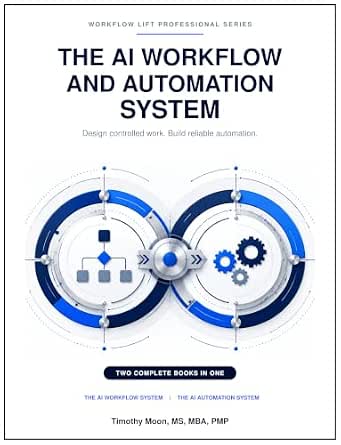 AI Workflow and Automation System – Workflow Lift Professional SeriesView on Amazon →
- 13
 n8n AI Automation: Build Smarter Workflows, Agents, and Intelligent Systems w…View on Amazon →
- 14
 Agentic Coding with Claude Code (5-in-1): A Practical Developer’s Handbook fo…View on Amazon →
Choosing Between Speed and Control
Workflow automation can affect how teams handle routine work, move information between services and respond to operational bottlenecks. The guide’s most useful distinction is not that one platform suits everyone, but that technical capacity changes which options are practical. A business without developers may value a visual builder, while an engineering team may need code-level control over branching, integrations and agent behavior.
The tradeoffs extend beyond ease of use. The source advises readers to check integration coverage, API limits, pricing at higher volumes, data handling and error maintenance before committing. Those factors can determine whether a workflow remains useful as usage grows or breaks when a connected service changes. The guide offers selection considerations, but does not provide product-by-product evidence on security, costs or reliability.
Products Worth Considering

Samsung 34-Inch Odyssey G5 Ultra-Wide Curved Gaming Monitor

Logitech MX Master 4 for Mac Wireless Ergonomic Mouse, Space Black

Anker SOLIX C300 Portable Power Station, 288Wh
As an affiliate, we earn on qualifying purchases.
How the Guide Sorts Its Picks
The source divides the market into no-code resources for business users, developer-focused material and enterprise-oriented guidance. It says tools such as Zapier and n8n serve different levels of user and operational complexity, while Microsoft Power Automate may suit organizations with an established Microsoft environment. These are the publisher’s characterizations; the supplied text does not include independent adoption or market-share data.
It also warns that workflows require ongoing attention. Connectors can change, business rules can evolve and errors need handling, so automation is not necessarily a one-time setup. The guide urges teams to assess the coding skills they actually have, verify required APIs and estimate costs at higher volumes, rather than choosing on a tool’s advertised simplicity alone.
“The main tradeoff in this category is simplicity versus scalability.”
— ThorstenMeyerAI.com guide
Missing Names and Comparative Evidence
The supplied source material does not show the full list of 14 options, so this article cannot name or assess every pick promised by the guide’s headline. It also does not give publication dates for the named resources, current product prices, detailed security certifications or the evidence behind individual rankings. The recommendation of a “best overall” choice is attributed to the guide, not presented as an independently established result.
It is also unclear how the listed books or guides relate to the software products they discuss, including whether each item is itself software, instructional material or both. Readers should check the original listing and current vendor documentation before relying on any specific feature, integration or compliance claim.
Verify Fit Before Adopting
Teams considering the recommendations should first map a specific workflow, identify the applications and APIs it touches, and decide who will build and maintain it. They can then compare the relevant options against technical skills, projected volume, integration needs and data requirements. The source does not announce a follow-up release or product milestone, so no next update is confirmed.
Before moving sensitive information through an automation service, organizations should review its data-processing terms and security controls. A small test workflow can reveal integration gaps and maintenance demands before a wider rollout, but the guide supplies no test results that establish how any one option performs for a particular organization.
Key Questions
What is the guide’s recommended option for business users who do not code?
The guide names The No-Code AI Automation Playbook as its best overall choice for business users seeking no-code efficiency. That is the publisher’s recommendation, not an independent product ranking.
Which option does the guide suggest for developers?
It points developers toward n8n AI Automation for custom-agent control and Python integration. The source does not provide comparative test results for this recommendation.
Does the supplied material identify all 14 options?
No. It names several resources and products, but the complete 14-item list is absent from the source material provided here.
What should teams check before choosing an automation platform?
The guide advises reviewing team coding skills, required integrations, scaling costs, data protection and maintenance needs. It does not supply current product-level pricing or compliance findings.
Source: ThorstenMeyerAI.com