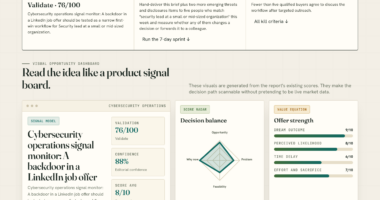
📊 Full opportunity report: Access Control That Fits The Needs Of AI Agents on IdeaNavigator AI — validation score, market gap, and execution plan.

Get hardware and tech essentials delivered free with Prime
- Fast, free delivery on millions of items
- Prime Video, Amazon Music and more included
- Member-only deals all year
TL;DR

IdeaNavigator AI has proposed an access-control product for companies deploying AI agents against internal systems. The concept would issue short-lived, task-scoped credentials, record actions and allow revocation; it is a product proposal, not a reported launch or validated deployment.
IdeaNavigator AI has outlined a proposed access-control platform for AI agents, centered on short-lived credentials tied to specific tasks and a record of each agent action. The concept targets security and platform engineering teams deploying agents inside companies, but no product launch, customer deployment or test results are reported; teams may also want to review how to set limits on AI agent access.
The proposed product would act as an identity broker, issuing agents credentials limited by task and duration rather than relying on broad, long-lived access—a key concern when limiting AI agents’ access. It would associate each action with both the agent making the request and the human who initiated it, apply policies to individual tools and provide a mechanism for revoking access.
A full action ledger is also part of the proposed minimum viable product. The concept is intended to give security teams a record of what an agent did and a way to stop its access, while narrowing the privileges available for a particular workflow through AI automation tools. The proposal does not specify technical integrations, supported agent frameworks or how the identity link would be verified.
IdeaNavigator AI suggests charging monthly for each agent identity, with additional enterprise policy and compliance tiers. Its proposed validation plan is to interview 20 security leads who are blocking agent deployments, then pilot the broker on one high-value workflow with each design partner. Those are planned research and pilot steps, not evidence that the interviews or pilots have taken place.
Access control for AI agents
IdeaNavigator AI proposes task-scoped credentials and action records for agents using internal systems. The concept has no reported launch, customer deployment, or test results.
How the proposed broker works
The concept aims to limit agent privileges to a specific task and duration.
Give an agent short-lived access scoped to its task.
Set access rules for individual tools.
Link actions to the agent and initiating human, keep an action ledger, and offer revocation.
Potential value for teams
These are intended benefits; the proposal reports no measured outcomes.
- Narrow permissions for a workflow.
- Review actions linked to an agent and requester.
- Explore a separate product with suggested per-agent pricing and enterprise tiers.
- Understand what an agent did.
- Have a proposed way to stop its access.
- Assess the controls before considering broader use.
Validation still ahead
The suggested research and pilots have not been reported as completed.
Open product questions
The concept leaves key implementation and readiness details unspecified.
Which systems?
Supported IAM platforms, agent frameworks, and tool integrations are not specified.
How is identity verified?
The method for linking actions to an agent and initiating human is unclear.
How do controls behave?
Policy setup, changing tasks, and revocation during active actions remain unanswered.
Does it work in practice?
No pilot findings, security evaluations, performance data, or measured outcomes are reported.
How Task-Scoped Access Could Help
The proposal addresses a practical governance problem: companies may want agents to perform actions in internal systems without granting them broad access associated with a human account or shared service credential. A credential restricted to one task could, in principle, limit the consequences of an error or misuse. A record linking actions to both an agent and a requesting person could also make investigations and accountability more tractable.
Those benefits remain intended outcomes, not demonstrated results. The proposal offers no measurements of reduced exposure, faster incident response or successful deployment approvals. For security leaders, the central question is whether a broker can enforce narrowly scoped permissions across the systems and tools agents actually use, without adding operational friction that makes teams bypass it.
The business model also depends on adoption. Per-agent pricing and higher enterprise tiers are suggested, but no pricing, customer commitments or market-size figures are provided. Validation with security teams and live workflow pilots would help establish whether the problem is urgent enough for buyers to fund a separate product.
Products Worth Considering

Apple MacBook Air 15-inch Laptop with M5 Chip, 24GB Memory, 1TB SSD, Midnight

DJI Mini 4K Drone with 4K UHD Camera, Under 249 g

Apple AirPods Pro 3 Wireless Earbuds with Active Noise Cancellation
As an affiliate, we earn on qualifying purchases.
The Credential Gap in Agent Deployments
IdeaNavigator AI frames existing corporate identity and access management as designed mainly around human users, logins and sessions. In its account, agents can operate continuously, use service accounts or inherit permissions that exceed what an individual task requires. It argues that this can leave teams without a clear way to tie each action to a specific agent or revoke that agent’s access promptly.
The proposal says that, in current deployments, teams may borrow a human OAuth token or use a broadly privileged API key. It characterizes agent-native identity controls as an unmet need, but provides no survey, deployment data or independent evidence quantifying how common those practices are. Its assertion that agents moved from demonstrations into production workflows in 2026 is framing for the opportunity, not a reported industry-wide measurement.
Rather than proposing a broad replacement for corporate IAM, the concept is framed as a narrow first workflow: test an identity broker on one valuable internal use case with each design partner. That approach would let teams examine permissions, action records and revocation in a bounded deployment before considering wider use.
Product Readiness and Pilot Results
No product name, release date, technical specification or customer is identified. It is unclear how the proposed broker would integrate with existing IAM platforms, handle agents that call multiple tools, or establish that an action came from the attributed agent and human requester.
The proposal also does not explain how policies would be configured, what happens when a task changes, or how revocation would affect actions already in progress. There are no reported pilot findings, interviews, security evaluations or performance data. Whether short-lived, task-scoped credentials can be applied consistently across real enterprise workflows remains untested in the information provided.
Interviews and Workflow Pilots
The next steps described are interviews with 20 security leads who are blocking agent deployments, followed by pilots on one high-value workflow per design partner. Those tests could clarify which permissions and integrations are required and whether the proposed controls help teams approve deployments.
No schedule, participating organizations or success criteria are given. A meaningful assessment would need to show how the broker limits access, records agent actions and handles revocation in practice, as well as whether it fits existing security operations. Until those details and results are available, the platform remains a product opportunity under consideration rather than a validated solution.
Source: IdeaNavigator AI
Key Questions
Has the AI-agent access-control platform launched?
No launch is reported. The material describes a proposed product and a plan for customer interviews and pilots, without naming a release date or deployed product.
How would the proposed identity broker work?
It would issue short-lived, task-scoped credentials, apply policies to tools, link actions to an agent and the human who initiated them, keep an action ledger and offer revocation. Implementation details have not been provided.
What is the proposed validation plan?
IdeaNavigator AI proposes interviewing 20 security leads who are blocking agent deployments, then piloting the broker on one high-value workflow with each design partner. No completed interviews or pilot results are reported.
What remains unknown about the product?
There is no information on integrations, technical design, customers, launch timing, pricing or measured security outcomes. It is also unclear whether the controls can work across the systems used in real enterprise agent workflows.
Source: IdeaNavigator AI