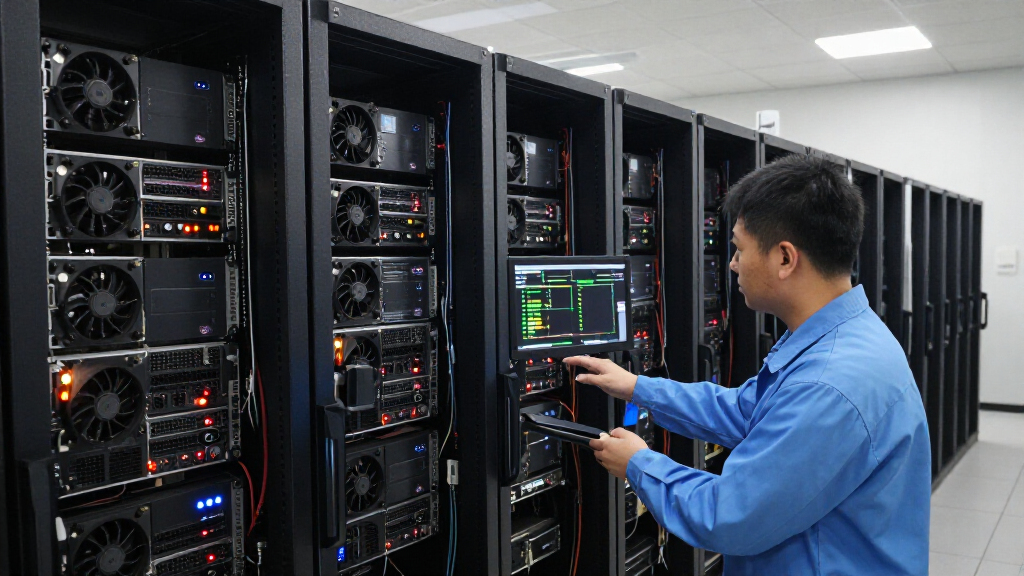

🔍 Read the full analysis: A 2027 AI Scenario: Rapid Progress Meets A Compute Bottleneck on ThorstenMeyerAI.com

Get hardware and tech essentials delivered free with Prime
- Fast, free delivery on millions of items
- Prime Video, Amazon Music and more included
- Member-only deals all year
TL;DR
Thorsten Meyer’s November 18 scenario argues that AI could accelerate AI development sharply in 2027, then run into limits in chips, data centers and power. The cited evidence shows improving software-task performance and growing infrastructure investment, but it does not establish that a sixfold acceleration or artificial superintelligence will arrive in 2027. Key measurements have limits, and the adoption data does not show an economy-wide rollout.
Thorsten Meyer published a 2027 AI scenario on November 18, arguing that AI systems could accelerate the development of future systems before hitting limits in computing capacity. The piece is explicitly a scenario, not a factual forecast: its evidence supports some faster progress, but does not establish that a year’s progress will arrive in two months or that artificial superintelligence will appear in 2027.
Meyer’s proposed chain has four steps: AI systems take on more work in developing other AI; that feedback loop compresses the time needed for progress; the process encounters physical constraints such as chips, data-center buildings and electricity; and later gains depend on expanding infrastructure and automating physical work. Meyer calls that later phase “embodied self-improvement.” The article treats the timing and outcome as hypotheses to test.
The strongest quantitative evidence cited is METR’s measure of the duration of software tasks AI agents can complete reliably. Its 80% time horizon rose from 0.89 minutes for GPT-4 in March 2023 to 185.9 minutes for an early Claude Mythos Preview in April 2026. That is a record of observed benchmark results, not a projection of future performance. METR marked its public page as no longer actively updated on September 8, 2026.
Meyer says the forecast changes substantially depending on which historical measurements are used. In the article’s own fits to METR data, an exponential trend fitted since 2024 doubles every 3.4 months and reaches a 16-hour task horizon in January 2027; a fit beginning in 2019 doubles every 6.4 months and reaches it in June 2028. The article also reports that its hyperbolic fit performed worst in backtests, reaching infinity by January 2, 2026, when fitted to models available before July 2025. These are the author’s model fits, not dates or outcomes reported by METR.
Why Compute Could Set the Pace
The scenario matters because it links two different kinds of constraint. If AI systems materially improve the tools and research used to build later systems, development could speed up; if computing capacity cannot expand at the same rate, physical infrastructure could limit how much of that capability can be trained or deployed. The article identifies electricity and data-center capacity as possible bottlenecks rather than assuming that software progress automatically translates into widespread use.
The infrastructure figures cited point to substantial construction activity, but do not by themselves prove that enough power or compute will be available when needed. US data-center construction spending ran at an annual rate of $96.5 billion in September 2026, compared with $50.7 billion a year earlier, according to the source material. The article also cites Epoch AI’s assessment that power may be the first constraint on scaling and that new power supply takes three to five years after a decision. That lead time could matter if demand grows faster than facilities and grid capacity.
Deployment is another separate question. The source says 18% of US firms used AI in a business function in late 2025 and early 2026, while 2% reported AI-related job cuts. Those figures do not establish how quickly adoption will change in 2027. They underline that progress on a technical benchmark, business use and changes in employment are different measures.
Products Worth Considering

Anker SOLIX C300 Portable Power Station, 288Wh

Samsung Galaxy Tab A11+ Kids Edition, 128GB, Royal Blue

Logitech MX Mechanical Wireless Illuminated Keyboard, Tactile Quiet, Graphite
As an affiliate, we earn on qualifying purchases.
What METR’s Benchmark Measures
METR defines its time horizon as the task duration, measured by human expert completion time, at which an AI agent is predicted to succeed at a specified reliability. The 80% result means the agent is expected to succeed on tasks of that duration four times out of five. The source describes METR as a nonprofit that evaluates frontier AI agents and says its task set primarily covers software engineering, machine learning and cybersecurity.
The measure has important limits. METR says its tasks are cleaner and more defined than economically valuable work in real settings. It also cautions that a two-hour benchmark task is more like work a new hire or freelance contractor could complete in two hours than work by an experienced colleague. The source reports that measurements above 16 hours are unreliable with the current task suite; of 31 tasks estimated to take humans at least eight hours, human completion times were measured for only five.
Meyer’s article also discusses AI helping to improve AI development. It reports that METR estimates Anthropic is improving models on well-specified tasks at roughly twice its earlier rate, while saying it “would not be surprised” by a rate between 1.3 and 3 times the earlier pace. A sixfold acceleration would be needed for one year of progress to arrive in two months under the scenario’s framing. The source says OpenAI’s GPT-6.2 Astra is its first externally released model to meet the company’s “High” threshold for AI self-improvement. These are attributed claims about development and model evaluation, not confirmation of a sixfold feedback loop.
“We reach ASI either in 2027 or shortly after. The effect: in two months we see the progress of a whole year, and then further progress until we hit a ceiling in available compute.”
— Thorsten Meyer
Where the 2027 Case Can Break
The central uncertainty is whether recent benchmark gains continue at the pace needed for the scenario. The forecast changes from January 2027 to June 2028 when Meyer changes the start date of his exponential fit, and the article itself says the most dramatic hyperbolic curve performed poorly in backtests. METR’s public series is no longer actively updated, according to the date given in the source, leaving the cited benchmark without newer observations there.
The benchmark also covers a narrow class of tasks and has stated reliability limits at longer durations. It cannot alone establish that AI systems can take over a broad share of AI research, that the pace of improvement will compound, or that measured capability will translate into business adoption. The article’s self-improvement and infrastructure claims are not equivalent to independent confirmation of the complete scenario.
It is also unclear when compute, power or construction would become a binding limit, how quickly new capacity could come online, and whether automated labs or robotics would improve physical production on the proposed timeline. The source does not establish that 2027 will bring ASI; it notes that the term itself has no agreed definition. Meyer discloses that the article was researched and drafted with AI assistance, including Anthropic’s Claude, and says Anthropic, OpenAI and METR did not review or sponsor it.
Signals to Watch Through 2027
Meyer frames the next year as a test of the scenario, with evidence needed at each link: new, comparable measures of AI task performance; clearer evidence that AI systems are speeding up model development; and observable constraints in chips, data centers or electricity. Tracking whether those measurements continue to improve—and whether they remain comparable to METR’s existing task suite—will help distinguish a persistent trend from a curve fitted to a limited set of results.
Readers can also watch for data on infrastructure completion and power availability, rather than construction spending alone, alongside evidence of AI adoption in workplaces. The source gives no specific schedule for new benchmark releases, facility openings or grid connections. Until those developments are reported, the 2027 timeline remains a scenario to test, not a confirmed outcome.
Key Questions
Is the article predicting that artificial superintelligence will arrive in 2027?
No. Meyer describes a scenario and personal bet, not a forecast presented as fact. The source also says ASI has no agreed definition.
What does METR’s 80% time horizon mean?
It estimates the duration of a task, based on human expert completion time, at which an AI agent is predicted to succeed four times out of five. The cited tasks mainly concern software engineering, machine learning and cybersecurity.
Does the benchmark prove AI progress will accelerate sixfold?
No. The 0.89-minute and 185.9-minute figures are measured results at different dates. The sixfold figure is the acceleration implied by Meyer’s “one year in two months” scenario; the cited measurements do not prove that rate.
What could limit AI development even if software improves quickly?
The scenario identifies chips, data-center capacity and electricity as potential constraints. The timing and severity of any bottleneck are not established by the figures cited.
What evidence would help test the scenario?
Comparable updated capability measurements, evidence of AI accelerating AI research, and reporting on compute and power capacity would help test its main claims. Workplace adoption data would be needed to assess whether technical progress is spreading into the broader economy.
Source: ThorstenMeyerAI.com