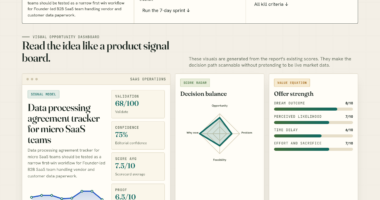
📊 Full opportunity report: Understanding The Link Between Trade Patterns And Russia’s Duma Election Results on IdeaNavigator AI — validation score, market gap, and execution plan.

Get hardware and tech essentials delivered free — and shop member deals
- Fast, free delivery on millions of items
- Access to Prime Big Deal Days deals on October 6–7
- Prime Video, Amazon Music and more included
TL;DR
Recent trade and supply-chain data suggest a correlation with the upcoming Russian Duma election results. Analysts are exploring how economic factors influence voter support for United Russia, with early indicators pointing to potential electoral shifts.
Recent trade and supply-chain data indicate a potential link to the upcoming Russian Duma election results, with early signals suggesting that economic patterns may influence voter support for United Russia. This analysis underscores how economic and geopolitical developments can shape electoral outcomes in Russia.
Trade and supply-chain operations data are increasingly being used to gauge political developments in Russia ahead of the September 2024 Duma elections. Analysts note that fluctuations in trade flows, import-export balances, and supply chain disruptions often reflect broader geopolitical tensions, which in turn can impact voter sentiment.
According to an operations lead managing supply-chain and trade exposure, signals from platforms like Polymarket suggest that the likelihood of United Russia winning between 340 and 354 seats is currently high, with an 88/100 confidence level. These signals are being interpreted as early indicators of political stability or shifts, based on economic resilience or vulnerability.
Experts caution that while trade data can provide valuable insights, they are only one piece of a complex puzzle that includes political campaigning, public opinion, and international relations. The connection between economic indicators and election results remains an area of active research and debate.
Implications of Trade Data on Election Outcomes
The analysis of trade and supply-chain data as a predictor of election results matters because it offers a potentially early warning system for political shifts in Russia. If economic patterns continue to align with electoral support for United Russia, policymakers, investors, and international observers could use this information to anticipate changes in Russia’s political landscape. This approach also highlights the growing role of economic data in understanding geopolitical developments.
As an affiliate, we earn on qualifying purchases.
Trade and Politics in Russia’s Electoral Landscape
Russia’s 2024 Duma election is a critical event, with United Russia expected to secure a majority. Historically, economic stability has played a significant role in supporting the ruling party’s position. Recent years have seen increased scrutiny of how trade relations, sanctions, and supply-chain disruptions influence domestic political support.
Trade flows between Russia and key partners, including China, the European Union, and neighboring countries, have experienced fluctuations amid geopolitical tensions and sanctions. Analysts have observed that these economic shifts often correlate with public support levels, although the causality remains complex.
Platforms like Polymarket have surfaced signals suggesting that the probability of United Russia winning a narrow majority is high, with some indicators pointing to a stable or slightly improving economic outlook. Yet, these signals are still preliminary and subject to change as new trade data and political developments emerge.
As an affiliate, we earn on qualifying purchases.
Limitations of Trade Data as Electoral Predictors
It is not yet clear how strongly trade and supply-chain signals correlate with actual voting behavior in Russia. The relationship is complex, influenced by domestic political messaging, media narratives, and international sanctions, which may distort or obscure economic indicators’ predictive power. Additionally, the current signals are preliminary, and their reliability remains to be validated as more data become available.
As an affiliate, we earn on qualifying purchases.
Monitoring Trade Trends and Electoral Developments
As the September 2024 election approaches, analysts and political observers will continue to monitor trade and supply-chain data for emerging patterns. Further research is needed to establish the strength of the correlation and to refine predictive models. Official election results and post-election analysis will ultimately determine the accuracy of these early indicators.
geopolitical risk assessment tools
As an affiliate, we earn on qualifying purchases.
As an affiliate, we earn on qualifying purchases.
Key Questions
Can trade data reliably predict election outcomes in Russia?
Trade data can provide early signals and insights into economic conditions that may influence voter support, but they are only one of many factors affecting election results. Their reliability depends on the broader political and economic context.
How do geopolitical tensions impact trade patterns in Russia?
Geopolitical tensions, including sanctions and diplomatic conflicts, often lead to fluctuations in trade flows, supply-chain disruptions, and shifts in import-export balances, which can reflect or influence domestic political support.
What role do international observers play in analyzing these signals?
International analysts and political experts assess trade and economic data alongside other indicators, such as polling and political developments, to form a comprehensive picture of the electoral landscape.
Will trade signals influence campaign strategies in Russia?
Potentially. Political campaigns may respond to economic indicators by adjusting messaging or policy positions, especially if economic conditions appear to sway public opinion or voter support.
When will the actual election results be known?
The election is scheduled for September 2024, with official results expected shortly thereafter. Post-election analysis will clarify how well economic signals predicted the outcome.
Source: IdeaNavigator AI
Fall Picks
fall essentials
As an affiliate, we earn on qualifying purchases.